Find below a new note from JPMorgan’s Stephen Walters which is pretty right on the outlook for next year:
Australia’s economy is undergoing a major transition in the wake of the extended mining investment boom. The capital spending splurge – more was invested in mining in Australia between 2005 and 2012 than in any other country during that period (chart) saw spending soar above 6% of GDP, but the investment boom now is ending. The surge in investment was triggered by the earlier spike in the terms of trade, which soared 80% over the same period. The good news is that the subsequent boost to export volumes – in iron ore and coal, in particular – is kicking in, with a big lift in liquefied natural gas (LNG) exports to come. Indeed, the lift in global demand for Australian raw materials is particularly well-timed. So, the first part of the economy’s transition – from mining investment to production – is going well.
The problem lies in the domestic economy, where lift has been elusive, despite the RBA’s steady drip-feed of official interest rate cuts since the terms of trade peaked in late 2011.
Large swathes of the trade-exposed domestic economy remain compromised by the uncooperative AUD, which frustrated RBA officials describe as “uncomfortably high”. Also, there is a large and sustained fiscal drag in train as the new federal government in Canberra attempts to bring the budget back toward surplus, and business and consumer confidence is fragile. Meanwhile, high and rising costs have rendered much of the trade-exposed economy uncompetitive.
Worst hangovers follow the wildest parties
Australia has handled previous terms of trade booms very badly; recession has followed the five previous commodity price bonanzas dating back to the gold rush of the 1890s. The forecast this time, however, anticipates a far more benign outcome. Indeed, unlike during previous such episodes, Australia now boasts an independent, nimble central bank which, crucially, has prevented an inflation break-out, and a flexible exchange rate that acts as a pressure valve for domestic excesses. Although AUD has not fallen as much as RBA officials hoped, it has dropped materially since the terms of trade peaked, cushioning the adjustment for the economy.
Still, booms in commodity prices and investment absorb spare capacity in labor and product markets, driving up costs, and inevitably require adjustment to more sustainable conditions.
Modest post-boom adjustments are apparent in the historical data for a handful of commodity exporting countries like Chile, New Zealand and Norway, but not Australia, nor the batch of South American economies that suffered deep recessions in the 1970s once their terms of trade fell. The worst hangovers usually follow the wildest parties, but not this time; the forecast anticipates merely another year of subtrend growth, not recession. Australians should accept an extended period of sub-optimal growth as the modest price to be paid for the earlier euphoria.
Sub trend output growth … again
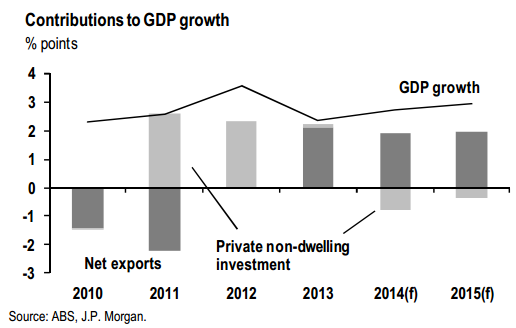
The forecast anticipates real GDP growth of 2.75% in CY14, modestly from the 2.5% estimated for CY13. As was the case this year, when nearly 90% of the expansion in GDP came from the lift in net exports, most of the growth in the economy next year will come from traded goods and services (first chart), which should add 1.9%-points to growth in GDP.
The flipside of net trade delivering most of the growth in the economy is that domestic demand will remain weak. The forecast assumes growth in gross national expenditure (GNE) of just 0.9% in CY14, albeit better than the bare 0.2% growth rate achieved in 2013.
With growth below trend throughout 2014, the economy will accumulate even more slack. The jobless rate likely will climb to reach 6.5% by the middle of 2014, before gradually declining as output growth moves back above trend in 2015.
Wage growth likely will stay soft, helping to keep inflation within the RBA’s 2-3% target range. This will leave the central bank with room to move on policy as needed.
Lack of policy traction outside housing
Stubbornly high AUD remains a key impediment to the economy’s adjustment. The currency has spent a considerable amount of time above parity with the USD since the easing cycle started, thanks to the high terms of trade, initially, and then to increased capital inflows to fund the investment boom.
The RBA has struggled to gain traction from the cumulative 225bp of rate cuts since late 2011, partly owing to the AUD’s drag on the traded goods sector. The rate cuts were designed not to trigger a weaker AUD, which RBA officials noted was undergoing structural adjustment upwards in a world of lower nominal returns, but to offset the damage done to the affected parts of the economy.
Yet, with confidence among both business and consumers fickle, investment outside mining remains in the doldrums. Investment outside mining peaked before the global crisis in 2008 at 14% of GDP, but has been flat at 11% for five years. Business surveys point to little improvement from here. Activity in manufacturing, once the largest sector of the economy, is in near-terminal decline thanks to low productivity and intense offshore competition, tourism is compromised by Australians’ increased appetite for overseas travel, thanks to high AUD, and employment in labor intensive sectors like retailing and banking is in retreat.
Growth gap to widen in CY14
Public sector demand also is weak. The new federal government in Canberra is yet to update the position of the Budget, but is committed to returning to surplus within three years. This means there will be an accumulated fiscal drag of 2%-points of GDP by 2017 that will act as a headwind for the domestic economy. State governments also are striving to improve finances in order to retain their credit ratings. There already is a gap between the growth contributions from waning mining investment and exports and the non-mining economy that will grow larger over the course of 2014.
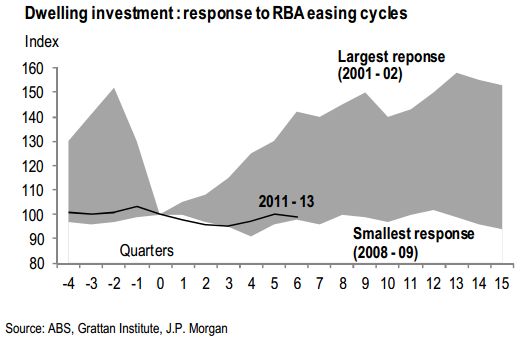
In the interest-sensitive housing market, at least, the impact of the RBA’s previous rate cuts is evident. House prices are rising and the success rate of auctions is high, which history indicates usually lead a lift in home construction, the endgame as far as policy-makers are concerned. Thus far, though, the impact on construction is limited (chart).
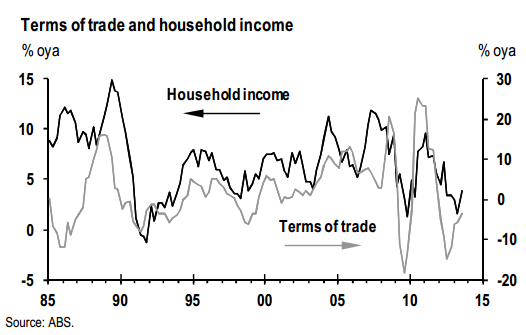
Moreover, housing contributes a diminished share of GDP, thanks to falling construction in recent years. The sharp rise in house prices, though, at least is rebuilding household wealth, alongside the bounce in the equity market. This will help to offset consumer caution, although household income growth is the weakest in 20 years, owing to the slack labor market, falling terms of trade (chart), and compressed investment income from interest and dividends.
RBA’s easing cycle not yet over
Not until 2015 does the forecast assume growth returning to trend as activity in non-mining finally fills the void left by mining. In an environment of sub trend growth, rising unemployment, benign wages and inflation, and a stubbornly high AUD, RBA officials likely have further work to do. We forecast one more official interest rate cut in this cycle, in February 2014, and no start to the normalization of the policy stance until early 2015. The forecast includes a total of 100bp of rate hikes in CY15.
More or less right except 2015 will also be below trend as the capex cliff gets steeper still. And remember, even if we are growing in accounting terms, it is going to feel like a recession. Also, if Sydney property runs much further or iron ore busts then the risks of an actual recession are much higher than normal.
David Llewellyn-Smith is Chief Strategist at the MB Fund and MB Super. David is the founding publisher and editor of MacroBusiness and was the founding publisher and global economy editor of The Diplomat, the Asia Pacific's leading geo-politics and economics portal.
He is also a former gold trader and economic commentator at The Sydney Morning Herald, The Age, the ABC and Business Spectator. He is the co-author of The Great Crash of 2008 with Ross Garnaut and was the editor of the second Garnaut Climate Change Review.