

Primary Health Care’s managing director, Edmund Bateman, made some interesting remarks about the Australian economy over the weekend, which I believe nicely encapsulates the Australian economy’s current trajectory:
Primary Health Care managing director Edmund Bateman says avoiding a recession at the time of the global financial crisis may have locked the Australian economy into a drawn-out recovery, as opposed to a painful but short-term hit.
Dr Bateman said the economy was unlikely to improve soon from the “hard place” where it was languishing. “It is slowly grinding uphill,” he said.
If the country had plunged into recession at the time of the economic downturn, it might have bounced back more quickly, he said.
Instead, the nation would experience a “10-year recovery, instead of what might have been a short-term, very painful outcome”.
Arguably, 22 years without a technical recession has made policy makers and the community complacent and believing that Australia is the “miracle economy”. The lust for structural (micro-economic) reform has long waned, with rent seeking the order of the day. High cost structures have been locked-in, and most of the economy outside of the mining sector is now uncompetitive, helped by an over-valued currency.
The end result is GDP growth that is keeping pace with the growing population, but not much more, and a post-GFC recovery that could be described as little more than lackluster.
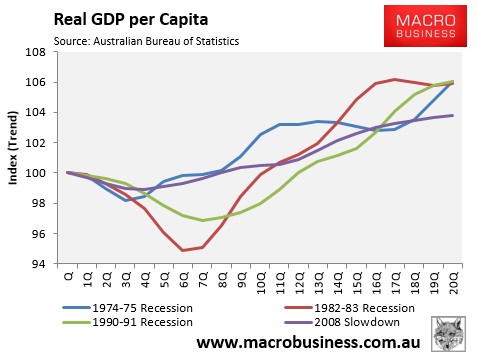
Bateman’s suggestion that Australia’s economy might now be better placed had it experienced a short and painful recession is also not without merit. Indeed, the recovery from the GFC has been weaker than the recessions of the 1970s, 1980s and the 1990s, when measured on a per capita basis (see next chart).
With the once-in-a-century mining investment boom about to commence a multi-year decline, the employment-to-population ratio trending lower, and the appetite for reform likely to remain absent for some time to come, continued “zombie-like” growth is likely to continue for the foreseeable future.
unconventionaleconomist@hotmail.com
