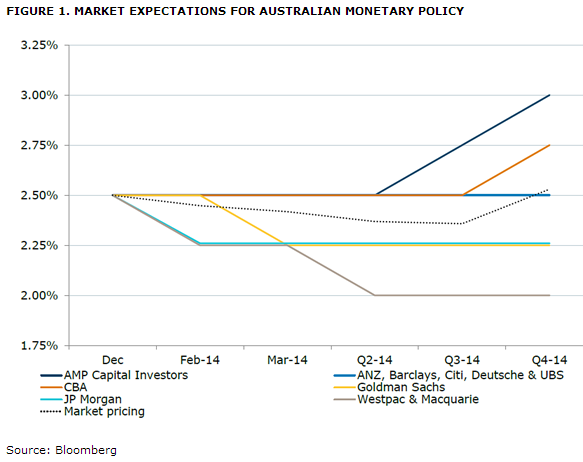
ANZ has a little note out today that attempts to quantify the causes of currently wide divergences in interest rate forecasts. the SMH has a good summary:
There’s a notable divergence among economists in terms of their outlook on monetary policy, observes ANZ’s chief economist for Australia Ivan Colhoun.
Some economists expect the RBA to ease the cash rate again early next year, others expect it to remain on hold through 2014, while others forecast the central bank to hike rates in the third or fourth quarter of next year.
So why is there a divergence? There are an “unusually large number of moving parts” that are affecting the monetary policy outlook at this time, Colhoun writes in a note. These include the outlook for the Australian dollar, terms of trade, mining investment and unemployment. ANZ’s economists expects the RBA to remain on hold next year. While they forecast mining investment to fall-off in the second-half of 2014, they expect the impact will be offset by moderately strongly global growth, a lower exchange rate, a broadly stable terms of trade and a plateauing in the unemployment rate at about 5.75 to 6 per cent.
Underlining the divergence in expectations, the latest Bloomberg survey of economists shows:
The market median is for the cash rate to remain unchanged at 2.5% for the whole of 2014 (11 out of 30 economists expect this outcome);
An even larger number of economists (13 of 30) are forecasting interest rate rises in 2014, with hikes occurring in Q3-Q4 (this view is not the median as some forecast one rate rise and other two increases); and
Six of 30 economists are forecasting a further reduction in the cash rate with moves, not surprisingly, occurring in H1 2014.
All I can add is that the last several years have seen several periods of confusion about interest rates among economists. The first was in 2011 when just about everyone was calling for and expecting rate hikes. The entire community was wrong as housing was headed into the toilet and the terms of trade was about to peak. MB did rather better, shooting down the “bullhawks”.
2012 was marked by a reverse consensus that interest rates would fall but virtually nobody expected by so much. Again MB was ahead of the pack.
Advertisement
Now there’s a wider spread of expected outcomes which, by definition, will mean an improvement in the efficacy of forecasts, even if for all the wrong reasons!
Next year is not that hard. Just track housing. If it stalls, there’ll be cuts. If not, there won’t. There’ll be no hikes but we will see macro prudential emerge if housing stays strong.
David Llewellyn-Smith is Chief Strategist at the MB Fund and MB Super. David is the founding publisher and editor of MacroBusiness and was the founding publisher and global economy editor of The Diplomat, the Asia Pacific's leading geo-politics and economics portal.
He is also a former gold trader and economic commentator at The Sydney Morning Herald, The Age, the ABC and Business Spectator. He is the co-author of The Great Crash of 2008 with Ross Garnaut and was the editor of the second Garnaut Climate Change Review.