The Housing Industry Association (HIA) has released a new report on residential dwelling approvals, with five out of eight markets now seeing improved conditions on the back of strong growth in higher density apartments:
The trend improvement in residential building approvals has strengthened in the second half of 2013 and augers well for new home building activity heading into 2014…
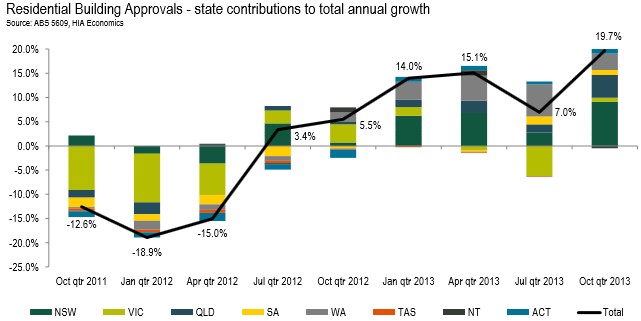
Prior to more recent updates, most indicators of residential construction had indicated that much of the overall recovery – hopefully a ‘first round’ recovery to precede further improvements – was attributed to the two prominent success stories of New South Wales and Western Australia. Residential building approvals are indicating brighter prospects for this situation to now broaden to other states, most notably Queensland…
In NSW, approvals have seen strong increases in more recent months and this has finally seen the state begin to perform as though it is ‘the premier’ state… Queensland is another state emerging from being a serial under-performer. In the three months to October, Queensland was the second largest contributor to aggregate growth in approvals, contributing 7.7 percentage points to annual national growth. WA continued to be a key driver, contributing 3.4 percentage points.
Elsewhere the results are mixed. In Victoria, approvals have followed a variable path of overall decline for over two years now. There are some tentative signs that the declines have found a floor, particularly in the detached house segment of the market following a protracted decline. In the nation’s capital, approvals appear to be easing from the elevated levels that characterised the past three years. Meanwhile, South Australia and the Northern Territory are seeing approvals trend higher, although levels in SA are still well short of what could be described as healthy. In the NT the level of approvals is quite strong. That leaves Tasmania where, thankfully, there are signs that the sharp falls experienced between early 2011 and early 2013 have finally found a floor.
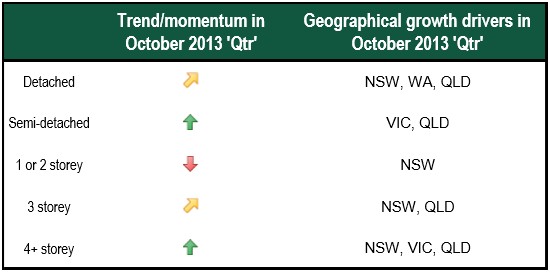
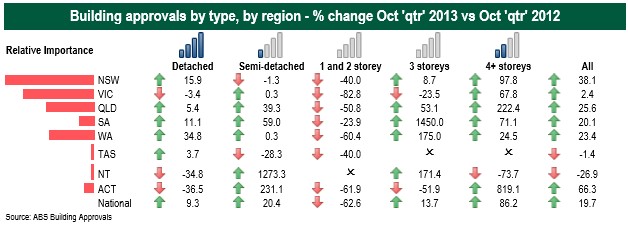
Looking at the situation in terms of the types of dwelling being approved, it is encouraging to see positive signs across the range of dwellings. Much of the strong growth in the October quarter was driven by approvals in the higher-density product of dwellings in 4+ storey buildings. Whether this will be sustained remains unclear, but as discussed in more detail below, the growth in this category of approvals has been geographically broad based. On the other end of the spectrum detached house approvals are slowly grinding higher, while the other lower density category of approvals – semi-detached and town-house dwellings -has also been trending higher.
Detached house approvals have just held on to their majority, with a 53.3 per cent share of total approvals in this latest update…
WA and NSW continue to be the key drivers of the improvement in detached house approvals… Elsewhere, signs of improvement are emerging – annual growth in the October 2013 quarter was positive in Queensland, SA and Tasmania. In the NT and the ACT the broader trend of decline in detached approvals remained in evidence and was reflected in the annual declines in the October quarter. In Victoria, despite the annual decline in the October quarter, there may be tentative signs that detached house approvals have at least found a floor…
Building approvals figures in late 2013 are signalling improving prospects for the recovery in new residential construction to continue into 2014. The reasons for these prospects improving are twofold.
First, the initial recovery in approvals was largely driven (in geographic terms) by NSW and WA. In this update, Queensland has demonstrated itself to be a key contributor to aggregate growth, while approvals continue to head in the right direction in South Australia and the NT. Five out of eight jurisdictions where approvals are trending higher is certainly an improvement from what we were seeing in early 2013.
Secondly, the mix of dwellings experiencing improving approvals numbers is also fairly broad based. Much of the growth has been driven by approvals in the higher-density product of dwellings in 4+ storey buildings and while it still remains unclear whether the improvements will be sustained (or if there may be risk of some reversal), the growth in this category of approvals has been geographically broad based. At the other end of the dwelling spectrum, detached house approvals continue to steadily grind higher while the other lower density category of approvals, semi-detached and town-house dwellings, has also been trending upward.
Advertisement
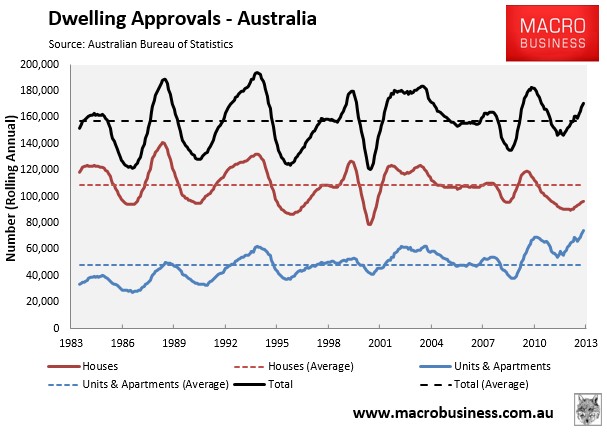
Given we have record low interest rates, established house prices rising, widespread stimulus aimed at first time buyers of newly constructed dwellings, and near record population growth, the uplift in dwelling approvals is disappointing, especially when viewed on a population-adjusted basis [Australia’s population has risen by around 45% over the past 30 years]:
As argued many times before, unless reforms are made to: free-up land supply and competition amongst land holders and developers; reduce taxes and regulatory changes on development; streamline development approval processes; and improve the provision of housing-related infrastructure, then the cost of new homes are likely to remain above what most people can afford or are willing to pay, and the construction pick-up will remain muted.
Leith van Onselen is Chief Economist at the MB Fund and MB Super. He is also a co-founder of MacroBusiness.
Leith has previously worked at the Australian Treasury, Victorian Treasury and Goldman Sachs.