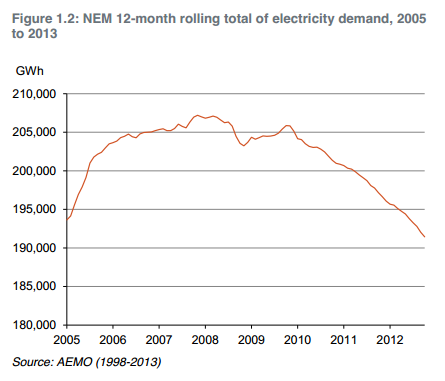
Electricity use in Australia is falling. From the 1960s to the end of the 20th century, electricity consumption increased at an average annual rate of six per cent. Investment in power stations and electricity networks also rose steadily. Since 2009, however, eastern states’ electricity production has fallen and in Western Australia growth has plateaued since 2011.
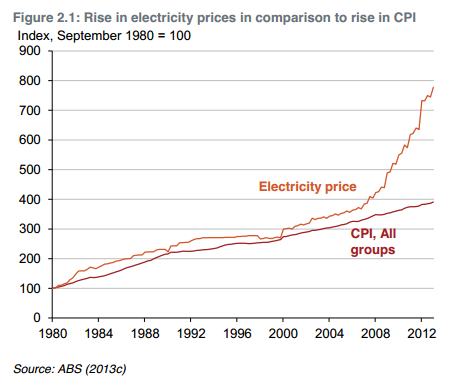
Yet this extraordinary fall in demand has not led to a fall in price, as would occur in a conventional market. Since 2006 the average household has reduced power use by more than seven per cent.
But in that period the average household power bill has risen more than 85 per cent: from $890 to $1660 a year. One reason is that Australians are funding billions of dollars of infrastructure that falling consumption has made redundant. These price rises are unsustainable, but who will pay for the correction: power companies, governments or – once again – consumers?
Falling consumption has several causes. Customers are responding to high prices by reducing use or switching to a new breed of more energy-efficient appliances. The cost of solar energy has fallen: a million households now have solar PV panels on their roofs. The economy has become less energy intensive as the manufacturing sector has declined.
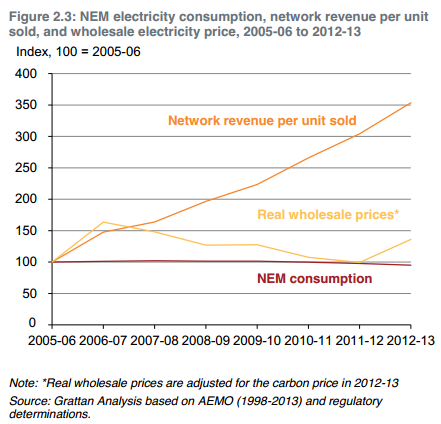
The nature of Australia’s energy market means that these changes are not leading to lower prices. Electricity generators operate in a free market: when consumption falls they must produce power at a lower price in order to sell it, or reduce production. But network businesses – which carry power from the generator to the business or home and which take about 45 per cent of a household’s electricity bill – are regulated monopolies not subject to market forces.
For years, regulators have allowed these companies to earn excessive profits by setting tariffs that are too high given the low risk they face as monopolies. Some states have also allowed the companies to overinvest in infrastructure. This was less of a problem when demand was rising and higher costs were spread over a larger volume of sales. But when electricity use falls, the high cost of the network is spread over a smaller volume and customers pay more. Continually rising prices could induce them to disconnect from the network. Enough disconnections would trigger a crisis that insiders call the ‘death spiral’.
To prevent this from happening governments must:
Ensure that network companies make future investments that better match future power needs.
Begin the hard task of reforming network tariffs so that prices companies charge reflect the costs they incur.
Review the value of network assets to decide who should pay for any write-down of surplus infrastructure.
These solutions are neither simple nor painless. But consumers deserve a better system. A future Grattan Institute report will produce recommendations for how that can be achieved.
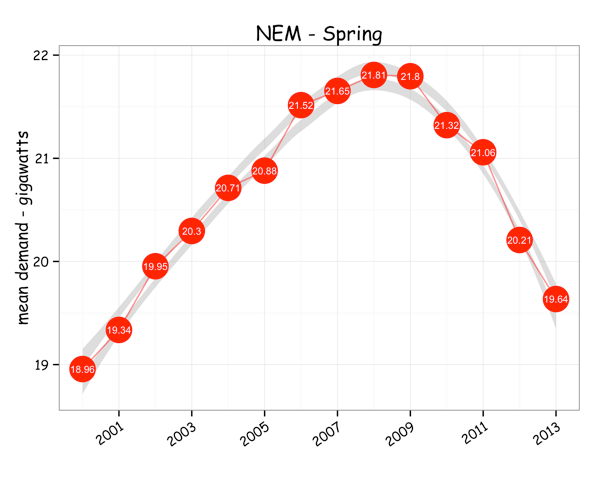
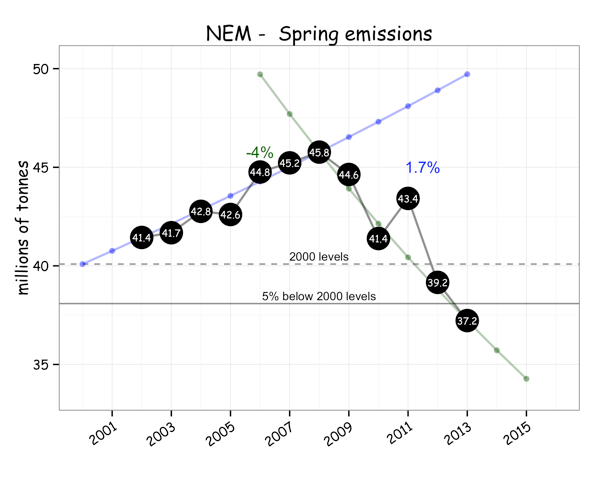
That is not to say that the carbon price is not also having an impact. The following charts from the Energy Institute at Melbourne University suggest it is. Here is peak demand in the National Electricity Market (NEM) in Spring (the carbon price was enacted two Springs ago):
David Llewellyn-Smith is Chief Strategist at the MB Fund and MB Super. David is the founding publisher and editor of MacroBusiness and was the founding publisher and global economy editor of The Diplomat, the Asia Pacific's leading geo-politics and economics portal.
He is also a former gold trader and economic commentator at The Sydney Morning Herald, The Age, the ABC and Business Spectator. He is the co-author of The Great Crash of 2008 with Ross Garnaut and was the editor of the second Garnaut Climate Change Review.