Getting an accurate gauge of the current state of the labour market is important for policymakers wishing to assess the likes of spare capacity and medium-term inflation pressures in an economy. However, labour market data the world over is notoriously volatile. Not only this, but the “headline” figures such as employment growth or the unemployment rate can often present imperfect signals on their own of overall labour market trends.
This latter point was made clear in our most recent A/NZ Economics Analyst where we looked at the Australia and NZ labour markets through the prism of labour force participation rates. For Australia, we found that while an unemployment rate at just 5.7% suggests a labour market that appears in relatively good shape, if cyclical weakness in labour force participation was to normalize over the coming 6-9 months, the unemployment rate could easily exceed our current forecast peak of 6.2% by 2Q2014. In other words, there was considerably more labour market slack than commonly perceived and this was likely to become more apparent as we headed into 2014.
In this note, we take a slightly different approach, but one that nevertheless builds on this theme of getting a better appreciation of the true state of the labour market.
…The employment growth implied LMI actually suggests a broadly similar rate of employment growth to the official ABS data over the past 12 months. Both measures sat around 0.8%yoy in October – around half the rate of growth from 12 months prior. That said, the LMI measure did imply a lower rate of annual growth in employment over the past 12 months by an average rate of around 20bps.
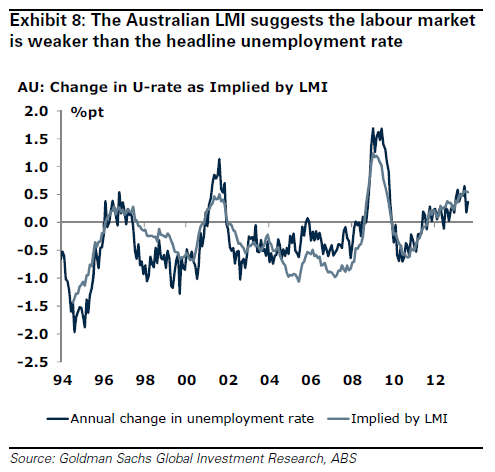
The unemployment rate change implied LMI points to a larger increase in the unemployment rate than has been observed by official data. The official ABS unemployment rate has risen 40bps over the past year, while the LMI suggests a larger 60bp increase. While this difference is admittedly not large, the divergence was as much as 40bps as recently as October.
David Llewellyn-Smith is Chief Strategist at the MB Fund and MB Super. David is the founding publisher and editor of MacroBusiness and was the founding publisher and global economy editor of The Diplomat, the Asia Pacific's leading geo-politics and economics portal.
He is also a former gold trader and economic commentator at The Sydney Morning Herald, The Age, the ABC and Business Spectator. He is the co-author of The Great Crash of 2008 with Ross Garnaut and was the editor of the second Garnaut Climate Change Review.