From HSBC comes an interesting note that could prive to be very significant for Australian assets, dollar and interest rates:
It’s now official: Beijing is accelerating the pace of RMB convertibility
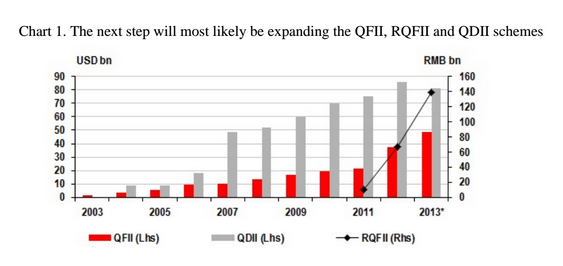
The reform blueprint unveiled after the 3rd Plenum states that China will accelerate both interest rate liberalisation and RMB convertibility. The next step will most likely be expanding the QFII, RQFII and QDII schemes. The speed that this is carried out depends on the improvement of regulatory capabilities. That said, we are pleased that the PBoC’s 30 points of financial measures for the Shanghai FTZ released yesterday are bolder than expected. Get ready for a series of concrete actions to be carried out over the coming quarters.
The blueprint released after the conclusion of the Third Plenum addressed all of the key financial reforms that the market has long been expecting. Key reform measures include accelerating interest rate liberalization, reforming the RMB exchange rate regime, speeding up RMB capital account convertibility by promoting the two-way opening up of capital markets and the easing of restrictions on cross-border capital and financial transactions (please refer to: China’s turning point: Beijing sets a bold reform course, published on 18 November 2013. ). The financial reforms and further ‘opening-up’ are expected to be tested in the experimental Free Trade Zone (FTZ) in Shanghai (see: Shanghai FTZ: A trigger for a wave of reforms and liberalisation, 29 September), followed by broader implementation in additional FTZs in other cities.
The guidelines issued on 2 December, which consist of 30 points, is a bold move which not only offers financial support for the FTZ in Shanghai, but also pushes forward liberalization in cross border investments and trade while deepening financial reforms. We see several upside surprises among these guidelines, which suggest a marked acceleration in capital account liberalization:
1. Residents of the FTZ in Shanghai are allowed to set up free trade accounts (FTA) denominated in both CNY and foreign currencies, and non-residents are allowed to set up non-resident free trade accounts (NFTA). Transactions between FTAs and offshore accounts, NFTAs, and non-resident accounts outside the FTZ in Shanghai are free. In addition, FTAs and NFTAs are allowed for conducting cross-border financing and guarantees. Eventually, when the time is right, CNY and foreign currency funds deposited in FTAs and NFTAs will be allowed to be fully convertible.
2. In addition to the further liberalization of corporate cross border direct investment, individuals working in the FTZ in Shanghai are allowed to invest overseas, including in offshore security markets. Meanwhile, Chinese and foreign corporates, non-banking financial institutions and other economic organizations that are registered in the Shanghai FTZ are allowed to borrow in both CNY and foreign currency denominated funds from offshore markets.
3. Financial institutions and corporates within the FTZ in Shanghai are allowed to carry out investments and trade in securities & futures exchanges in Shanghai. Furthermore, their offshore parent corporates can issue RMB bonds in the onshore capital markets.
The PBoC is also trying to promote RMB cross-border usage through current account transactions and direct investment in the FTZ in Shanghai. Moreover, by implementing a pilot program of negotiable certificate of deposits among qualified financial institutions in the Shanghai FTZ, deposit rate liberalization is expected to accelerate.
We believe that progress on the RMB capital account convertibility will be faster than many expect. The next step will be expanding portfolio flows. As the PBoC governor Zhou Xiaochuan recently said, “The QDII and QFII quota and qualification approval process will be eliminated at an appropriate time, allowing all legal entities full access to this mechanism.” We expect that the QDII and QFII frameworks will be expanded to a much larger scale. It’s now official. Get ready for a series of concrete actions to be carried out over the coming quarters.
In short, prepare for the FTZ to become the escape valve in the pressure cooker that is Chinese savings. Perhaps a better metaphor is a sluice gate and I expect a fair proportion of the flood will be headed our way.
David Llewellyn-Smith is Chief Strategist at the MB Fund and MB Super. David is the founding publisher and editor of MacroBusiness and was the founding publisher and global economy editor of The Diplomat, the Asia Pacific's leading geo-politics and economics portal.
He is also a former gold trader and economic commentator at The Sydney Morning Herald, The Age, the ABC and Business Spectator. He is the co-author of The Great Crash of 2008 with Ross Garnaut and was the editor of the second Garnaut Climate Change Review.