

Yesterday’s release of the overseas short-term arrivals and departures figures for October contained sombre news for Australia’s tourism industry, with the ratio of annual arrivals to departures fell to its lowest level since November 1985 (see next chart).
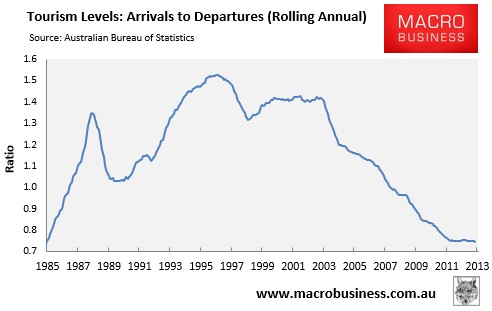
In the month of October 2013, the number of tourism arrivals fell by a seasonally adjusted 1.1%, whereas the number of tourist departures fell by 1.0%.
In the 12 months to October 2013, the annual number of arrivals increased by 4.7% relative to the corresponding period of the prior year, whereas departures rose by 7.1% (see next chart).
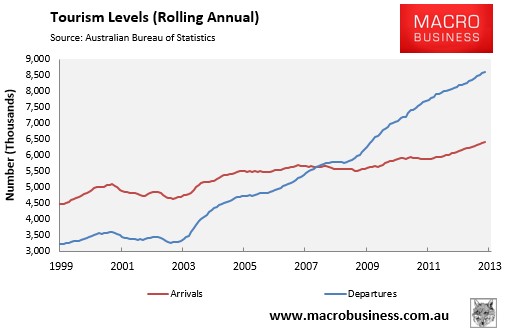
The year to October 2013 was a record for outbound and inbound tourism. A record 8.61 million Australians holidayed overseas over the year – a 161% increase on 10 years ago (3.30 million). However, this was partly offset by a record 6.42 million inbound tourists arriving in Australia over the year – a 37% increase on a decade ago (4.68 million).
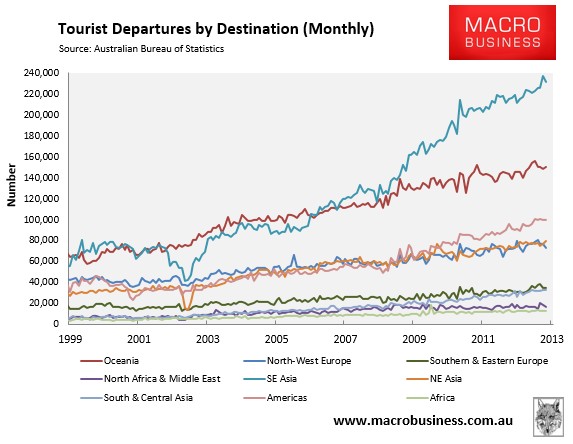
As always, South East Asia (particularly Indonesia and Thailand) remains by far Australia’s favourite holiday destination, receiving 231,000 visitors in October, or 31.5% of Australia’s total departures over the month. This was followed by Oceania (20.5%), the Americas (13.6%), North East Asia (10.8%), and North West Europe (9.9%):
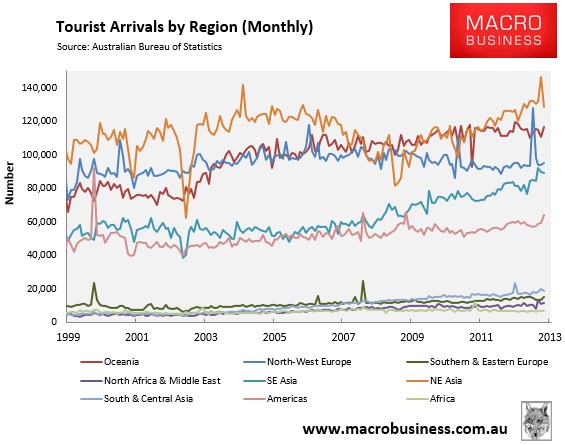
By contrast, the most foreign visitors to Australia came from NE Asia (mostly China) – although these fell heavily over the month – which accounted for 23.5% of arrivals in October, followed by Oceania (21.4%):
unconventionaleconomist@hotmail.com
