From FTAlphaville comes a Credit Suisse insight into the effects of the abolition of China’s one child policy:
The impact of the easing of the one child policy on birth rates may be overstated based on the experience of easing restrictions on parents who are both single children in their families (as shown in Exhibit 3). Guangzhou, a southern China city, had more than 14,000 couples, who were both single children in their families, hence eligible to have the second child, but only 360 couples had the second child in 2009.
It is an extremely complicated process for a couple to receive an approval for having the second child (Exhibit 4). Take the example of Nanjing, where if a couple decides to have the second child, they need to discuss the birth plan with their neighborhood organizations. It requires more than 30 official stamps and 50 approval letters, to verify the Hukou status and one child status, before the couple can be granted the right to have the second child. In the past, having a child was a decision not just made by parents but also the government. Now, the decision is made collectively by the couple, their neighbours and those controlling the approval process. If one does not have connections with the authorities (“Guanxi”), the process could take months. The economic pressure also weighs in, as costs of having a child has increased in recent years. According to a survey conducted earlier by sina.com, only about one third of respondents indicated that they prefer to have the second child in case of policy easing. In our view, those who really want to have their second child will rush to do so, but the additional births after the first batch is likely to cool off quickly, though there still will be additional babies every year as a result of the policy easing.
…Over 2014-2020, we estimate a total of 8.3 million additional children born due to the relaxation of the policy on top of 108 million children without the easing of the policy. By 2030, we project 19.5 million additional children. Our projection is slightly more conservative compared to the estimates by other research teams in Financial Services. That is because (1) gaining the approval letter for the second child may prove to be a complicated and torturing process; (2) some couples otherwise willing to have their second child have already been sterilized and therefore can never have children in the future; (3) some are intimidated by the economic costs of raising children, housing and educational costs in particular.
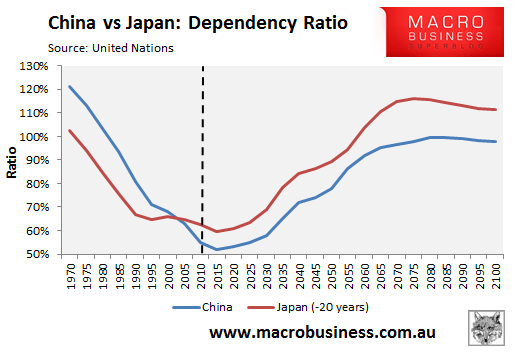
So, China will birth only one extra Australia as a result of the policy shift. Not enough to combat this:
David Llewellyn-Smith is Chief Strategist at the MB Fund and MB Super. David is the founding publisher and editor of MacroBusiness and was the founding publisher and global economy editor of The Diplomat, the Asia Pacific's leading geo-politics and economics portal.
He is also a former gold trader and economic commentator at The Sydney Morning Herald, The Age, the ABC and Business Spectator. He is the co-author of The Great Crash of 2008 with Ross Garnaut and was the editor of the second Garnaut Climate Change Review.