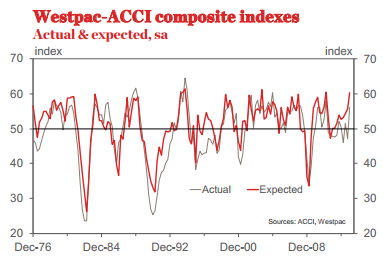
Some ironic news today with the quarterly ACCI manufacturing survey jumping to a recovery high and confirming what we’ve already seen in the PMI:
The Westpac–ACCI Actual Composite rose to 56.2 in the December quarter from 47.8 three months ago. At its current level, the Actual Composite points to moderate growth in the sector; however, we caution that this is only the third expansionary reading in the past two years.
Arguably, the release of pent-up demand following the election has brought about this noteable improvement in conditions. The weaker Australian dollar and an emerging uptrend in housing investment activity have also been supportive.
The improvement in the Actual Composite in the December quarter was primarily driven by a sharp increase in the output (from 0% to +20%) and new order (from –4% to +32%) net balances, with flow-on consequences for overtime and employment. On employment, manufacturers look to have put an end to the job shedding that has been a key finding of this survey over the past two years.
From the responses received for exports, it seems that the majority of the demand impulse has been domestic. Only 8% of all respondents reported an increase in exports in the December quarter, while just 7% expect an improvement in the coming three months. This suggests the still historically-high level of the Australian dollar remains a significant impediment for Australian manufacturers.
Nonetheless, with the Expected Composite rising to 60.3 in the December quarter, Australian manufacturers clearly anticipate a further improvement in conditions in early 2014 driven by domestic demand. This expectation is likely built upon the jump in business confidence witnessed after the election as well as an improvement in production costs and selling prices.
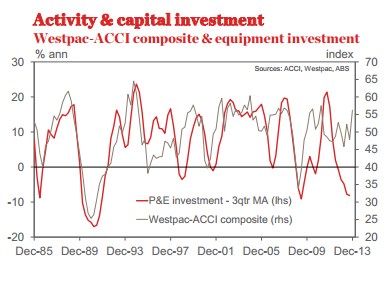
Capacity utilisation in the manufacturing sector improved in the December quarter. While the improvement in activity is certainly a step in the right direction, given the degree of uncertainty over the outlook, firms remain reluctant to increase capacity through investment or hiring. Persistent gains for output will arguably be necessary to see a shift in this firmly entrenched attitude towards expansion.
However, there’s a long way to go before this looks any good:
David Llewellyn-Smith is Chief Strategist at the MB Fund and MB Super. David is the founding publisher and editor of MacroBusiness and was the founding publisher and global economy editor of The Diplomat, the Asia Pacific's leading geo-politics and economics portal.
He is also a former gold trader and economic commentator at The Sydney Morning Herald, The Age, the ABC and Business Spectator. He is the co-author of The Great Crash of 2008 with Ross Garnaut and was the editor of the second Garnaut Climate Change Review.