Westpac’s Justin Smirk has released solid analysis of today’s soft labour market data for October, which I largely agree with:
A total rise in employment of just 1.1k in October means that over the last six months total employment has actually fallen 16.1k. You have to go back to June 2009, in the aftermath of the GFC, to find an as weak employment print (–16.5k in six months).
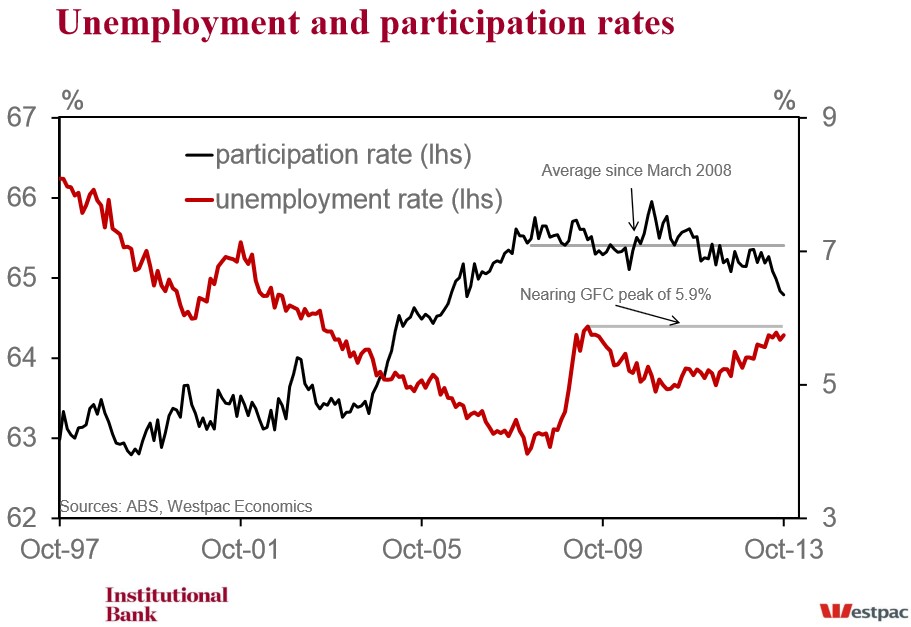
The only reason we have not seen a larger rise in the unemployment rate in the last six months, it has lifted just 0.1ppt from 5.6% to 5.7%, is that declining participation has resulted in the total labour force growing just 3.9k over the same period. The participation rate has fallen from 65.3% in April to 64.8% in October.
Remembering that the population continues to grow, the ABS estimates that the working age population has grown by 160.1k in the last six months, you can see that there must have been a significant outflow of discouraged workers, or retiring workers from the labour force.
We estimate that, had the participation rate not fallen over the last six months the unemployment rate would now be 6.5%.
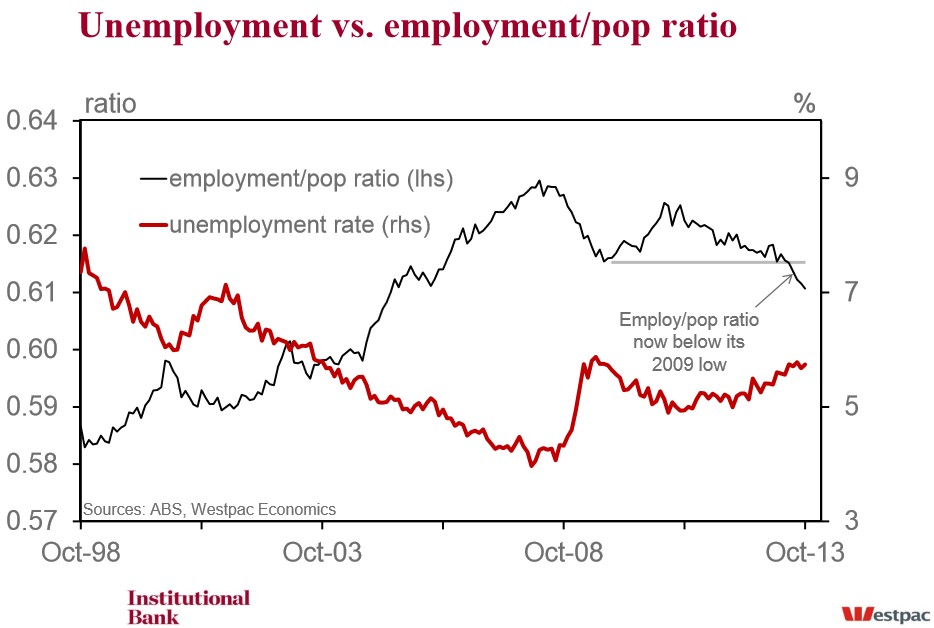
Highlighting that this is indeed a soft labour market we note the ongoing fall in the employment to population ratio. At 61.1% in Oct, the share of the population that is employed continues to trend lower than the post GFC low in 2009 (61.5%). So while falling participation has been helping to hold down the unemployment rate, total employment is growing at a much slower pace than the working age population – clearly a soft labour market.
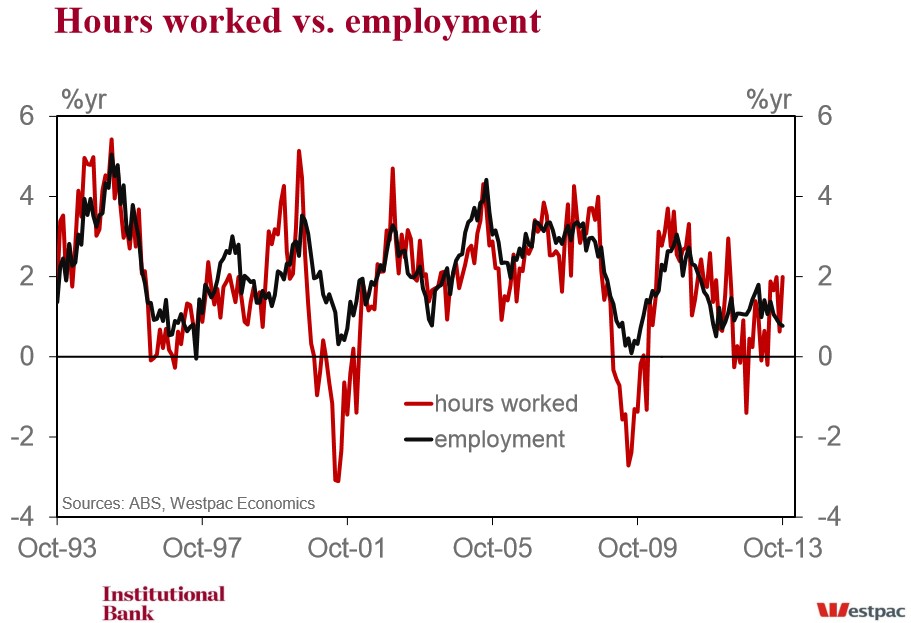
In October, total hours worked rose 0.4%mth which saw the annual pace lift back to 2.0%yr, from 0.6%yr in September, on par with August. Firms have been reluctant to employ and recently they have been working their existing workers harder. It appears that they are continuing that trend.
In the last six months, we have also seen that the 59.8k decline in full-time employment has been only partially offset by a 43.8k rise in part-time employment. Again, you have to go back to June 2009 to find such a weak six months for full-time employment.
This is a soft labour market that does not match the recent bounce in confidence. It does, however, match the more subdued employment indicators from the various business surveys. While it is still early days, firms clearly are still reluctant to lift employment and the stronger rise in part-time and female employment suggests we are still yet to see a turnaround in the more traditional cyclical industries such as manufacturing and construction.
Leith van Onselen is Chief Economist at the MB Fund and MB Super. He is also a co-founder of MacroBusiness.
Leith has previously worked at the Australian Treasury, Victorian Treasury and Goldman Sachs.