
There’s some kind of weird-ass denial abroad about the mining boom and I suggest investors ignore it. It’s over but some folks just can’t get their heads around it. The AFR today has a piece from a range of analysts looking to buy miners:
…In a note to clients released on Monday, Credit Suisse highlighted its trading preference for Rio Tinto and Fortescue Metals Group over BHP Billiton and believes that diversified mining companies can still outperform despite fears over China’s reforms and expectations of commodities prices declining in 2014.
“To the extent that the much discussed [China] reforms reduce fears on debt and too rapid rebalancing away from investment, miners should de-risk relative to the broader market,” said the Credit Suisse commodities research team, headed up by Paul McTaggart.
“For miners to outperform we do not require an increase in iron ore prices, only limited declines in line with consensus. If the Australian dollar weakens or other commodity prices improve, that further limits the impact from iron ore weakness.”
…“I prefer diversified miners with low cost business models, like BHP and Rio but I think they are expensive stocks at the moment,” said Merlon Capital Partners principal and portfolio manager, Ben Goodwin.
…Credit Suisse Australian equities strategist Damien Boey said he doubts that China’s rebalancing program will be an outright negative for the Australian resources sector, although he admits that the market seems to be pricing this in.
There is no doubt that the Chinese reform agenda is negative for Australian miners. In fact, Credit Suisse’s own Chinese team think so. The only reason it will not be is if it is supported by government stimulus, in which case there is no reform program. Even then markets will only become more concerned about Chinese debt and imbalances.
Part of this hope comes, I think, from government agencies like BREE where optimism is the primary recruitment criterion. Yesterday’s forecast chart for mining capex was a shining case in point:
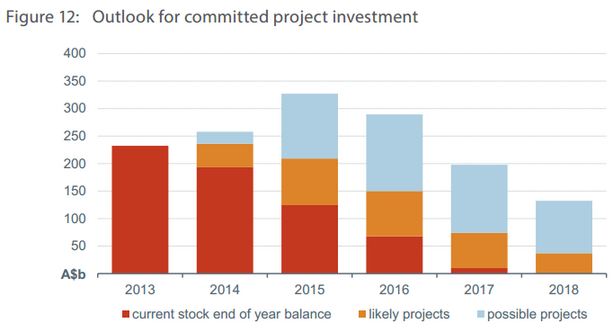
Where are $50 billion of “likely” new mine approvals going to come from in 2014 and $100 billion in 2015? Gold? The price is tumbling. Coal? Oversupplied. Iron ore? A little, but oversupply looms. Surely LNG? Priced out.
The last point is made today again by Shell. From The Australian:
ROYAL Dutch Shell, which has the nation’s biggest suite of potential and under-construction LNG projects, says it has seen no easing of cost pressures in the heated construction market, increasing the need for the federal government to improve competitiveness.
…Shell projects and technology director Matthias Bichsel, speaking to The Australian yesterday, said there had been no signs of easing costs in Australia, despite a slowing or shelving of some LNG projects.
“Costs in terms of productivity, labour availability, these are clearly issues that persist — that is one of the reasons we are here,” said Dr Bichsel, who is in Canberra with Shell’s global chairman, Jorma Ollia.
…Signalling Australian assets were not on the auction block in Shell’s asset sale program, Dr Bichsel said the company was happy with its project portfolio, which included stakes in the North West Shelf, the Prelude floating LNG project, the Sunrise LNG project and the Chevron-operated Wheatstone project.
…The comments signal the Arrow CSG to LNG project in Queensland, the nation’s best chance of a new LNG development or expansion, is not close to being approved or combined with the $70bn of plants already being built on Gladstone’s Curtis Island.
This is reinforced by news that China is turning Canadian LNG, from the AFR today:
Sinopec, China’s biggest oil refiner, is in talks with Apache to buy a stake in the Kitimat LNG export project on Canada’s Pacific coast, according to an industry executive with direct knowledge of the matter.
Kitimat LNG, co-owned by Apache and Chevron, was awarded Canada’s first liquefied natural gas (LNG) export license in 2011, allowing it to export 10 million tons per year.
The $US15 billion project, located in northern British Columbia, is expected to begin shipping gas to Asia by 2017.
Cost-out deflation is a secular trend for Australian mining as we digest the excesses of the boom for five to ten years. Capex is caput. Looking for growth in miners is possible if you can find one that has scope to crush its costs but even then it will be fighting a tide of falling prices for its output.
