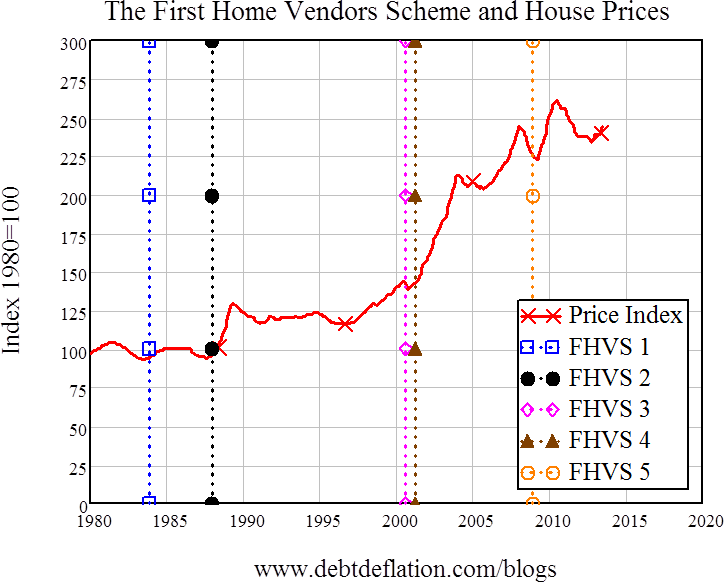
It’s worth popping over to Business Spectator today to read Steve Keen who provides a nice history of Government manipulation of the property market. I was especially taken by his chart on the effects of FHOG:
The scheme certainly worked in its primary objective – stimulating the economy. But this was at the expense of its alleged secondary objective, of “ensuring that Australian families can gain access to adequate housing at a price they can afford”. The second (Keating), fourth (Howard) and fifth (Rudd) incarnations of the scheme set off obvious bubbles in house prices, each one building on the legacy of its predecessor (see Figure 4).
Figure 6: How to turbocharge house prices
So the second key characteristic of the Australian market is that it’s one where government manipulation rules, rather than mere market forces. While this manipulation was initially aimed at macroeconomic stimulus, it has resulted in entrenched strong class interests in the housing market, with the favoured owners and landlords overwhelmingly more powerful than tenants.
Good stuff though one wonders why SK continues to ignore the Government manipulation in the choking of supply as a key factor in price rises.
David Llewellyn-Smith is Chief Strategist at the MB Fund and MB Super. David is the founding publisher and editor of MacroBusiness and was the founding publisher and global economy editor of The Diplomat, the Asia Pacific's leading geo-politics and economics portal.
He is also a former gold trader and economic commentator at The Sydney Morning Herald, The Age, the ABC and Business Spectator. He is the co-author of The Great Crash of 2008 with Ross Garnaut and was the editor of the second Garnaut Climate Change Review.