
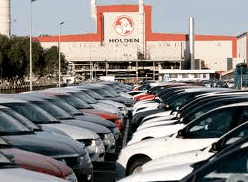
Things are looking hopeless for the Australian car industry. Over the weekend, the AFR reported that Stefan Jacoby, the regional head of GM, declined a request to meet Australia’s Industry Minister, Ian MacFarlane, during a visit to Holden’s Melbourne headquarters last week, signalling that relations are sour. Meanwhile, around 200 Holden workers went on strike last week over a dispute about redundancy payments, while a representative group of 25 auto workers are expected to march to Canberra to lobby the Government for assistance.
Ford has already announced that it will shutter operations in 2016, while it is looking increasingly likely that Holden will follow. If both Ford and Holden shuts down local operations, then it could render Australia’s car component makers unviable due to lack of scale. Chances are that Toyota would then follow suit, ending car production in Australia.
Over the weekend, The Australian’s Henry Ergas questioned whether any Australian politician “has the courage to sign the death certificate” for the car industry. According to Ergas, the whole industry is uncompetitive, it lacks scale, and it is building cars that consumers increasingly don’t want (i.e. large sedans). To add insult to injury, the introduction of Euro 5 and 6 emissions standards by 2018 will impose further, substantial costs for vehicle redesign and retooling, requiring open-ended commitments to ever-rising subsidies if assembly is to remain in Australia.
Ergas also argues that taxpayer support provided to the car industry – equivalent to some $30,000 for each of its 50,000 workers per year – imposes a range of other costs on the economy: including “preferential government procurement, restrictions on importing secondhand cars, and unique Australian technical standards”. In summary, “it is hard to imagine a less efficient way of [helping workers] than paying for all the inputs consumed in making cars to assemble vehicles people don’t want to buy.”
While I don’t dispute Ergas’ arguments, there are some practical limitations to letting the car industry shut down at this time. According to the recent interview with Professor Yuran Roos, Chairman of South Australia’s Advanced Manufacturing Council, the multiplier effect from local production is large, with around 250,000 jobs directly or indirectly dependent on the industry throughout Australia. Therefore, shuttering Australia’s biggest manufacturing industry at precisely the same time as mining investment is set to plunge is a very risky proposition, potentially knocking the Australian economy onto an entirely different course.
Were the car industry to shutter later this decade at the same time as mining investment slumps, then the chances are that the Government would be forced to implement a fiscal stimulus package in a bid to support both jobs and growth. Does anyone seriously believe that such spending would be anymore efficient (or effective) than maintaining assistance to the car industry and keeping local production going for another decade?
Like it or not, the car industry is probably too big to be euthanized at this time, even if there are longer-term allocative efficiency benefits in doing so. This is the difficult catch-22 situation facing the Government.
unconventionaleconomist@hotmail.com
