More today from Merrill Lynch and an accelerating US economy via FTAlphaville:
Getting the exact timing of the acceleration in growth is tough, but the case for better growth next year is strong. The economy has healed significantly since the 2008-9 crisis. In particular, the government, households, businesses and banks have gone a long way toward fixing their balance sheets, allowing them to slowly shift their focus from balance sheet repair to expansion.
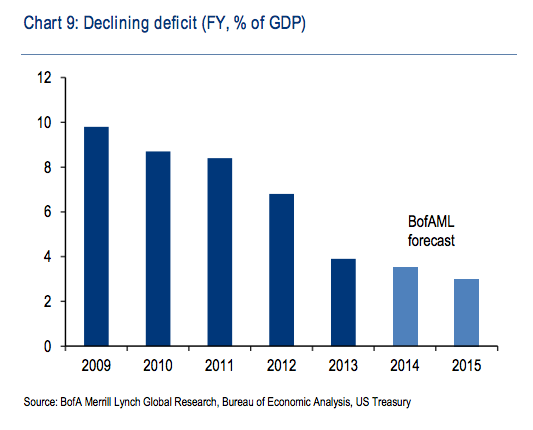
…Perhaps the most important rebalancing has been in the government. Despite all the talk of runaway Federal deficits, the medium-term deficit outlook has improved dramatically. The deficit peaked at 9.8% in 2009 and then steadily dropped. At the start of this year the CBO was predicting a FY2013 deficit of 5.3% of GDP. Then in May, the CBO did a massive revision and cut the projected deficit to 4.2% of GDP. In part, this was due to a $95 bn payment from Fannie Mae and Freddie Mac, but more than half of the revision was due to $105 bn in unexpected higher tax revenues. The final deficit outcome was even better: just 3.9% of GDP. The deficit is likely to continue to fall in the next two years (Chart 9).
The CBO assumes solid, almost 4% average GDP growth over the next four years, driving the deficit down to just 2.2% of GDP. We are less optimistic, expecting GDP growth of just above 3%, and we expect the deficit to fall to about 3.5% of GDP next year and 3% of GDP the following year. Note that this drop occurs without any further budget action and despite a gradual rise in interest rates. This in turn means a period of declining debt as a share of GDP. It also would mark the most dramatic five-year drop in the deficit in the modern era.
…Private sector rebalancing is equally impressive and, in some cases, incomplete. As we have noted before, the corporate sector has taken advantage of wide-open credit markets to clean up balance sheets. Most impressive, despite the feeble recovery, companies in the high yield sector have been able to term out their debt and maintain very low default rates (Chart 10). Prefunding has made many firms in the sector less vulnerable any dip in growth.
…Bank balance sheets have healed dramatically and in some ways are in better shape than before the crisis. Bad loans are being worked off: charge-offs and nonconcurrent loans are down sharply, and with fewer new bad loans, banks have been able to slow loan loss provisions back to normal levels. Capital ratios are in many cases well above pre-crisis levels.And while credit remains relatively tight in the mortgage market, overall lending standards have eased back toward more normal levels. New regulations continue to constrain bank lending, but the worst of the headwinds are behind us.
….The improvement in household balance sheets is more mixed. On a positive note, a combination of mortgaged defaults and refinancing has dramatically reduced the financial service ratio—the share of disposable income that goes to service debts, pay rents and insurance and property taxes. This series is at a record low for homeowners. On a negative note, households still lag behind in building up their net worth. As the working-age population gets older—with boomers entering their pre-retirement years—the ratio of net worth to income should be steadily growing. The crisis of 2008-9 has put most households behind schedule, although the recent recovery has restored a good chunk of the losses. Chart 12 illustrates the shortfall by comparing the net worth ratio to the share of the adult population in the 45 to 64 age range.
…If inflation persists below 1.5%, we would expect the interest rate forecast to drop further. We also expect the FOMC to cut its unemployment rate guidepost for hiking rates from 6.5% to 5.5% or lower. Ultimately, the Fed may decide to “overshoot” the inflation-neutral NAIRU to force inflation back up to target.
It’s all good except for one problem. I don’t think any of it can persist for long through higher interest rates and if the Fed tapers they will go higher.
David Llewellyn-Smith is Chief Strategist at the MB Fund and MB Super. David is the founding publisher and editor of MacroBusiness and was the founding publisher and global economy editor of The Diplomat, the Asia Pacific's leading geo-politics and economics portal.
He is also a former gold trader and economic commentator at The Sydney Morning Herald, The Age, the ABC and Business Spectator. He is the co-author of The Great Crash of 2008 with Ross Garnaut and was the editor of the second Garnaut Climate Change Review.