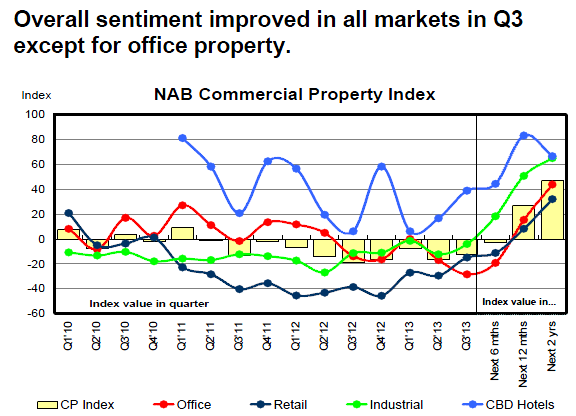
NAB has relaesed a new index for commercial property and it shows some recent improvement in sentiment bu not much for price action:
NAB’s Commercial Property Index rose to -13 in Q3 (-16 in Q2). The overall Index was weighed down by further weakening in office sentiment. Measured optimism seen in NAB’s Q3 Business Survey may have spilled over into commercial property markets, with property professionals in all markets (bar office) raising their expectations for capital and income growth in the next 1-2 years. As a result, NAB’s Commercial Property Index is now expected to rise to +27 by Q3’14 and +47 in Q3’15.
Sentiment edged up in most states in Q3. WA and Queensland were the exceptions with weaker sentiment likely impacted by slower mining investment activity. Sentiment improved most in Victoria, but overall was highest in NSW. Survey participants in most states are more confident about the next 1-2 years, with Victoria to overtake NSW as the strongest state in 2 years time. Expectations were scaled back heavily in WA, which is now the least optimistic state over the next 1-2 years.
Capital values grew for CBD hotels (0.4%) in Q3, but were down for industrial (-0.5%), retail (-0.5%) and office (-0.7%). CBD hotels to lead capital returns with stronger growth of 2.8% and 3.8% forecast for the next 1-2 years. Property professionals also see stronger capital returns for industrial (1.5% and 2.8%) and retail (0.3% and 1.3%) property, but have scaled back their expectations for capital growth in the office market to 0.6% and 2.1% in next 1-2 years.
Gross rents fell in all markets in Q3. The rate of decline slowed for industrial (-0.4%) and retail (-1.6%) property, but
accelerated for office (-2%), Average industrial rents are forecast to grow 1.3% in the next year, but fall for retail (-0.9%) and office (-0.8%). National industrial rents are expected to rise 2.2% in the next 2 years, with growth also resuming for retail (0.4%) and office (0.6%). Incentives remain very important in the office and retail leasing markets.
Supply conditions have softened in office and retail property markets, but tightness is evident in the CBD hotel market. Vacancy rates climbed in all market segments in Q3, with the office market under most pressure.
More property developers are planning to commence works in the near-term, with most seeking to develop residential property (especially in NSW and Victoria). The majority of developers entering the market are looking to cash in on landbanked stock, but more developers are now also chasing new acquisitions.
The ability of property developers to access debt and equity funding improved further in Q3. The survey results indicate that the average pre-commitment requirement to meet external funding requirements for new developments has now also fallen to its lowest level since early-2011. Consumer confidence continues to be seen as the main challenge facing property businesses in the next year, but concerns over stock availability have also risen sharply, especially in WA.
David Llewellyn-Smith is Chief Strategist at the MB Fund and MB Super. David is the founding publisher and editor of MacroBusiness and was the founding publisher and global economy editor of The Diplomat, the Asia Pacific's leading geo-politics and economics portal.
He is also a former gold trader and economic commentator at The Sydney Morning Herald, The Age, the ABC and Business Spectator. He is the co-author of The Great Crash of 2008 with Ross Garnaut and was the editor of the second Garnaut Climate Change Review.