Westpac’s Elliot Clarke has today released the below note arguing that the Federal Reserve’s quantitative easing (QE) measures have done little to boost overall credit creation across the US economy, although it may have forestalled further weakness. Household credit growth remains soft, due to limited demand from end borrowers as well as the tighter lending standards introduced in the wake of the GFC. By comparison, corporate credit creation has been mixed, with a noticeable pick-up in non-financial firms’ credit growth offset by weakness in small business lending, where credit availability remains constrained. There has also been little increased corporate borrowing to expand productive capacity.
At its simplest, the credit easing undertaken by the Federal Reserve following the GFC was intended to improve credit conditions for end borrowers, both in terms of price and availability. On the price front, the FOMC has certainly met its objective, bringing borrowing rates down to historic lows and keeping them near those levels – the impact of 2013’s ‘taper talk’ on mortgage rates being an exception. However, more than four years on from the end of the recession, credit creation in the US economy remains decidedly sub-par.
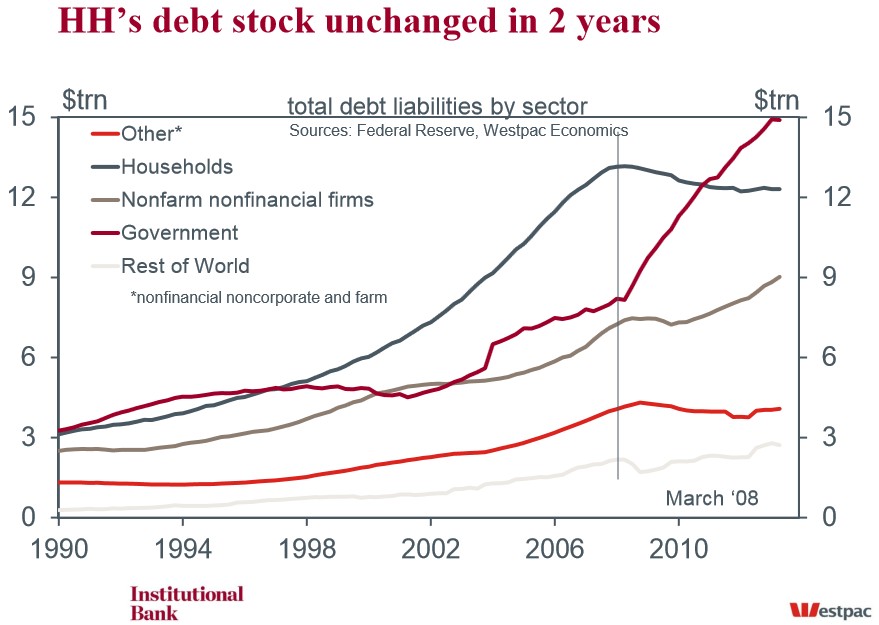
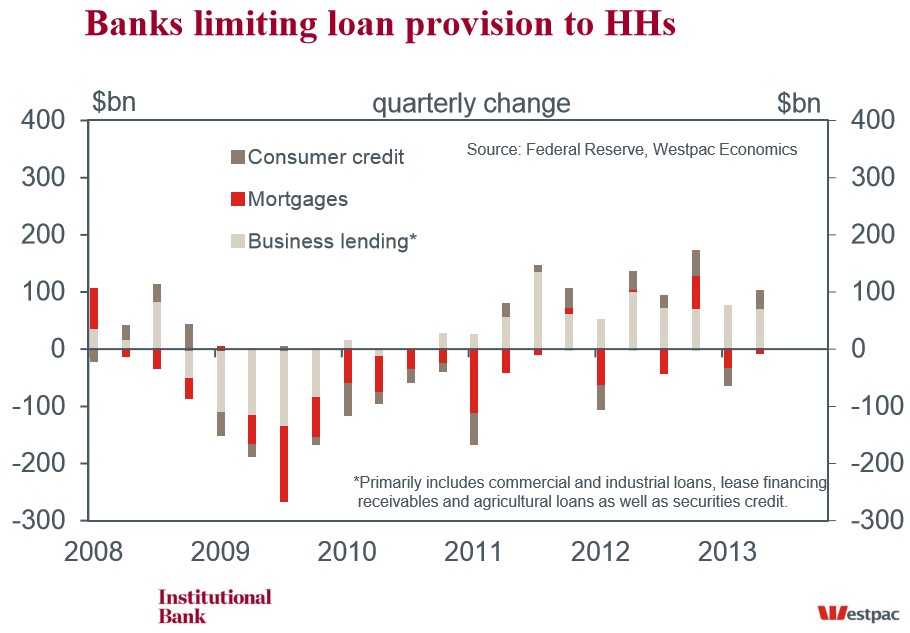
This is most obviously true for households who have remained very cautious in their appetite for leverage in the wake of the GFC. Indeed, in dollar terms, the level of household credit has remained broadly unchanged for the past two years following a moderate deleveraging episode between March 2008 and June 2011. In the past two years, we have seen one notable quarterly increase in the size of commercial banks’ mortgage books (December 2012) and a singular quarterly increase in the combined loan book of Fannie Mae and Freddie Mac (June 2013), the two conforming-loan government sponsored entities – conforming in the sense that they require a solid credit rating, a sizeable deposit (typically 20%), and the loan to be smaller than the mandated loan limit. The remaining flow of credit provided to households during the past two years has been in the form of low-deposit, low-credit-score home loans facilitated by Ginnie Mae and the Federal Housing Administration (FHA) and consumer credit. The latter has primarily been in the form of government-funded student loans, although auto-loan growth has also been supportive.
As displayed by the October Senior Loan Officers Survey (SLOS), the absence of credit creation in the household sector is the result of limited demand from end borrowers as well as the tighter lending standards introduced in the wake of the GFC which were never really rescinded. While the SLOS indicates prime borrowers have benefited from looser lending standards in the past year, this improvement is negligible relative to the initial tightening.
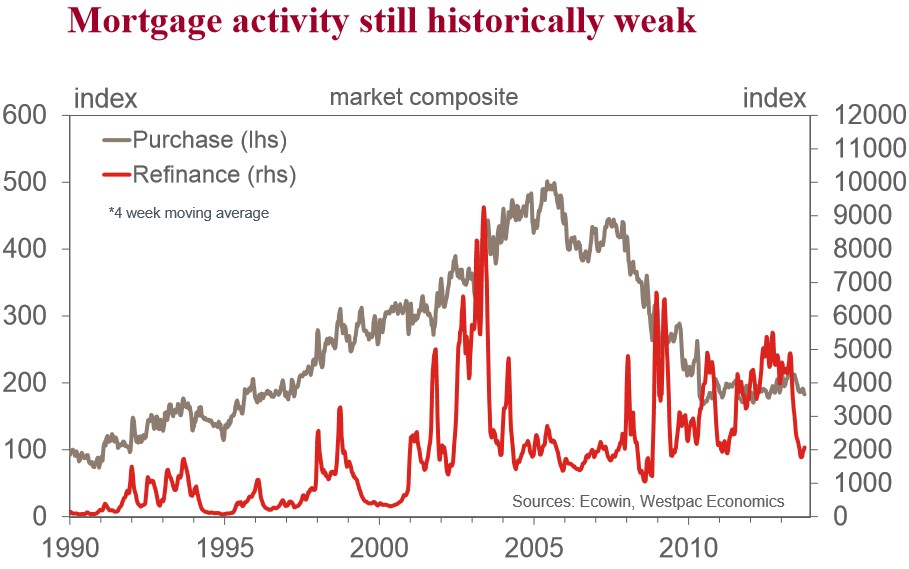
As an aside, it is worth noting that a special question in the October survey sought to assess the impact higher mortgage rates have had on household loan demand. The answers were consistent with available data on mortgage approvals, indicating a noticeable, albeit moderate, impact on purchase applications and a much larger impact on refinance applications. The timing of this deterioration also corresponds with the 5.6% decline in pending home sales seen in September.
Turning to the corporate sector, there has been a much more noticeable pick-up in credit creation. Indeed, an uptrend has been apparent in nonfinancial firm credit liabilities since the end of 2009, with the pace of growth accelerating moderately over the past year.
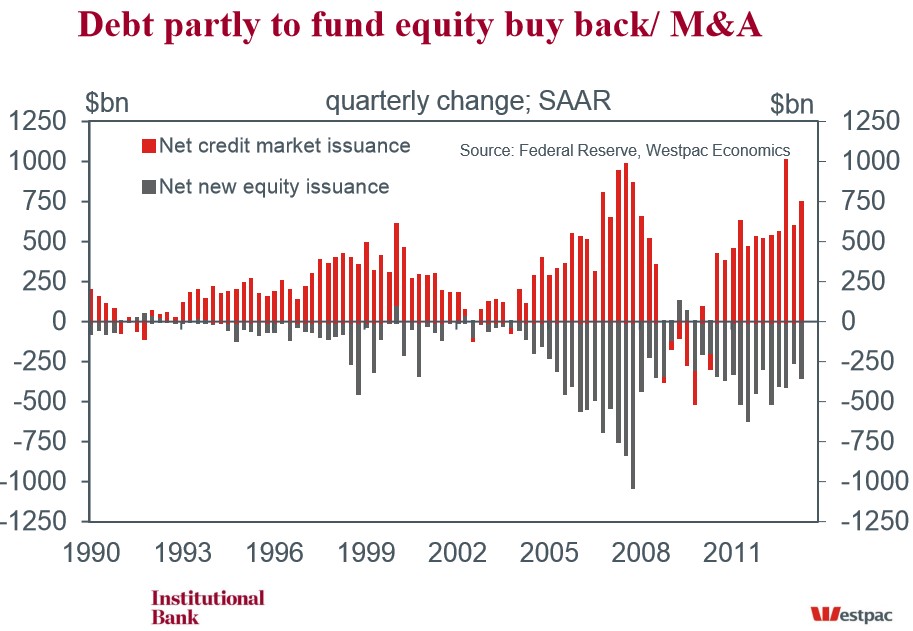
That this acceleration has occurred at a time when annual growth in business investment has decelerated from over 9% in June 2012 to little more than 2% in June 2013 is somewhat surprising – one would normally expect higher leverage to be taken on to finance greater real investment. But we don’t have to go too far for an explanation. From the flow of funds data, it is evident that nonfinancial firms have been adjusting their financial structure, funding stock buy backs and acquisitions with borrowed funds. This is not only a recent phenomenon; it has been seen throughout the recovery.
On small business lending, good information is hard to find. As best can be assessed, lending conditions for small businesses remain restrictive. The latest NFIB small business survey indicated a historically-low 30% of respondents were borrowing on a regular basis; of that group, a net 5% reported loans were “harder to get” compared to their last attempt.
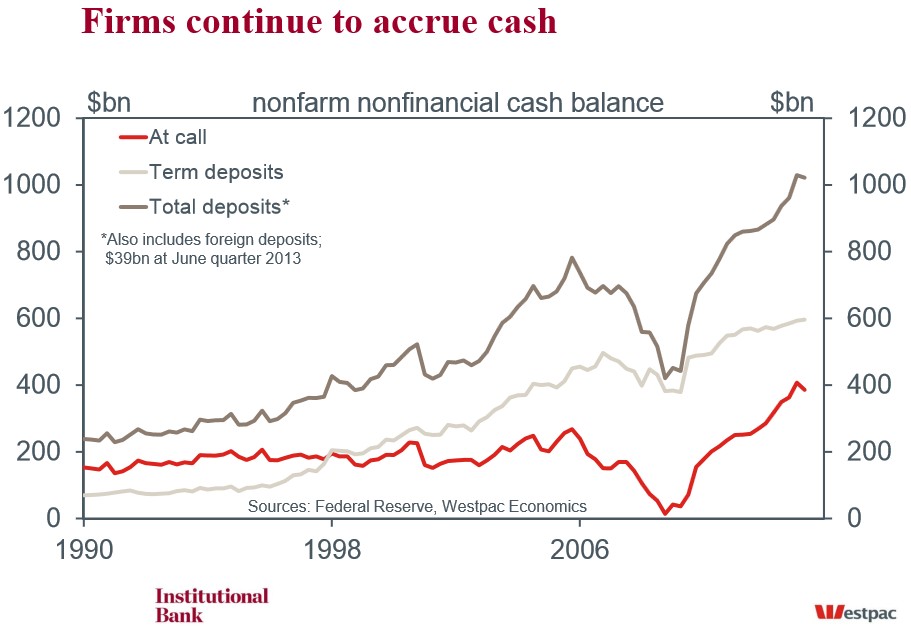
This recovery’s business investment narrative then looks to have been all about US corporates maximising reported profits (both by making the financial structure more efficient and through acquisitions) as opposed to expanding capacity. It is hardly surprising then that jobs growth has remained so fickle, and that what jobs growth there has been has been focused toward household service provision instead of production and business services. That cash continues to be accumulated amongst US corporates is yet another sign of a lack of investment opportunities and a high degree of uncertainty over the outlook.
In the past we have often emphasised that, despite its end-user focus, US credit easing has failed to spark persistent momentum in the aggregate economy. Arguably, the lesson to draw from this experience is that alternative policy measures are certainly an effective way to forestall further weakness and maintain the structural integrity of the financial system. However, in and of themselves, these policies are unable to engender greater dynamism. For that, confidence and clarity around fiscal policy, household’s financial health and the broader economy are key. On each front, there is a great need for improvement.
Leith van Onselen is Chief Economist at the MB Fund and MB Super. He is also a co-founder of MacroBusiness.
Leith has previously worked at the Australian Treasury, Victorian Treasury and Goldman Sachs.