
If it hasn’t been embarrassing enough watching Australian foreign and strategic policy get warped through the lens of “stopping the boats”, it has become increasingly apparent that our relationship to our nearest Northern neighbor is deteriorating, with spying allegations hot off the press:
Material leaked by NSA whistleblower Edward Snowden reveals that Australia’s intelligence gathering in Indonesia has gone all the way to the president.
Documents obtained by the ABC and Guardian Australia, from material leaked by the former contractor at the US National Security Agency, show that Australian intelligence attempted to listen in to president Susilo Bambang Yudhoyono’s telephone conversations on at least one occasion.
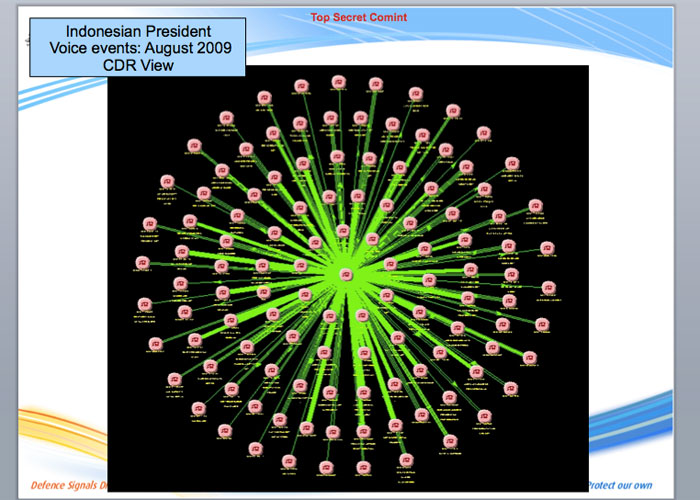
The documents also show that they tracked the activity on his mobile phone for 15 days in August 2009.
The top-secret documents are from Australia’s electronic intelligence agency, the Defence Signals Directorate (now called the Australian Signals Directorate), and show for the first time how far Australian spying on Indonesia has reached. The DSD motto stamped on the bottom of each page reads: “Reveal their secrets – protect our own.”
They show that Australian intelligence actively sought a long-term strategy to continue to monitor the president’s mobile phone activity.
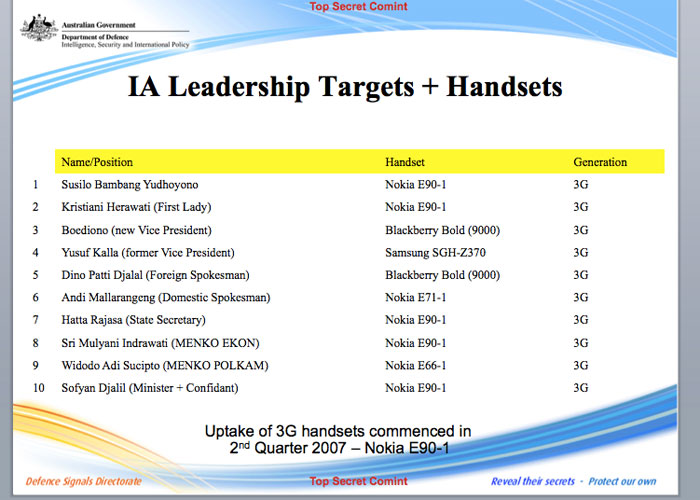
The surveillance targets also included senior figures in his inner circle and even the president’s wife Kristiani Herawati (also known as Ani Yudhoyono). Also on the list of targets is the vice president Boediono, the former vice president Yussuf Kalla, the foreign affairs spokesman, the security minister and the information minister.
One page lists the names and the 3G handsets they were using at the time.
A number of the people on this list are lining up as potential candidates for the presidential election to replace Mr Yudhoyono next year.
The documents are titled “3G impact and update” and appear to chart the attempts by Australian intelligence to keep pace with the rollout of 3G technology in Indonesia and across South-East Asia.
A number of intercept options are listed and a recommendation is made to choose one of them and to apply it to a target – in this case the Indonesian leadership.
The document shows how DSD monitored the call activity on Mr Yudhoyono’s Nokia handset for 15 days in August 2009.
One page is titled “Indonesian President voice events” and provides what is called a CDR view. CDR are call data records; it can monitor who is called and who is calling but not necessarily what was said.
Another page shows that on at least one occasion Australian intelligence did attempt to listen in to one of Mr Yudhoyono’s conversations.
But according to the notes on the bottom of the page, the call was less than one minute long and therefore did not last long enough to be successfully tapped.
Let’s not be naive, all agencies are doing this stuff all of the time. The only condition being “don’t get caught”.
Obviously this material pre-dates the Abbott Government but it has already done a great job of pissing off Indonesia with its double-speak about asylum boats before this story mushroomed.
I have often wondered why PMs rarely bother with foreign policy in their early days – Kevin Rudd excepted – and now I know.
