Chinese demand for Australia’s natural resources may prove to be stronger than currently believed, according to BHP Billiton chief executive Andrew Mackenzie.
Speaking at the opening of the mining giant’s new headquarters in Melbourne, Mr Mackenzie said early indications from the Chinese government’s recent economic policy summit were positive for Australia and its mining industry.
”If you read the small print – and no doubt we will hear more about this in a couple of weeks – from the third plenum that has just happened in China, I think even more than we might think they are going to require us to supply the resources to continue to develop not just China but much of north Asia as well,” he said.
”These resources are going to be fundamental to them securing the economic prosperity they crave for themselves and their citizens.”
China’s reform package is impressive in its scope but it is far too early to be making these claims. It may prove to be true that Chinese rebalancing is delayed and investment growth remains strong but that means it won’t be rebalancing and the problems of debt-accumulation super-charging growth will only be delayed.
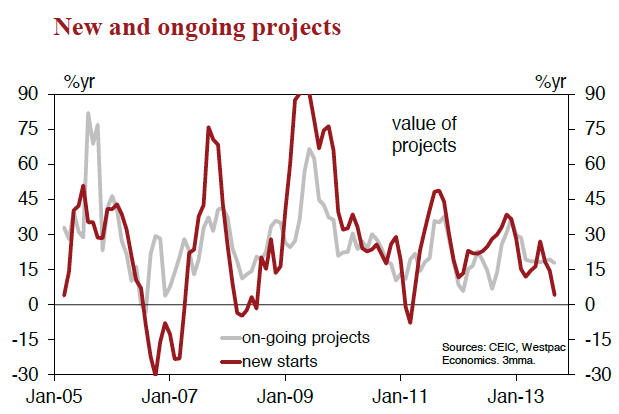
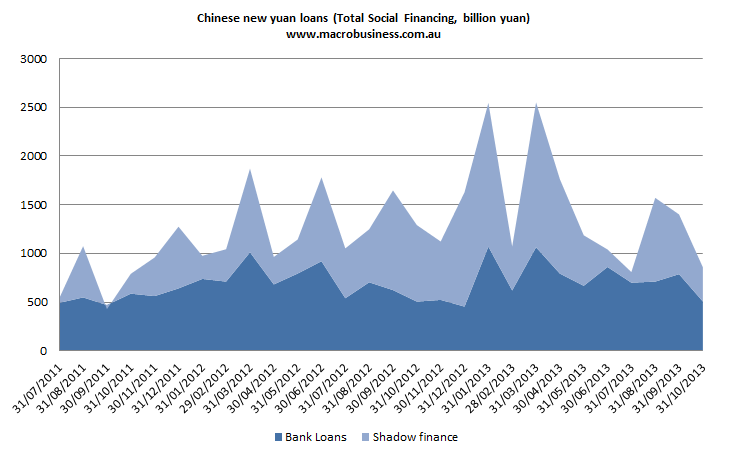
As well, there is mounting evidence that China is going to slow into next year. The infrastructure pipeline is running dry and credit is tightening after a mid year surge:
China Development Bank and fellow state policy lender Agricultural Development Bank of China have had to delay or dramatically reduce Chinese bond issues as the impact of a tight onshore credit market begins to be felt.
The China Railway Corporation, another state entity, was forced to delay a deal recently, while well-known private companies including the electric carmaker BYD and internet company Baidu also saw deals delayed over the summer, according to bankers familiar with the situation.
Issuers are dealing with a string of problems stemming from the drying up of interbank market liquidity and fierce competition from wealth management and trust products for investors’ funds.
CDB, the policy bank whose credit profile is as good as the government of China itself, was forced last week to cut a proposed Rmb24bn ($3.9bn) deal by 60 per cent to Rmb10bn and pay a yield of more than 5.5 per cent.
“Chinese 10-year Treasury bond yields are at a six-year high and are up about 100 basis points versus a year ago,” said one senior bond banker in Beijing. “CDB’s yields have widened by a bit more than 100 basis points and other corporate bonds are seeing yields rise by 150-200 basis points.”
The head of fixed income sales and trading at a European bank in Shanghai said the policy banks pre-disclose their issuance plans, so it is easy to see when they delay. “But for most corporations, they just quietly delay their issues and no one knows that except for the underwriter.”
“Government and policy banks have suffered the most. Now pressure is coming to corporates,” he added. “It’s going to end pretty ugly unless PBOC [the central bank] changes its attitude to liquidity.”
This is exactly what to expect more of if China is serious about rebalancing. Bloomie has more:
A $6.6 trillion credit binge during the past five years, encouraged by Beijing policy makers as stimulus to combat a global economic slowdown, now threatens to stoke a debt crisis. At stake are trillions of yuan in bank loans that companies producing everything from ships to steel to solar power are struggling to repay as the world’s second-largest economy heads for the weakest annual expansion since 1999.
…China’s biggest banks are already affected, tripling the amount of bad loans they wrote off in the first half of this year and cleaning up their books ahead of what may be a fresh wave of defaults.Industrial & Commercial Bank of China Ltd. and its four largest competitors expunged 22.1 billion yuan of debt that couldn’t be collected through June, up from 7.65 billion yuan a year earlier, regulatory filings show.
“In the next three to four years, industries with excess capacity will be the main source of credit loss for banks and their nonperforming loans as China cleans up the legacy,” said Liao Qiang, a Beijing-based director at Standard & Poor’s. “The speed of the process will depend on the government’s determination and whether they are willing to incur short-term pain for long-term gain.”
And what are those sectors? Shipbuilding, solar panels, cement and steel:
…“The 2008 stimulus exacerbated an industrial glut that has been in existence since 2003,” S&P’s Liao said. “We expect the government to take measured steps in a crackdown on overcapacity because they need to weigh the impact on financial stability.”
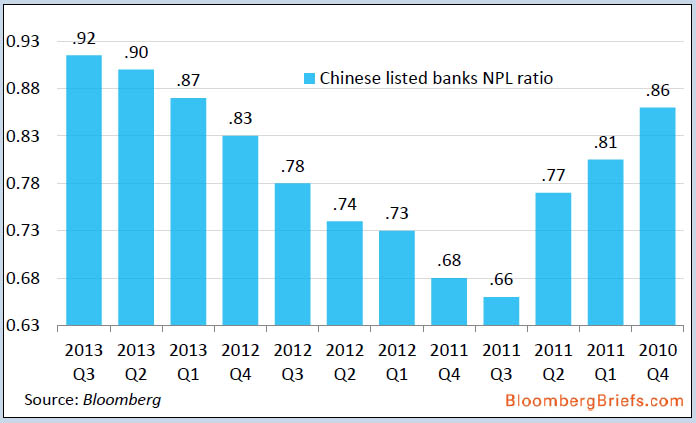
Nonperforming loans at Chinese banks increased for an eighth consecutive quarter in the three months ended Sept. 30 to 563.6 billion yuan, extending the longest streak in at least nine years. Still, they account for just 0.97 percent of the nation’s outstanding loans, according to the China Banking Regulatory Commission.
The bad-loan ratio could climb to as high as 1.5 percent in the next few quarters, according to Lian Ping, chief economist at Shanghai-based Bank of Communications Co.
The trend is very clear in NPLs. Also from Bloomie:
Don’t get me wrong, an actual “credit event” is still a tail risk. China has very good options for cleaning up its banks. Much better than Western systems. There are the Asset Management Companies (AMCs) that have before bailed out banks through the back door and can do so again. The reform proposals also include liberalisation of securitisation markets which will help prevent clogging of the banking system with bad loans.
These mechanisms should prevent any bad debt problems turning into a self-fulfilling debt-deflation cycle as shrinking capital crimps lending.
But that is not the issue. What is is will the reform proposals – which propose a process of creative destruction – slow and change the mix of growth for commodities? If applied as described in the document then, yes, they will probably do both and China will rebalance towards consumption.
But at this point we simply do not know if the CCP is prepared to allow slower growth and so the central conundrum remains. If fixed-asset stimulus is required to keep growth up through the process then it is highly questionable that there is a process at all.
David Llewellyn-Smith is Chief Strategist at the MB Fund and MB Super. David is the founding publisher and editor of MacroBusiness and was the founding publisher and global economy editor of The Diplomat, the Asia Pacific's leading geo-politics and economics portal.
He is also a former gold trader and economic commentator at The Sydney Morning Herald, The Age, the ABC and Business Spectator. He is the co-author of The Great Crash of 2008 with Ross Garnaut and was the editor of the second Garnaut Climate Change Review.