

Yesterday’s release of the overseas short-term arrivals and departures figures for September contained mixed news for Australia’s tourism industry, with both inbound and outbound tourists rising by 1.0% over to month to new annual highs.
However, the ratio of annual arrivals to departures fell to its lowest level since November 1985 (see below chart).
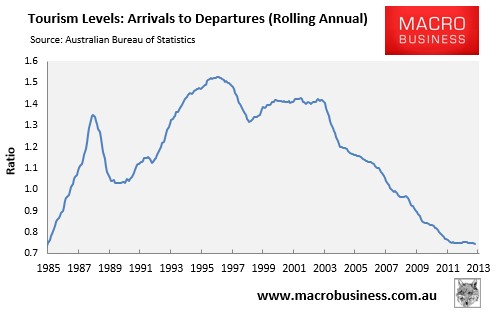
In the 12 months to September 2013, the annual number of arrivals increased by 5.5% relative to the corresponding period of the prior year, whereas departures rose by 6.1% (see next chart).
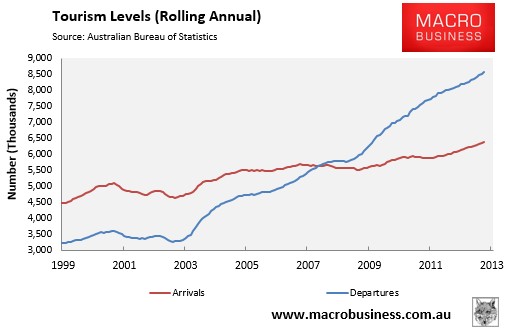
The year to September 2013 was a record for both inbound and outbound tourism. A record 6.39 million inbound tourists arrived in Australia over the year – a 37% increase on a decade ago (4.67 million). However, the number of Australians holidaying overseas also hit a record 8.57 million departures – a 160% increase on 10 years ago (3.29 million).
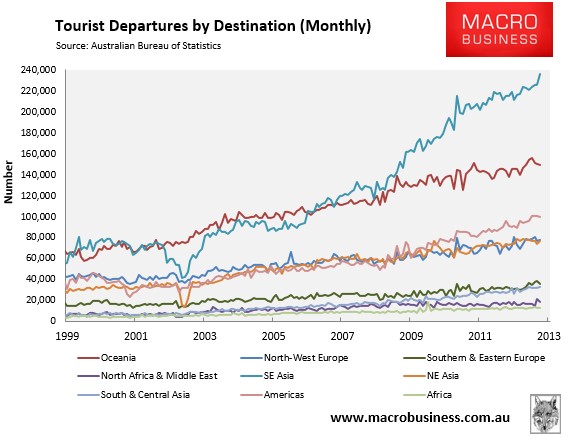
South East Asia (particularly Indonesia and Thailand) remains by far Australia’s favourite holiday destination, receiving a record 236,400 visitors in September, or 32% of Australia’s total departures over the month. This was followed by Oceania (20%), the Americas (13.5%), North East Asia and North West Europe (each 10%):
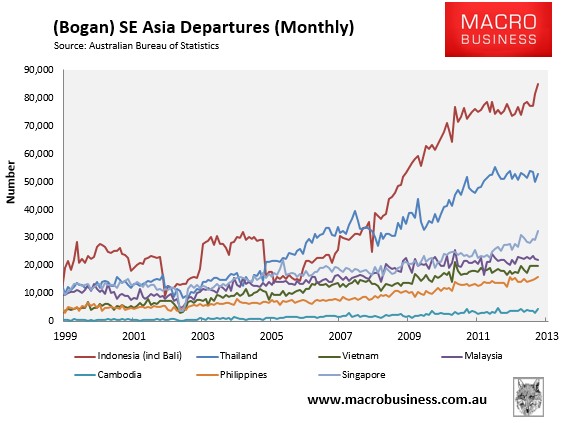
Departures to the bogan hotspot of Bali (Indonesia) skyrocketed in September to a new record high, and remains by far Australia’s favourite single tourism destination:
By contrast, the most foreign visitors to Australia came from NE Asia, which accounted for 26% of arrivals in September, followed by Oceania (20%). The surge in NE Asian arrivals has been driven by China, with a record 72,600 Chinese visiting Australia in September (13.3% of total intake), with visitor numbers rising by 8,000 or 12.4% over the month:

unconventionaleconomist@hotmail.com
