Westpac has released a note today arguing that non-residential building construction, which fell marginally (-0.3%) over the June quarter, will remain laclustre over the foreseeable future:
The non-residential building sector moved sideways in the June quarter. This consolidation of conditions met our expectations. When we wrote on May 15 this year we suggested that: “the upswing in private non–residential building sector is set to give way to a consolidation, ahead of a second upward leg.”
In this note “building” refers to the non-residential sector.
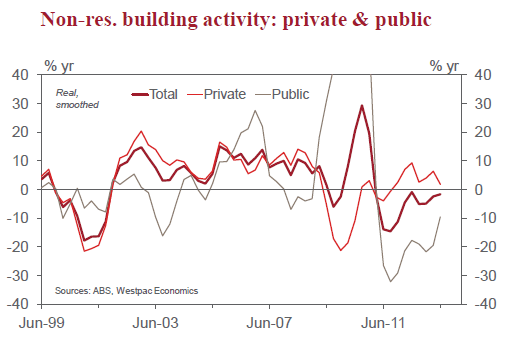
Activity was broadly flat in Q2. Real work done was little changed at $8.3bn, a 0.3% decline on the quarter prior.
Private real work edged 0.8% lower in the quarter, after a 1.1% fall in the March quarter. This follows a 10% rise in the year to December quarter 2012.
Activity on public building projects rose 0.5% in the March quarter and increased by a further 1.0% in the June quarter. That follows nine quarters of decline as the school building stimulus package wound down.
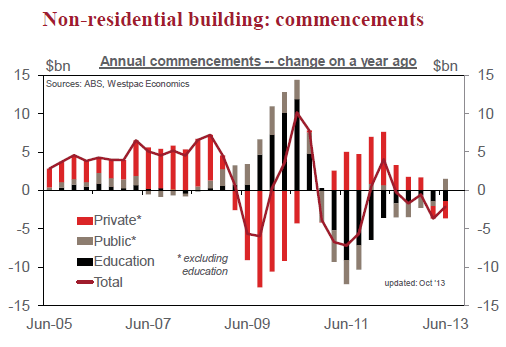
Total commencements moderated a little in the June quarter, continuing a trend evident during the past year. This followed a two year recovery in commencements and is evidence of a lack of momentum in the sector, consistent with the generally subdued domestic backdrop.
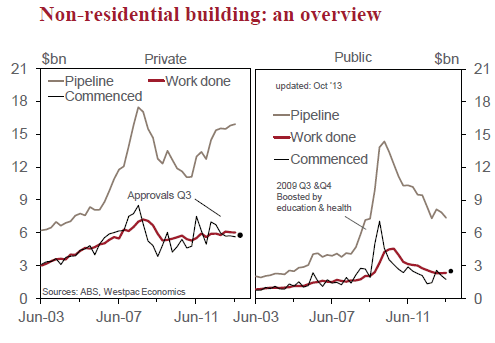
Commencements were valued at $7.4bn in the June quarter, moderating from $7.8bn in the March quarter. The quarterly average for 2012/13 was $7.7bn, down from $8.3bn in 2011/12. Commencements of private buildings were valued at $5.6bn in Q2, a tick down from $5.7bn in Q1. For 2012/13 the quarterly average was $5.7bn, a slight moderation from $6.2bn in 2011/12.
The total building work pipeline has levelled out since early 2012, at a little over $23bn. The pipeline of private work moved 3.6% higher over the past year, an increase of $0.5bn to $15.9bn. That lift was despite commencements for the year being valued some $1bn below the level of work completed during the period, suggesting job variations added a little to the work pipeline.
Prospects for 2013: Subdued economic conditions domestically and globally over the past year will constrain the building sector near-term. This is evident in the office market, with vacancy rates increasing so far in 2013. We continue to expect a broad consolidation of building activity in 2013, with work supported by the current sizeable work pipeline.
A turnaround in fortunes for building nationally will require a strengthening of general economic conditions. Domestically, record low interest rates are set to support household demand, although we expect the response to be modest by historical standards. Internationally, we expect world growth to remain disappointment into 2014.
Leith van Onselen is Chief Economist at the MB Fund and MB Super. He is also a co-founder of MacroBusiness.
Leith has previously worked at the Australian Treasury, Victorian Treasury and Goldman Sachs.