For the past three years, a select group of austerity extremists (some Austrian, some Libertarian) has held the global economy to ransom in a quest to dominate Europe. They ultimately capitulated when confronted with the ballot box in Germany and so Europe began an economic recovery six months ago as fiscal stabilisers were finally allowed to work.
Now the nutters are at large in the US. From the FT:
US banks were stocking cash machines with extra funds, investors dumped Treasury bills and US equity indices sank on Thursday in a sign of mounting unease that Washington risks defaulting on its debt later this month.
On the third day of a government shutdown, policy makers and business leaders expressed increasing concern that Republicans and Democrats would not reach a deal before the October 17 deadline to raise the debt ceiling.
Christine Lagarde, managing director of the International Monetary Fund, gave warning of dire consequences for the rest of the world if the stalemate were not resolved. “The government shutdown is bad enough, but failure to raise the debt ceiling would be far worse,” she said. “It is ‘mission critical’ that this be resolved as soon as possible.”
Two of the country’s 10 biggest banks said they were putting into place a “playbook” used in August 2011 when the government last came close to breaching the debt ceiling.
One senior executive said his bank was delivering 20-30 per cent more cash than usual in case panicked customers tried to withdraw funds en masse.
The move to source extra cash is a precaution to deal with an unnecessary upturn in demand, banks said. The Federal Deposit Insurance Corporation insures deposits up to $250,000.
Banks are also holding daily emergency meetings to discuss other steps, including possible free overdrafts for customers reliant on social security payments from the government.
The US Treasury has said the US could run out of money to pay its bills as early as October 17 if there was no congressional deal.
“A default would be unprecedented and has the potential to be catastrophic: credit markets could freeze, the value of the dollar could plummet, US interest rates could skyrocket,” the Treasury said in a report on Thursday, citing “negative spillover effects around the world”. It added: “There might be a financial crisis and recession that could echo the events of 2008 or worse.”
I am unchanged in my view that this will resolve peacefully. Any other outcome will smash the Republicans. And don’t get me wrong. I agree with the doctrine of nations living within their means. But in Europe and the US, fiscal brinkmanship is not the way to bring it about.
Advertisement
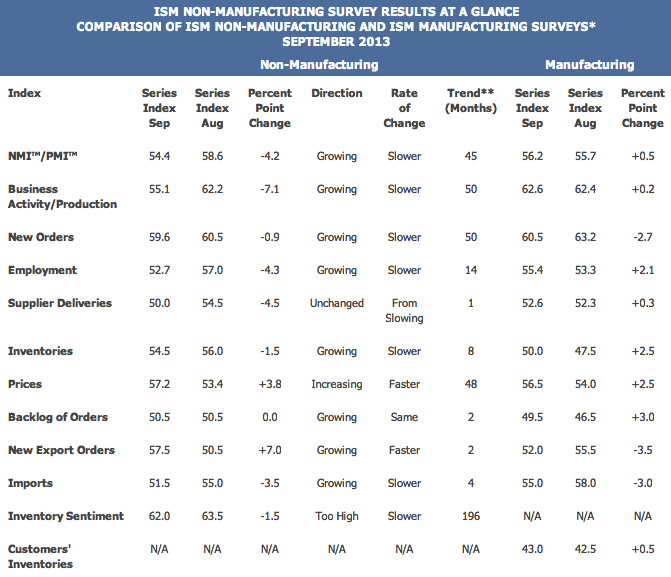
For investors, there is another problem lurking beneath the surface. The hikes in bond rates (which were unchanged last night) and nascent slowing in the housing market is slowing the US economy. Last night’s ISM services index fell sharply:
It’s not drastic and some of the internals remain encouraging. But the comments show interest rate sensitive sectors stalling:
Advertisement
“Overall business conditions are slowing — small manpower decrease of 5 percent.” (Construction)
“Business levels continue to be strong. Shifting from transient to group travelers.” (Accommodation & Food Services)
“Increased activity following summer vacations, but several postponements as well. Clients still unsure about the economy and business costs (e.g., healthcare).” (Professional, Scientific & Technical Services)
“The federal government’s spending is increasing greatly as agencies execute their final budgets and utilize fiscal year 2013 appropriated funds prior to their expiration on September 30th. This has caused a major increase in procurement activity for goods and services. Budgets are uncertain for fiscal year 2014, so some items requiring funding in future years are not being purchased.” (Public Administration)
“Business has leveled off — not much in the way of growth.” (Retail Trade)
“Some pick-up in sequential sales growth, but still flat with last year.” (Wholesale Trade)
In our upside down world, to my mind this is bullish for equities (for a short term trade). The likely outcome of the fiscal debacle is a new “sequester” of some kind for 2014. That is, increased austerity. Once the shutdown passes much of the immediate government activity will rebound but with a slowing economy because of the damage done by the bond market, more austerity is going to keep the US economy from breaking out of its sub-2% recovery. That will ensure QE for another material stint, maybe another year. And we know what that means for US stocks, following on from any post-crisis relief rally. Even the ASX might benefit because it is hard to see the Australian dollar returning to parity in the context of a steady unwind of the commodity super cycle, despite an already weakening US dollar.
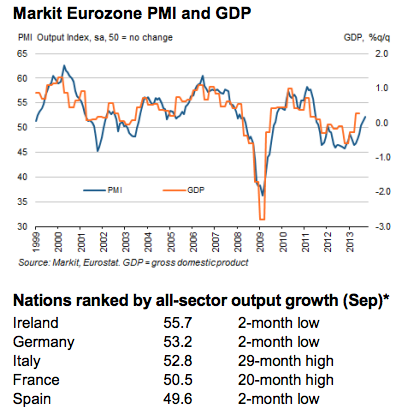
Meanwhile, in Europe, the post-austerity recovery goes on. From Markit, the European composite PMI was firm:
Advertisement
The September PMI surveys provided further evidence that the eurozone recovery gathered pace, after the region pulled out of the longest recession in its history. There were also reassuring signals on the jobs front as the rate of losses eased to a very modest pace, raising the possibility of employment starting to recover in the near future. Output Index rose to a 27-month high of 52.2 in September, up from 51.5 in August and above the earlier flash estimate of 52.1.
For thirty years the world enjoyed an equities bull market in part based upon an always reliable Keynesian doctrine of fiscal counter-cyclical intervention. We now have the opposite at work with upticks in the cycle stomped on by Austrians. The Keynesians took it too far and built up big imbalances. Now, so too are their opposites, who should be thinking long term deficit reduction.
David Llewellyn-Smith is Chief Strategist at the MB Fund and MB Super. David is the founding publisher and editor of MacroBusiness and was the founding publisher and global economy editor of The Diplomat, the Asia Pacific's leading geo-politics and economics portal.
He is also a former gold trader and economic commentator at The Sydney Morning Herald, The Age, the ABC and Business Spectator. He is the co-author of The Great Crash of 2008 with Ross Garnaut and was the editor of the second Garnaut Climate Change Review.