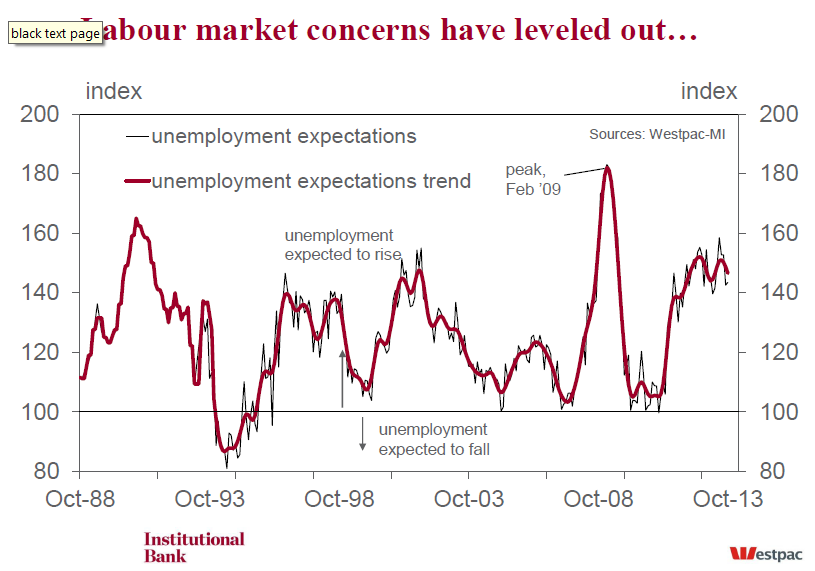
The unemployment expectations index rose just 0.6% in Oct, which you would consider to be broadly flat following the 6.6% fall in Sep. Sep was the largest monthly improvement (a fall in the index suggests consumers are not expecting unemployment to rise as much as they were) since the 6.9% fall in Nov 2012.
Through the year to Sep, the index is down 6.0%. There has been a clear turnaround or peaking of the index; the pace was –8.2%yr in Sep, –0.7%yr in Aug compared to a 3.2%yr pace in Jul.
The trend in the index has shifted with the MI reporting a 2.2% fall in Oct following on from a 1.1% fall in Sep and a 1.4% fall in Aug.
Nevertheless, the trend is still some 13% higher that it long-run average. So despite the improvement, the index is still pointing near term weak weakness in full-time employment and total hours worked.
It is interesting to compare to the results post the 1996 election. Back in March 96, unemployment expectations fell 23pts only to bounce 26pts in April. Following the Sep 13 election, expectations fell a more modest 10pts but bounced just 1pt in Oct.
In summary, expectations rose 3pts over the two months following the 1996 election but have fallen 9pts in the two months following the 2013 election.
The improvement following the 2013 election has come via managers & professionals (–14pts) and paraprofessionals & trades (–18pts). Sales & clerical (+3pts) and labourers & operators (1pt) have been broadly flat. Sales & clerical is the only group currently exhibiting a trend rise in expectations.
Just as surprising has been the improvement in expectations in the mining states. WA is still the most pessimistic but it has improved while Qld is now only slightly more pessimistic than NSW.
David Llewellyn-Smith is Chief Strategist at the MB Fund and MB Super. David is the founding publisher and editor of MacroBusiness and was the founding publisher and global economy editor of The Diplomat, the Asia Pacific's leading geo-politics and economics portal.
He is also a former gold trader and economic commentator at The Sydney Morning Herald, The Age, the ABC and Business Spectator. He is the co-author of The Great Crash of 2008 with Ross Garnaut and was the editor of the second Garnaut Climate Change Review.