Following last night’s FOMC minutes it’s mixed messages galore today with the primary theme being imminent taper. Here are the money quotes:
In their discussion of the path for monetary policy, participants debated the advantages and disadvantages of reducing the pace of the Committee’s asset purchases at this meeting, focusing importantly on whether the conditions presented to the public in June for reducing the pace of asset purchases had yet been met. In general, those who preferred to maintain for now the pace of purchases viewed incoming data as having been on the disappointing side and, despite clear improvements in labor market conditions since the purchase program’s inception in September 2012, were not yet adequately confident of continued progress. Many of these participants had revised down their forecasts for economic activity or pointed to near-term risks and uncertainties. For example, questions were raised about the effects on the housing sector and on the broader economy of the tightening in financial conditions in recent months, as well as about the considerable risks surrounding fiscal policy. Moreover, the announcement of a reduction in asset purchases at this meeting might trigger an additional, unwarranted tightening of financial conditions, perhaps because markets would read such an announcement as signaling the Committee’s willingness, notwithstanding mixed recent data, to take an initial step toward exit from its highly accommodative policy. As a result of such concerns, a number of participants thought that risk-management considerations called for a cautious approach and that, in light of the ambiguous cast of recent readings on the economy, it would be prudent to await further evidence of progress before reducing the pace of asset purchases. Consistent with the framework discussed by the Chairman during the June press conference, asset purchases were contingent on the Committee’s ongoing assessment of the economic outlook and were not on a preset course; this approach implied a need to adapt and to adjust asset purchases in response to changes in economic conditions in order to preserve the Committee’s credibility. With many outside observers expecting a decision to reduce purchases at this meeting, some participants emphasized a need to clearly communicate the rationale behind any decision not to do so, in order to avoid conveying a message of pessimism regarding the economic outlook or to reinforce the distinction between decisions concerning the pace of purchases and those concerning the federal funds rate. One participant suggested that postponing the reduction in the pace of asset purchases would also allow time for the Committee to further discuss and to implement a clarification or strengthening of its forward guidance for the federal funds rate, which could temper the risk that a future downward adjustment in asset purchases would cause an undesirable tightening of financial conditions.
The participants who spoke in favor of moderating the pace of securities purchases at this meeting also cited the incoming data, but viewed those data as broadly consistent with the Committee’s outlook for the labor market at the time of the June FOMC meeting when the contingent expectation that the pace of asset purchases would be reduced later in the year was first presented to the public. Moreover, they highlighted what they saw as meaningful cumulative progress in labor market conditions since the purchase program began. Those participants generally were satisfied that investors had come to understand the data-dependent nature of the Committee’s thinking about asset purchases, and, because they judged that the conditions laid out in June had been met, they believed that the credibility of the Committee would best be served by announcing a downward adjustment in asset purchases at this meeting. With the markets apparently viewing a cut in purchases as the most likely outcome, it was noted that the postponement of such an announcement to later in the year or beyond could have significant implications for the effectiveness of Committee communications. In particular, concerns were expressed that a delay could potentially undermine the credibility or predictability of monetary policy by, for example, increasing uncertainty about the Committee’s reaction function and about its commitment to the forward guidance for the federal funds rate, with the result of an increase in volatility in financial markets. Moreover, maintaining the pace of purchases could be perceived as a sign that the FOMC had turned more pessimistic about the economic outlook. Finally, it was noted that if the Committee did not pare back its purchases in these circumstances, it might be difficult to explain a cut in coming months, absent clearly stronger data on the economy and a swift resolution of federal fiscal uncertainties. Most of the participants leaning toward a downward adjustment in the pace of asset purchases also indicated that they favored a relatively small reduction to signal the Committee’s intention to proceed cautiously.
With regard to adjustments in the pace of asset purchases, whether at this or a future meeting, a few participants expressed a preference for not cutting MBS purchases but reducing purchases only of Treasury securities initially, with the intent of continuing to support the recovery in the housing sector. However, the appeal of including both types of securities in any reduction was also mentioned. In addition, in an effort to reduce uncertainty about how the Committee might adjust its purchases in response to economic developments and to alleviate some of the related communications issues, one participant suggested an approach that would mechanically link the reduction in asset purchases to numerical values for the unemployment rate, with the goal of ending the program when the unemployment rate reached a stated level.
Not much hawkish in there. But there is another section of the release that got markets more excited about imminent taper. The projections section which included the following snippet:
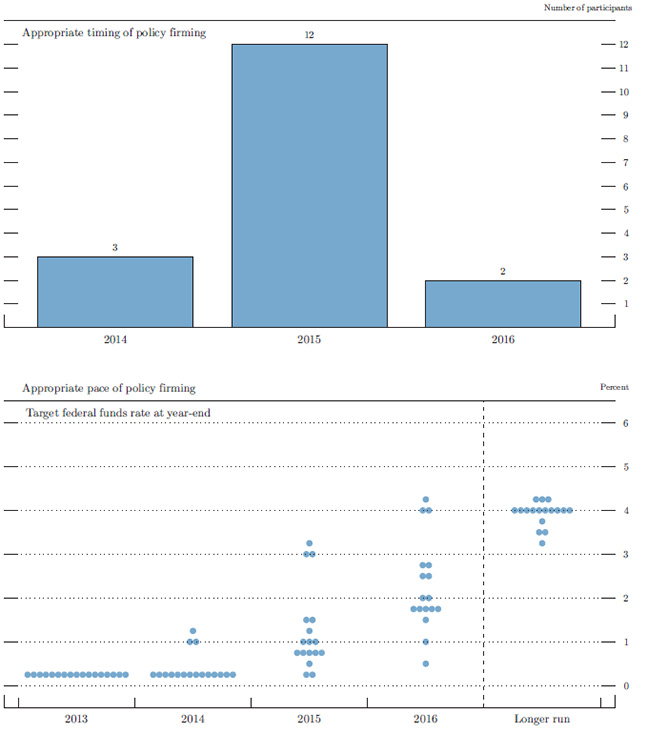
Most participants judged that highly accommodative monetary policy was likely to remain warranted over the next few years to support continued progress toward maximum employment and a return to 2 percent inflation. As shown in figure 2, a large majority of participants judged not only that it would be appropriate to wait until 2015 or later before beginning to increase the federal funds rate, but also that it would then be appropriate to raise the federal funds rate target relatively gradually. Most participants viewed their economic projections as broadly consistent with a slowing in the pace of the Committee’s purchases of longer-term securities this year and the completion of the program in mid-2014.
Advertisement
Markets interpreted that as the key message and sold off gold, copper and long-dated Treasuries, piled into the US dollar and, ironically, equities, although that may have had more to do with the appointment of Janet Yellen or just be a dead cat bounce.
Mixed messages indeed!
On the data front, FOMC fears were played out with the weekly MBIA index showing mortgages are declining year on year:
Mortgage applications increased 1.3 percent from one week earlier, according to data from the Mortgage Bankers Association’s (MBA) Weekly Mortgage Applications Survey for the week ending October 4, 2013. …The Refinance Index increased 3 percent from the previous week and is at its highest level since the week ending August 9, 2013. The seasonally adjusted Purchase Index decreased 1 percent from one week earlier. … For the second consecutive week, the unadjusted Purchase Index was lower compared to the same week one year ago….The average contract interest rate for 30-year fixed-rate mortgages with conforming loan balances ($417,000 or less) decreased to 4.42 percent, the lowest rate since mid-June, from 4.49 percent, with points increasing to 0.44 from 0.34 (including the origination fee) for 80 percent loan-to-value ratio (LTV) loans.
Advertisement
On the shutdown front there is not much to report. Much political back and forth but not much more. The Tea Party is dying in the polls but doesn’t seem to care. From Bloomie:
A poll released Oct. 7 by the Washington Post and ABC News found that 71 percent of voters disapproved of how congressional Republicans have handled the budget negotiations. That compared to disapproval ratings of 61 percent for Democrats in Congress and 51 percent for Obama.
Yet, a survey released Oct.7 by the Pew Research Center found that 45 percent of Tea Party Republicans expressed little or no concern about the effect of the government shutdown. By contrast, 10 percent of Democrats and 26 percent of non-Tea Party Republicans responded the same way.
A number of folks are now claiming that only collapsing markets will end it. Short term Treasuries spiked again, as high as 0.39% so we don’t have that long to wait.
David Llewellyn-Smith is Chief Strategist at the MB Fund and MB Super. David is the founding publisher and editor of MacroBusiness and was the founding publisher and global economy editor of The Diplomat, the Asia Pacific's leading geo-politics and economics portal.
He is also a former gold trader and economic commentator at The Sydney Morning Herald, The Age, the ABC and Business Spectator. He is the co-author of The Great Crash of 2008 with Ross Garnaut and was the editor of the second Garnaut Climate Change Review.