
Progress on the debt ceiling but not the shutdown overnight. From the FT:
Stock prices jumped on Thursday at the news that the Republican leadership in Congress was ready to propose a deal for a short-term lift in the debt limit.
John Boehner, the Republican House speaker, outlined the proposal to his members, before leading a senior delegation to the White House to meet President Barack Obama later on Thursday afternoon.
The Republican leadership wants to take the threat of sovereign default off the table to allow it to refocus attention on the parallel fiscal crisis, the stand-off over the budget which has caused a partial government shutdown.Mr Boehner will need to win over his members on the debt ceiling who in the past have often forced him to change the leadership’s position in favour of a tougher line.
“I am hoping (Mr Obama) would look at this as a good faith measure to move half way so that a conversation can begin,” Mr Boehner.
The White House was non-committal ahead of the meeting, saying in a statement it was “willing to look at any proposal Congress puts forward to end these manufactured crises.”
“But we will not allow a faction of the Republicans in the House to hold the economy hostage to its extraneous and extreme political demands,” the statement said. “Congress needs to pass a clean debt limit increase and a funding bill to reopen the government.”
Later, Obama agreed. From Bloomie,:
The White House endorsed a short debt-limit increase with no policy conditions attached, signaling potential support for House Republicans’ plan for a month-long reprieve from a default.
Markets obviously think it’s good news with the S&P up almost 2%. Long bonds also sold off 0.5% in yields, though this was much less than earlier in the day. Yields on six week bonds also spiked as you’d expect. Oil piled it on too, and gold fell. The US and Australian dollar’s both climbed marginally. In short, risk on.
So is it good news? I’m not so sure. Goldman Sachs puts it this way:
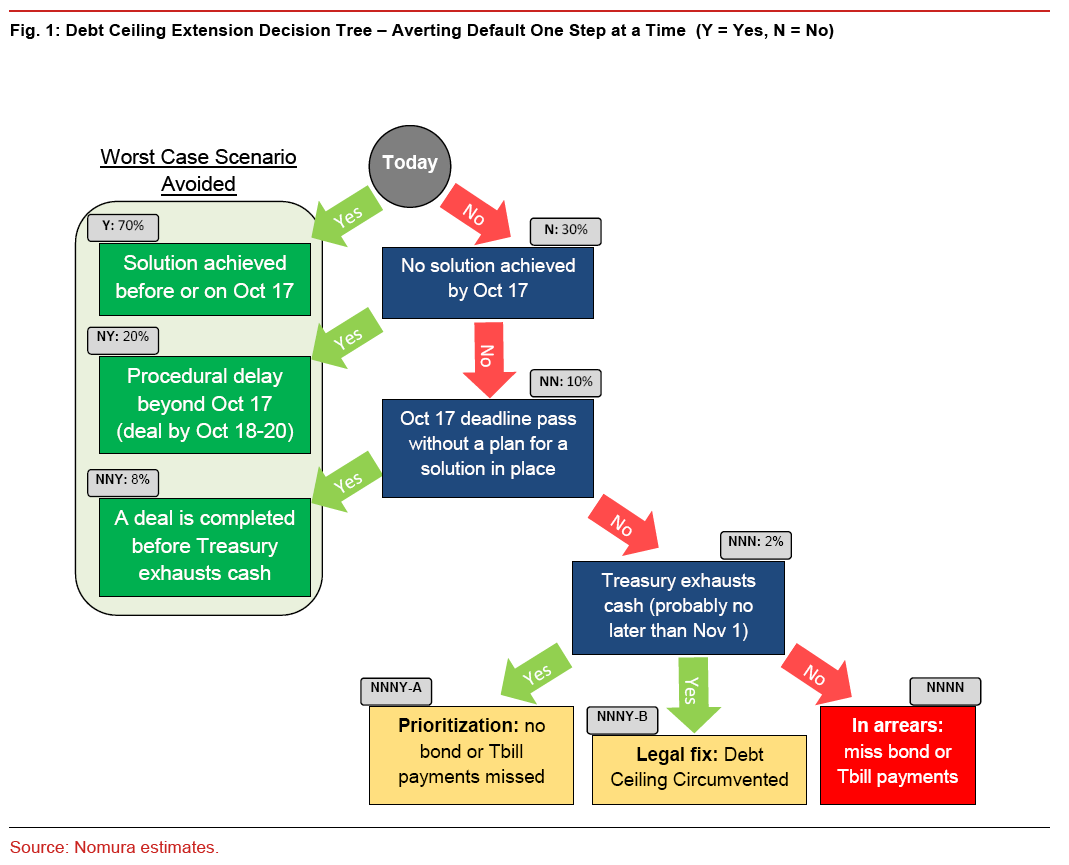
No final resolution seems likely before next week. Congress had been scheduled to leave for a weeklong recess after October 11, but this has been canceled. The House may vote on its short-term debt limit plan later today or tomorrow. Republicans hold 232 seats and 217 votes needed for a majority, so Republicans can lose only 15 votes from their own party and the vote tonight or tomorrow could be very close unless Democrats support the measure. The Senate is likely to vote on Saturday a different plan offered by Senate Majority Leader Reid (D) to suspend the debt limit through 2014. That procedural vote would require 60 affirmative votes to clear, meaning at least 6 Republicans would need to support it. If the House bill passes today or tomorrow, the Senate bill to extend the debt limit for one year looks unlikely to clear the 60-vote threshold necessary. If the House bill fails, however, the Senate approach could gain momentum. If the Senate’s one-year extension fails and the Senate takes up the House bill, the key question will be whether the Senate adds a “continuing resolution” to reopen the government. If this is added, the House would then have to vote once again on the modified version, but would presumably have to rely on more Democratic votes and less Republican votes than when the 6-week extension comes up for a vote in the House tonight or tomorrow. In our view, the developments over the last day reduce the probability of “tail risk” scenarios that would result from going far past the deadline, but there is still a good chance that Congress will run up to the deadline before reaching a final resolution and there is a clear possibility that final resolution might not be reached until shortly after October 17.
Raising the debt ceiling prevents default or the need for sudden and drastic austerity cuts to fund debt repayments but it increases the chances of short term economic damage as the shutdown has a potential six week extension. Moreover, it also increases the chances of a deal involving greater fiscal drag next year. The shutdown is knocking 0.1% off GDP per week just in public spending (and probably double that through multipliers) so another few weeks will be very serious for an economy barely growing at 2%.
There was more bad data too, suggesting the damage bill is climbing. The weekly Unemployment Insurance Claims Report, which is collected by the states, rocketed in part on the shutdown:
In the week ending October 5, the advance figure for seasonally adjusted initial claims was 374,000, an increase of 66,000 from the previous week’s unrevised figure of 308,000. The 4-week moving average was 325,000, an increase of 20,000 from the previous week’s unrevised average of 305,000.
It’s no wonder that FOMC member James Bullard was out declaring that:
“Monetary policy has to go on, regardless of the data available,” he said, citing regular discussions with business leaders that gave “a good sense” of the state of the economy.
…The official, a voting member of the Federal Open Market Committee, said the budget crisis “changed the odds” about a decision to trim the stimulus efforts at the upcoming Fed gathering on Oct.29-30, though emphasized it remained a “live” meeting.
Mr. Bullard said it was “imperative” to secure a debt and budget deal to preserve the international financial standing of the U.S..
His last growth forecast in September baked in some potential impact from a shutdown and budget impasse, and Mr. Bullard played down the immediate effects of a closure now in its 10th day.
Even with a quick resolution, taper is awfff until next year.
