
As the shutdown rolls on, so too do the ripples. Stocks rallied Friday after default fears subsided when Republicans indicated they would not push negotiations so far and Treasuries sold off with yields up almost 1%. The US dollar also jumped but the Aussie held its gains. But longer term implications are mounting. From the FT:
As efforts to conclude trade deals with the European Union and 12 Pacific Rim nations suffered a big blow as a result of its government shutdown, with US trade officials cancelling next week’s round of talks in Brussels and Barack Obama scrapping a trip to meet Asian leaders.
Mike Froman, US trade representative, called Karel De Gucht, EU trade commissioner, on Friday to tell him that the shutdown would “prevent” his office from “proceeding” with the second round of talks.
“He noted that financial and staffing constraints related to the shutdown make it impossible to send a full team of negotiators; USTR will work with the [European] Commission to craft an alternative work plan that can begin once the US government shutdown ends,” a USTR spokeswoman said.
The cancellation of the trip also undercut the Obama administration’s ambition to promote his “pivot” to Asia, a long-term strategic plan to cement American interests in the region and to push back against rising Chinese influence.
Mike Green, a former Asia director at the national security council, said the cancellation could have “consequential and lasting strategic implications” for the US in the region. “Our Chinese friends are spreading doubt around the region about our staying power,” he said.
I think we can put these in the hand-wringing category for now. More important are the implications for the Fed taper, which are becoming real. Calculated Risk quotes a mortgage broker:
We are still taking applications, locking rates, processing our little hearts out, and closing. Our principal problem: in the post-Bubble spasm authorities decided that ALL borrowers should produce two years’ tax returns (not just the few self-employed, or owners of rental property, or those needing investment income to qualify). And authorities decided that neither the borrowers nor their CPAs could be trusted to give us true copies, so we must pull transcripts from the IRS (the dreaded 4506T).The IRS is shut. When it re-opens it will have to process a backlog growing by the hour.
Are the authorities helping by waiving the transcript, or granting good faith safe harbor? NooOOOooo. Many lenders — to their great credit — seem willing to defer the risk to post-closing. However, home sales and closings will suffer soon, if only by expired rate locks.
Regular readers will know that I’m already of the view that the taper has been pushed out to next year on a weakening US economy via the slowing housing market so this may emerge as an exacerbating factor. On top of that the Fed faces growing practical data constraints for this year as well. From the WSJ:
“If this lasts for several more days” or weeks, Federal Reserve Bank of Atlanta President Dennis Lockhart said Thursday, “by the end of October we will still be looking at a very ambiguous situation.” “Less data is not helpful in gauging where the economy is and where it’s going,” said Mr. Lockhart, whose views often represent the emerging consensus at the central bank. “So that would tend to make me somewhat more cautious.” … Beyond the loss of economic data, the shutdown could also act as a drag on economic growth, Mr. Lockhart said. “It’s a little early to draw any conclusions,” Mr. Lockhart said. “If it’s protracted then I would expect that there would be some measurable impact at least on fourth-quarter growth.”
…A shutdown lasting more than a few weeks could also cause headaches for the October jobs report, due out Nov. 1, said Keith Hall, a former commissioner of the Bureau of Labor Statistics, which produces the jobs report. Government analysts are due to start the next survey of households in mid-October, muddying the data due to a delay in data collection.
Once the data does flow once more it unlikely to show the acceleration in fourth quarter growth required to trigger taper, even if much of the potential growth is only delayed as payments flow once it’s over.
The more lingering effects on growth will be from an outcome of increased austerity but no clearer yet. However, the context is, from the WSJ:
By using drastic tactics of threatening shutdowns and defaults, the tea party has shifted the terms of the debate on spending so much that the budget approved this year by the Senate Democrats (with no Republican support) actually calls for lower spending in 2014 than the “draconian” Republican budget proposed by Rep. Paul Ryan just two years ago.
Ryan’s 2012 budget plan called for discretionary spending of about $1.062 trillion (inflation-adjusted dollars) for fiscal 2014, while the Senate Democrats’ budget resolution calls for spending of $1.058 trillion.
And the continuing resolution approved last week by the Senate Democrats (with no Republican support) calls for spending of $986 billion, 18% lower than the funding level assumed in Obama’s 2010 budget submission.
Not so coincidentally, the House continuing resolution also calls for discretionary spending of $986 billion. In other words, the Democrats have fully agreed to the Republicans’ demands on government spending, even though the resulting fiscal drag has hobbled the recovery, costing millions of jobs.
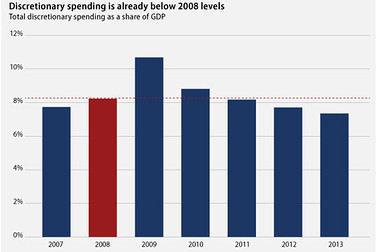
What the Tea Party Repblicans actually want in terms of lower spending is not terribly clear. The American media, at least, has taken as its symbol of this confusion one Rep. Marlin Stutzman, R-Ind., who mid last week announced that:
“We’re not going to be disrespected,…We have to get something out of this. And I don’t know what that even is.”
Others are aiming up at structural spending via the health care reform known as Obamacare, but:
Senior administration officials say Obama sees a vital principle at stake. Obamacare and the other policies that far-right House members want to change were debated in Congress and ratified by last year’s election. The president believes that it would weaken American democracy if one faction of one party of one house of Congress were allowed to impose its will through extortion. This spectacle of dysfunction will surely damage both sides politically. But Obama never has to face voters again. House Republicans are up for re-election in 13 months.
At this point, then, we appear to have a stalemate surrounding the Tea Party simply saving face. What that means for further austerity is anybody’s guess but it does not seem likely that Obama will give in again and the political costs for the Tea Party will soon become life-threatening. That raises the hope that any new “sequester” may be an innocuous bone which the Tea Party beat up for their supporters lest they disappear altogether.
Still, it’s becoming obvious that taper is a 2014 discussion and probably later rather than sooner. It’s no wonder that the Australian dollar held up on Friday.
