
A few weeks back I noted how retail landlords had been too aggressive in lifting rents at a time when sales for many discretionary retailers had tracked below the rate of inflation:
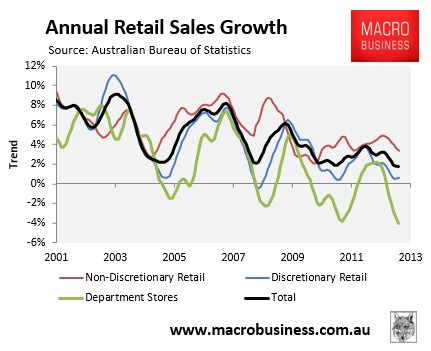
The cause of discretionary retail’s malaise are many. For example, there’s the “cautious consumer” – effectively the realisation that consumers won’t borrow and spend in the manner that they did prior to the Global Financial Crisis (GFC). There’s also the rise of internet shopping, and the increasing degree to which consumers buy goods from offshore.
Unfortunately for Australia’s discretionary retailers, their landlords have been slow to recognise these trends and have, for a number of years, lifted rents well above sales growth. This has squeezed retail margins, putting the sector under even greater strain.
Today, pressure from rising rents has combined with high labour costs to force the closure of another retail chain: adventure wear retailer Snowgum. From the SMH:
Rising rents and wages, stagnant sales and steep discounting from competitor Kathmandu are to blame for the collapse of adventurewear retailer Snowgum, managing director Ross Elliott says…
‘‘A large number of Snowgum retail stores are in high-rent shopping centres, all of which increase their rents by 5 per cent or more each year under their five-plus year rental agreements, during a period where sales in discretionary retail have declined in Australia,’’ Mr Elliott said.
‘‘On top of the rent increases, wages have increased substantially in Australia over the past 10 years to the point where a Sunday award casual employee now costs the business over $40 per hour to employ.
He said Snowgum would have been ‘‘okay’’ if sales had kept growing, but turnover slumped in 2008 during the global financial crisis and ‘‘sales have never really recovered’’…
The retail sector has been hit with a wave of collapses since the global financial crisis, especially in fashion…
As noted last time, there are strong reasons to believe that discretionary retail sales growth will remain soft in the years ahead, which will continue to pressure rents.
In particular, the strong growth in retail sales over the 1990s and 2000s was driven by the inexorable rise in household debt and the run-down of household savings. However, household debt levels stabilised from 2006, whereas household savings rates have returned to long-run historical norms. This suggests that sales can only grow in line with disposable incomes going forward, which is likely to be at a subdued rate as the once-in-a-century terms-of-trade boom unwinds.
With the retail industry likely to experience only subdued sales growth in the decade ahead, landlords will need to lower their asking rents, or expect more retailers to fold.
