
The AFR has reported today that Tony Abbott has emerged from talks with regional leaders at the East Asian Summit in Brunei to declare that Australia’s free trade agreements (FTAs) with China, Japan and Korea must be be concluded within 12 months:
“In the case of the China agreement, that has been meandering along since 2005, so it is very important that we . . . bring it to a conclusion.
“The Japan and Korea free-trade agreements have been similarly in train but unresolved . . . let’s give ourselves 12 months to bring these agreements to a satisfactory conclusion”…
“If we have more trade we have more jobs, and if we continue to have strategic stability in our region we will have more trade . . . jobs for Australians, that’s what these meetings are all about,” Mr Abbott said.
Putting a 12 month deadline on negotiations in a poor negotiating tool, since it signals to our partners that we are desperate to close a deal and are willing to scarifice quality for a fast agreement. Indeed, as H&H argued the other day and Robert Gottliebsen follows with today, such an approach “risk[s] seeing the other side wait until close to the deadline and then the pressure is on Australia to make commitments to meet it that it would not otherwise agree to. And no one is better than the Chinese in sensing and exploiting that negotiating weakness”.
The AFR’s article also highlights why meaningful bilateral agreements are unlikely to be done, with Australia steadfastly refusing to knock-down barriers to automotive imports and the North Asian economies refusing to budge on agriculture – Australia’s key priority:
Australia and Japan have been in negotiations over an FTA since 2006, but Japan’s refusal to budge on agriculture and Australia’s refusal to drop its 5 per cent tariff on imported Japanese cars have proved sticking points.
Australia and South Korea have been in negotiations since 2008, again with sensitivities around Australian agricultural exports and Korea’s insistence on investor state dispute resolution clauses.
As explained earlier this week, there are reasons to be skeptical of bilateral FTAs, which can actually reduce welfare.
First, when barriers, such as tariffs, are reduced to one party (or a small number of parties), but maintained to the rest of the world, it risks creating “trade diversion” – effectively a situation whereby the importing country shifts its buying from a more efficient, lower cost country whose goods are subject to a tariff towards the less efficient and higher cost FTA partner whose goods are not subject to a tariff. In such circumstances, the importing country loses the tariff revenue, whilst its consumers do not fully benefit from a price reduction, potentially making them worse-off.
Another cost associated with FTAs is the complex rules of origin (ROO) that are typically attached to such agreements, which can raise administrative costs for businesses (including complying with paperwork requirements) and custom services in administering and auditing the ROO, undermining the benefits from the FTA.
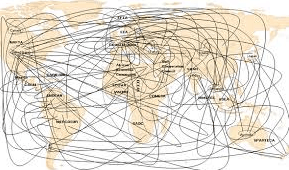
The costs associated with ROOs will be greatest where there is a large number of FTAs each with different requirements, resulting in a “spaghetti bowl effect” of increasing complexity.
In my view, the Government’s view of trade barriers as being merely negotiating coins that can be traded-off in exchange for other nations dropping theirs is misplaced. Trade barriers, like tariffs and quotas, impose real costs on the domestic economy, both to consumers in the form of higher prices and to productivity overall by reducing competitive pressures.
Reducing one’s own trade barriers, therefore, not only improves outcomes for consumers via lower prices, but also increases competitive pressures on domestic industry, helping to spur greater innovation and productivity in order to survive.
The Government should be viewing Australian trade policy and trade liberalisation more in this light – as a form of domestic competition policy, rather than something that can be traded away for a bunch of questionable bilateral deals with spurious efficiency impacts.
unconventionaleconomist@hotmail.com
