

Macquarie has released research today forecasting that the Australian economy is about to enter an expansion phase, bu0yed by the “wealth effect” from rising asset prices:
With a trough in our leading indicator in February, we think Australia is likely in the early stages of an expansion (or soon will be). While falling mining investment will be a larger headwind than in past cycles; we think the RBA could still cut rates further to stimulate home building. This should also lead to a lower currency, which is positive for trade exposed sectors.
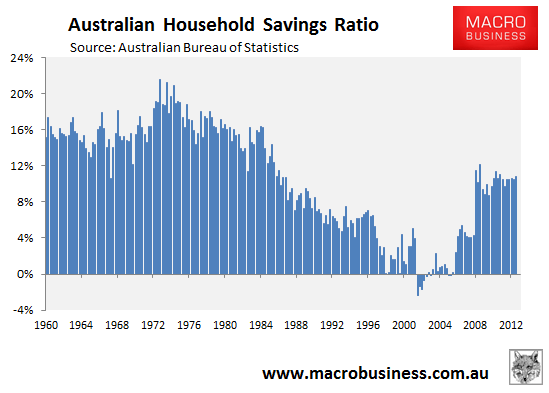
We think a positive wealth effect driven by rises in equity and house prices will be a growing tailwind for growth from late 2013. The savings rate should also fall as rising wealth boosts consumers‟ “passive savings”.
Macquarie’s leading indicator for the Australian economy is provided below, and does indeed suggest a pick-up in activity:
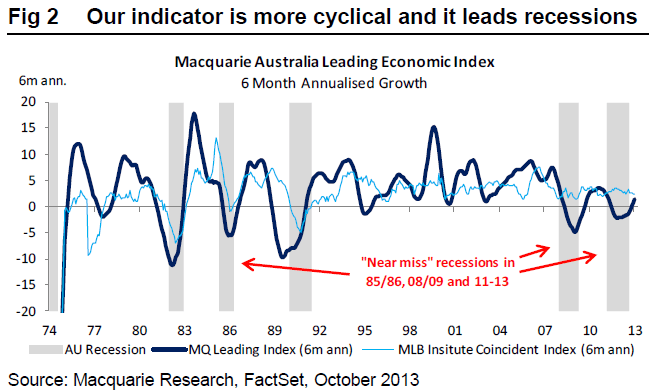
According to Macquarie, its leading indicator comprises the unweighted average of the following six components:
- All ordinaries index;
- Yield curve;
- Housing Finance and Building Approvals;
- Commercial Lending
- ANZ Job Ads; and
- Australian Dollar Commodity Prices.
While the above components may well be important for gauging economic performance, it begers belief that Macquarie’s leading index does not include what is arguably by far the biggest headwind to growth: the expected unwinding of the massive mining capex boom (see next chart).
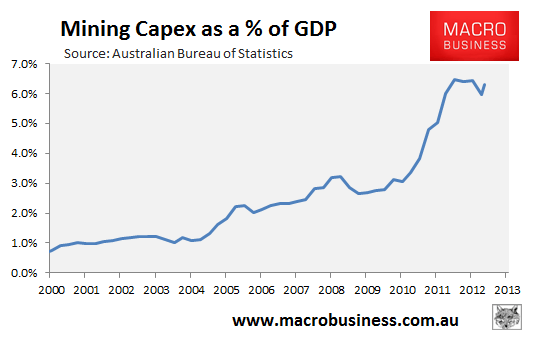
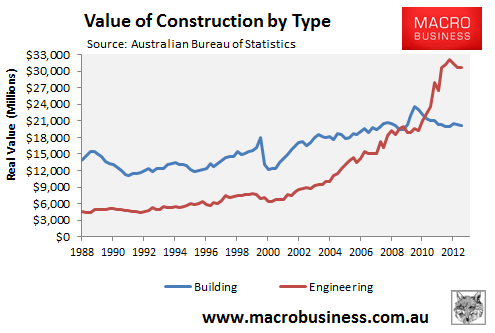
As shown in the next chart, mining-related capex (represented by engineering construction below) dwarfs building construction (both residential and non-residential), making it extremely unlikely that home building can pick-up the void left as the mining capex boom unwinds.
This leaves increased consumption spending brought about the “wealth effect” from rising asset prices to back-fill growth. However, it’s difficult to see consumers dramatically reducing their savings rates (see next chart) in the face of both a weakening labour market and slower income growth as the once-in-a-century terms-of-trade boom unwinds.
In short, while Australia may experience a short-lived cyclical bounce, it is likely to be over-run as the unwinding of the mining capex boom gathers pace.
unconventionaleconomist@hotmail.com
