Westpac’s busted Leading Index continues to lead the media echo chamber into a cul de sac:
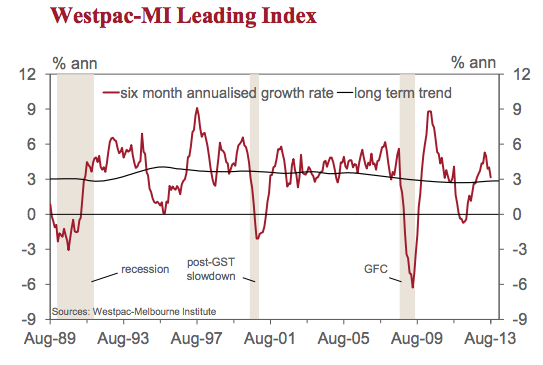
The annualised growth rate of the Westpac Melbourne Institute Leading Index, which indicates the likely pace of economic activity three to nine months into the future, was 3.2% in August, marginally above its long term trend of 2.9%. The annualised growth rate of the Coincident Index, which gives a pulse of current activity, was 2.4%, below its long term trend of 2.9%.
The economy has experienced a significant loss of momentum since the start of the year. Although the growth rate in the leading index remains slightly above trend, it has slowed abruptly over the last six months.
This trend in the growth rate of the leading index is more in line with Westpac’s forecasts for growth in 2013 and 2014. Some months ago the index was pointing to significantly above trend growth in 2013 but this current slowdown is more consistent with Westpac’s growth forecasts. Westpac expects growth of 2.5% in 2013 and 2.3% in 2014.
The growth rate in the Leading Index has fallen from 4.4% in March to 3.2% in August. Six of the eight components have contributed to the slowdown, including: overtime worked (–0.3ppts); productivity (–0.3ppts); US industrial production (–0.3ppts); the All Ordinaries Index (–0.2ppts); manufacturing materials prices (–0.1ppt); and the real money supply (–0.1ppt).
This was partially offset by a more positive contribution from dwelling approvals (+0.1ppts) with no change in the contribution from corporate gross operating surplus.
The Leading Index fell 0.3pts (–0.1%) in August from 294.8 to 294.5. Half of the four monthly components rose and half fell: the All Ordinaries and US industrial production rose 1.6% and 0.4% respectively; the real money supply and dwelling approvals fell 0.6% and 4.7% respectively. Quarterly components were mixed in the June quarter, overtime improving but manufacturing materials prices and the corporate profits down and productivity flat. Looking ahead, overtime worked fell back sharply in the September quarter. Commodity prices have also declined and company profits are likely to have come under significant downward pressure.
The Coincident Index, which provides a gauge of current conditions, rose 0.5pts in August from 280.6 to 281.1. The Index has been growing at a sub-trend pace for most of the last year with the annualised growth rate below its long run average of 2.9% in ten of the last twelve months. The August month saw real retail sales rise 0.2% but labour market conditions softened with a 0.1% fall in employment and the unemployment rate rising to 5.8%. Some of that weakness reversed in September.
As you can see, the Coincident Index has done a much better job of “leading” growth in the past few years. I expect this to continue.
David Llewellyn-Smith is Chief Strategist at the MB Fund and MB Super. David is the founding publisher and editor of MacroBusiness and was the founding publisher and global economy editor of The Diplomat, the Asia Pacific's leading geo-politics and economics portal.
He is also a former gold trader and economic commentator at The Sydney Morning Herald, The Age, the ABC and Business Spectator. He is the co-author of The Great Crash of 2008 with Ross Garnaut and was the editor of the second Garnaut Climate Change Review.