

The Australian’s David Uren has posted a ripper article today quoting various analysts on why non-mining investment is highly unlikely to fill the void left as mining investment unwinds from record high levels:
Either there will be a fall in the exchange rate sufficient to restore competitiveness or there will be a redoubled effort by business to take out labour costs. Either way, the Reserve Bank’s hoped-for revival in non-mining investment is unlikely to come soon…
In Australia’s manufacturing and tourism sectors investment has not been enough to cover depreciation… Investment in manufacturing has fallen from 2.5 per cent of GDP to 1.5 per cent since the financial crisis…
While risk aversion and uncertainty are part of the problem, a fundamental lack of competitiveness explains much of the weakness in Australian non-resource investment…
The real exchange rate, taking account of Australia’s generally higher inflation and lower productivity growth than that of trading partners, is 45 per cent above its post-float average. It is lack of competitiveness that leads firms to invest less than their depreciation…
Melbourne University’s Ross Garnaut has been underlining just what an enormous barrier the real exchange rate presents, highlighting that a 16 per cent rise following the vastly more modest 1974 resources boom was sufficient to bring growth crashing to a halt once the resource peak passed. Net exports across the entire range of non-resource industries have been in steep decline.
…When NAB asks what is the biggest factor constraining output, 60 per cent of businesses respond that it is lack of sales…
Goldman’s Toohey says it is hard to see where the impetus that will lift the non-mining sector will come from. It is not going to be from a fiscal injection, with commonwealth and state governments determined to rein in their budget deficits…
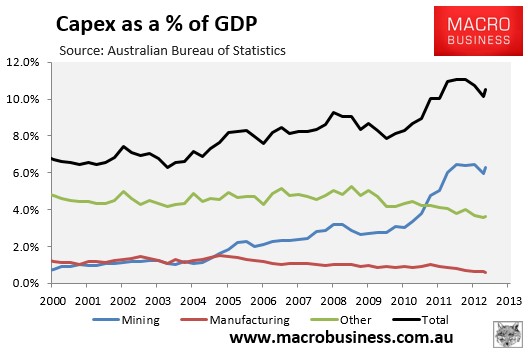
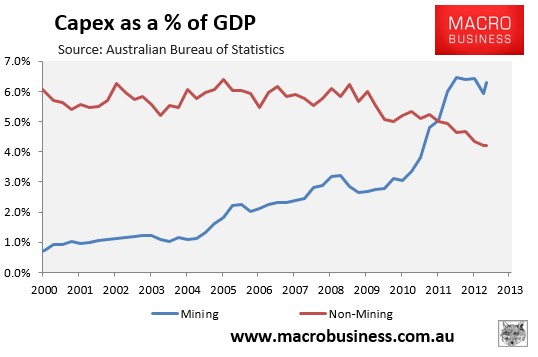
The near impossibility of non-mining investment rebounding sufficiently to offset falling mining investment is illustrated clearly by the below charts.
First, mining-related capital expenditures (capex) are 50% larger than non-mining capex, meaning that for every 10% fall in mining capex, the non-mining sectors must grow by around 15% for total capex to remain the same (see below charts).
ABS construction data tells a similar story, with engineering construction (mostly mining-related) also 50% larger than total building construction (both residential and non-residential) and 150% bigger than residential construction (the great hope for rebalancing):
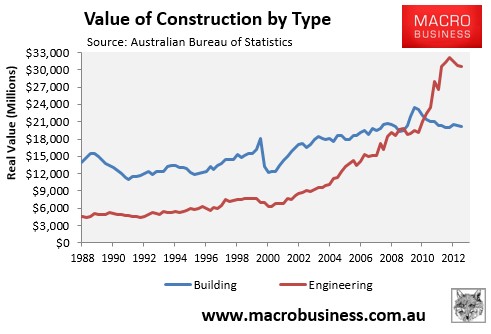
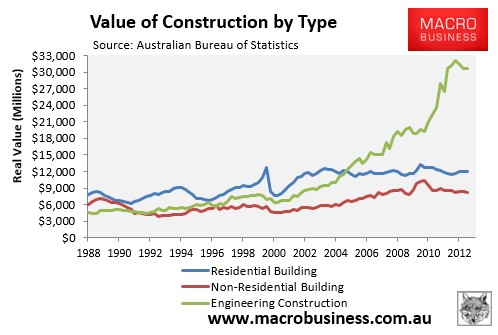
Put simply, the hope that non-mining construction can fill the mining capex hole remains a pipe-dream. Growth and employment are going to take a significant hit as the RBA’s hopes for rebalancing are forlorn.
Indeed, it is difficult to argue that the Australia economy has not become far too reliant on mining-led growth. In addition to the strong reliance on mining-related capex, Australia’s exports have also become heavily weighted toward a narrow base of commodities. As illustrated below, Australia’s four biggest exports – iron ore, coal, natural gas, and coal – have more than doubled their export share over the past decade, partly supporting the notion that exports from non-mining related industries have languished:
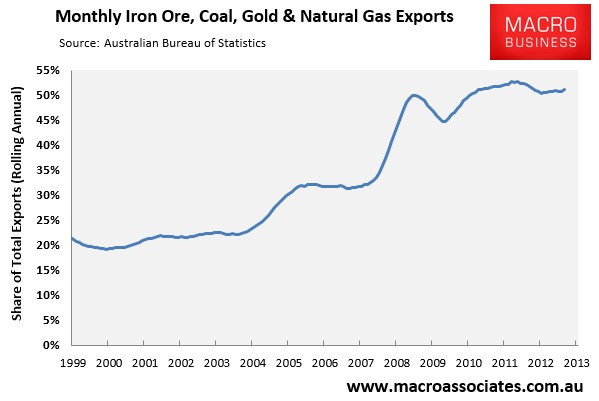
The key problem, as articulated by Professor Ross Garnaut (amongst others), is that Australia’s non-mining economy has become uncompetitive, held back by a high Australian dollar, inflated land prices, an expensive currency, amongst other things. And with domestic demand growth likely to remain sluggish as the 30-year credit boom unwinds, the population ages, and the labour market/income growth softens, the spare capacity that is plaguing the non-mining economy will remain, preventing further investment.
It is a problem that can only be solved via a broad-based program of micro-economic (structural) reforms aimed at knocking-down barriers to competition, improving productivity and innovation, in addition to targeting a lower currency via macro-prudential controls on higher risk lending. Only by lowering the nation’s cost of production, and improving competitiveness, can Australia hope to re-boot external demand for the non-mining economy and soak-up the surplus capacity across the economy.
Continuing to simply lower interest rates in the hope of boosting demand will not cut it. The Australian economy’s problems are mostly structural, not cyclical.
unconventionaleconomist@hotmail.com
