

The Assistant Federal Treasurer, Arthur Sinodinos, has today posted an article in The Australian urging a new round of reform aimed at boosting competition and improving resource allocation across the economy:
The best way to stimulate global growth is determined efforts to promote freer trade linked with domestic action to ease barriers to competition, flexibility and the reallocation of resources to higher value activities…
Our capacity to communicate with influence [to our trading partners] will be enhanced by progress in efforts to reform the structure of our economy and make it more flexible. This puts us in better shape to compete and sends a signal that we are not asking others to make changes that we are not willing to embrace ourselves.
Sinodinos’ focus on competitiveness and rellocating factors of production to their highest value use is a good one, and will be key in improving innovation, productivity, and ultimately Australia’s living standards. It is also the sort of approach that one would expect from a Liberal Government, which espouses the benefits of free markets and economic opportunity.
Unfortunately for Sinodinos, his approach seems to differ from that of his boss, Treasurer Joe Hockey, who as explained yesterday seems intent on entrenching Australia’s high land cost structure via his endorsement of a housing quango, whereby the various levels of government work to inflate land/house prices by pumping demand and choking supply:
“A lot of commentators, particularly over here [the US], don’t understand the Australian housing market. The fact is, we have a very generous immigration program. And we have very slow supply coming in to the market. Now rising house prices in Australia help to make some of the more marginal new housing developments affordable and realistic and deliverable. And in turn, that increase in supply helps to manage the market. So, Australia is a long way from a bubble… So it’s a very different asset class in Australia than in other jurisdictions”.
As noted yesterday, land is a key input cost for most businesses. So when costs are inflated, it reduces the competitiveness of industry, making it harder for Australia to compete abroad.
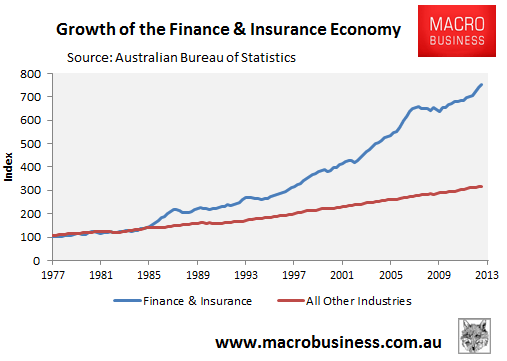
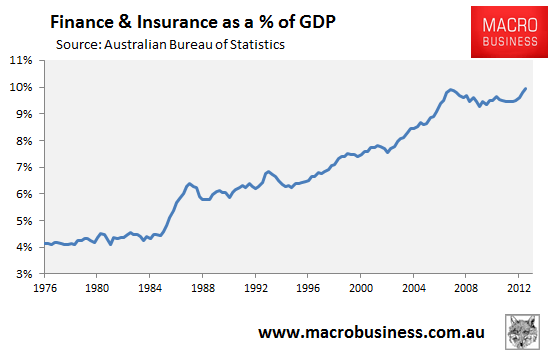
Resource allocation is also skewed away from the tradable sector towards the financial sector, as home buyers are required to take on ever-bigger mortgages as they chase prices higher. It should be no surprise that the finance and insurance industries – which are dominated by mortgage lending – have grown at more than twice the pace of the rest of the economy since financial markets were deregulated in the mid-1980s, due in part to the housing quango operated by the various levels of government (see below charts).
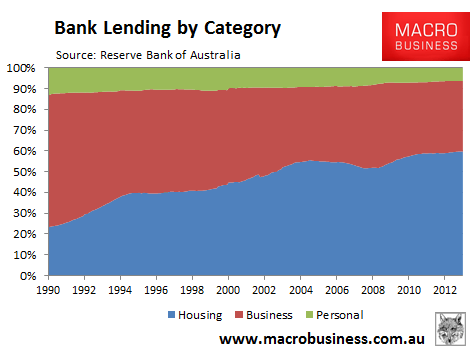
To add insult to injury, the housing quango is arguably starving the productive sectors of the economy of credit. In the early 1990s, Australia’s banks lent nearly two-thirds to businesses, with the balance split between housing and personal lending. However, after the mid-1990s explosion of housing values, these ratios have reversed, with housing lending dominating at the expense of businesses (see next chart).
Hockey appeared again last night in New York to declare to the Australian American Association that Australia is open for business:
Mr Hockey also flagged workplace relations laws, another hot issue for business, will be reviewed over time.
“We will look at adjustments to workplace relations laws to help business to grow, create new jobs and deliver high real wage growth while maintaining Australia’s strong and enforceable safety net for workers,” Mr Hockey said.
On fiscal policy, the Treasurer said the government needed a realistic time frame to return the budget to surplus. He plans to publish the Mid-Year Economic and Fiscal Outlook before Christmas.
“This will reveal the true updated state of the books and will establish the budgetary base on which we can build a sustainable future,” Mr Hockey said.
…“The challenge is to remove the impediments to private sector investment in infrastructure,” Mr Hockey said.
“So in the Australian context, the government will consult with the finance sector and key stakeholders, including the state governments, to investigate alternative financing options which will encourage further private sector involvement.
The problem is Joe Hockey hasn’t had any of his projects appropriately assessed for their productivity benefits. Open for business looks more and more like a fig for the same old rent-seeker economy in which sectional interests like housing and construction get a free pass. If the Coalition were serious about boosting productivity and improving resource allocation, open for business would mean open markets.
