

HSBC’s chief economist for Australia, Paul Bloxham, has today released a note arguing that Australian economic rebalancing is broadening, and the the economy is in the early stages of an upswing led by non-mining sectors:
Australia’s economic growth is showing more signs of rebalancing. Not only are low interest rates lifting the housing market, but timely industry-based surveys have shown recent improvement in the manufacturing, construction and the services sectors. The lift in yesterday’s inflation numbers also suggests that demand is rising, relative to supply in the economy. With the help of more stable conditions in Asia and steady and high commodity prices, Australia’s economy does appear to be in the early stages of an upswing, led by non-mining sectors and supported by a ramp up in resource exports.
For quite some time now we have been writing about Australia’s great rebalancing act… As we first set out late last year, with mining investment reaching its peak, Australia needed to see the other parts of the economy take over as drivers of growth. Importantly, this task was always likely to be less daunting than many other economies ‘rebalancing acts’ because, as we argued, it is growth that needs to rebalance, not the whole economy. Australia’s economy does not have huge imbalances, in our view, it just that growth had been uneven in recent years due to the massive run-up in mining investment.
Nonetheless, Australia’s rebalancing of growth has been quite gradual and there was particular nervousness about it around the middle of the year. The more gradual rebalancing than expected appears to have reflected a number of factors.
First, was the high level of the AUD. Despite falling commodity prices through last year and a local growth slowdown (GDP growth was +3.7% in 2012 and we expect it to be +2.5% this year) the AUD stayed stubbornly high. While it did fall quite sharply from April this year (from around US105 cents troughing at US89 cents in August) and was helped along by the Federal Reserve’s expected tapering, September’s non-taper and better Asian data recently have seen it climb again in recent weeks (back to around US96 cents).
Second, was political uncertainty. In the lead up to the Federal election, on September 7, there was significant uncertainty about the post-election tax and regulatory environment. Businesses appeared unwilling to make significant hiring and investment decisions. The labour market numbers show us that while hours worked had been rising – a sign of improving demand – firms had been meeting this demand by ramping up average hours worked, not taking on new employees. Employment growth has been weak, but hours worked in the economy have been rising solidly.
But recent timely surveys of consumer and business sentiment, as well as industry-based surveys, suggest a marked change in sentiment in the post-election period. Broad-based business confidence was at its highest level since 2010 in September and consumer confidence has also bounced in recent months. The various purchasing manager’s indices for construction, manufacturing and services all bounced in September. Surveys of investment intentions amongst manufacturers have also shown improvement recently.
Of course, the housing market has also responded to very low interest rates. Housing prices have risen by around 6% over the past year and are up almost 10% from their trough last year. Timely indicators of auction market activity suggest these trends are likely to continue. As we recently noted (see third link below), Australia appears to be at the beginning of a housing price boom – a typical sign that an economic upswing is on the way.
Even yesterday’s inflation numbers provide some support for the idea that demand is lifting. The modest lift we have seen in the underlying measures of inflation in the past couple of quarters is a sign that demand is starting to lift relative to supply.
The question is: will this lift in conditions be sustained? We see a number of reasons to think it will and one big reason to worry. The positives include: mortgage rates are around 40 year lows and are getting traction in the housing market; the equity market continues to be buoyant, lifting household wealth; and the change of government appears to have been well-received by the business community.
The bugbear in this story is the AUD. At its current level the AUD is uncomfortably high, and as the RBA Governor quixotically noted last week, he would ‘prefer it to be lower than this, rather than higher’. Clearly a lower AUD would help to facilitate further the rebalancing of growth. It would support the tourism industry, help to make manufacturers more competitive and encourage more local spending, rather than internet purchases from foreign lands.
However, it does appear that the RBA has become less concerned about the level of the AUD than they were around mid-year. This is partly because the higher AUD is being matched by improved conditions in Australia’s major Asian trading partners. Yesterday’s inflation print, which showed that underlying inflation is around the middle of the target band in the past six months, would also leave the RBA thinking that a significantly lower AUD may not even be as desirable as they previously thought – given that it would imply higher inflation.
Given the importance of the AUD to the story, this leaves us watching the Federal Reserve – much like the rest of the world! Earlier tapering could put some downward pressure on the AUD and help facilitate further rebalancing, later tapering and that rebalancing may continue to be gradual.
Overall, though, with local monetary policy gaining traction, a housing boom beginning, surveys looking better, inflation lifting a little and the risks to growth starting to tilt to the upside, the hurdle for any further rate cuts is getting very high. Indeed, if the global and local economies evolve as we expect, the next RBA rate move could be up and would come in the second half of 2014.
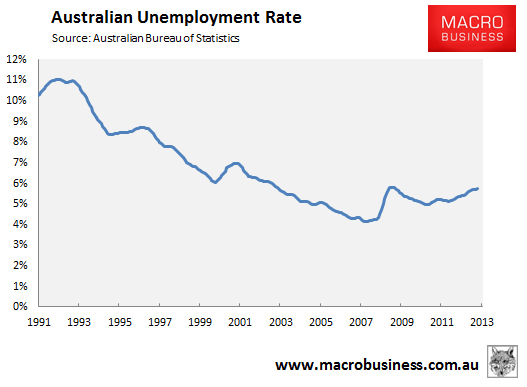
Sure, the economy is experiencing a mild cyclical upswing driven by cheap credit and rising asset prices, but the pick-up has been nowhere near enough to drive jobs growth above population growth, resulting in a steadily rising unemployment rate:
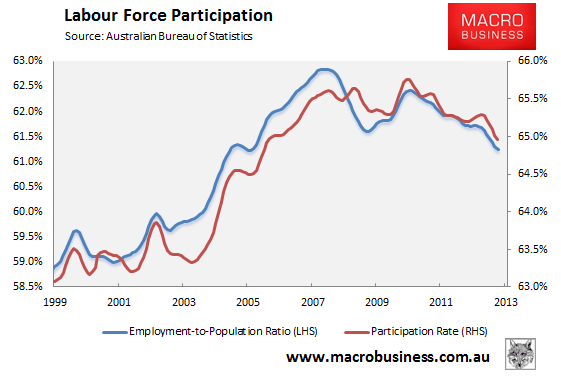
In spite of falling labour force participation:
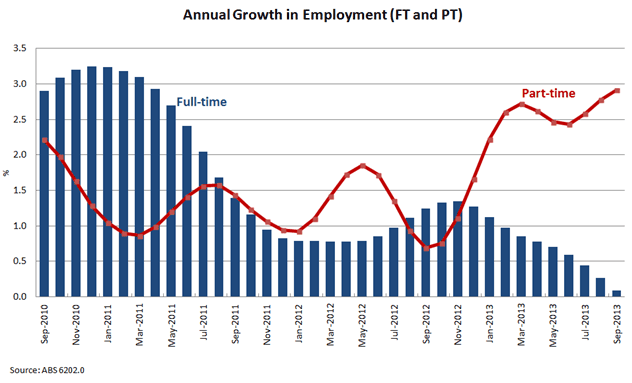
With virtually all of the recent jobs growth part-time:
And let’s not forget the huge mining investment cliff that is coming our way, which will place significant downward pressure on growth and jobs:
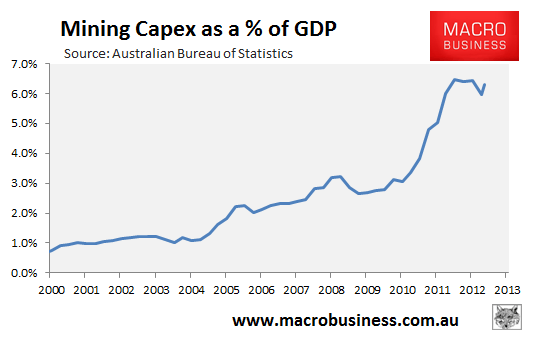
And as shown in the next chart, mining-related capex (represented by engineering construction below) dwarfs building construction (both residential and non-residential), making it extremely unlikely that home building can pick-up the void left as the mining capex boom unwinds.
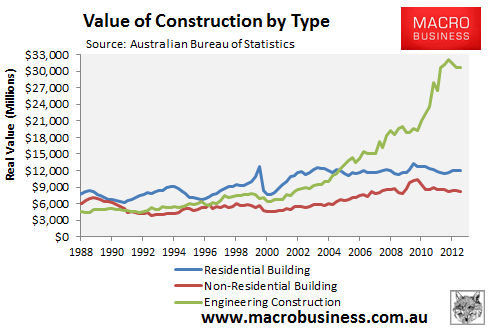
This leaves increased consumption spending brought about the “wealth effect” from rising asset prices to back-fill growth. However, it’s difficult to see consumers dramatically reducing their savings rates (see next chart) in the face of both a weakening labour market and slower income growth as the once-in-a-century terms-of-trade boom unwinds.
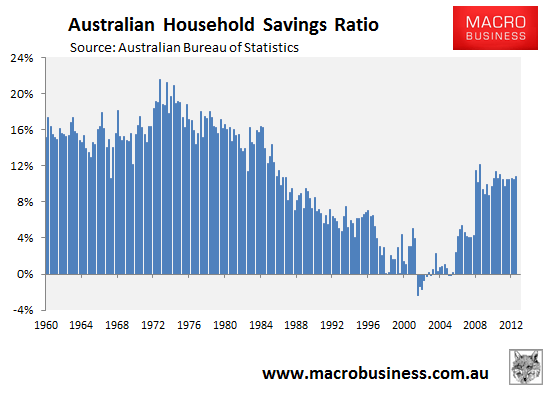
In short, while Australia may experience a short-lived cyclical bounce, it is likely to be over-run as the unwinding of the mining capex boom gathers pace.
Full HSBC report here.
unconventionaleconomist@hotmail.com
