

Business Spectator’s Stephen Bartholomeusz has a questionable article blaming former Treasurer, Wayne Swan, for running down the RBA’s capital base, whilst praising Treasurer Joe Hockey’s $8.8 billion capital injection:
The need for an injection, if one were needed, arose because the strength of the Australian dollar in the post-crisis period has had a significant impact on the Reserve Bank’s balance sheet and its reserve fund – its version of a capital base – in particular. The Reserve Bank holds very substantial interests in foreign securities and the fund had fallen from nearly $7 billion to less than $2 billion as a result of its currency losses…
Earlier this year, in an appearance before a parliamentary committee, Stevens revealed that the RBA had asked Swan not to take a dividend from the bank last year so that it could start rebuilding its reserves.
Indeed, correspondence between the RBA and the Treasurer that emerged subsequently made it plain that the bank was extremely concerned about its reserves level and had made it very clear that it didn’t want to pay any of its earnings out as a dividend.
Instead Swan, who was still trying desperately to maintain some level of fiscal credibility and the unrealistic aspiration for a budget surplus, insisted the bank pay nearly half its $1.1 billion profit over to the Commonwealth.
Hockey, in one action, has recapitalised the RBA, whereas it could well have taken years to get the reserve fund back to levels the RBA felt were prudent.
As noted by Michael Pascoe yesterday, governor Glenn Stevens stated that the RBA was happy to build-up its capital over time and did not ask for the capital injection:
“The high exchange rate has also had a significant impact on the Reserve Bank’s own balance sheet. It led to a decline in the value of the Bank’s foreign assets and hence a diminution in the Bank’s capital, to a level well below that judged by the Reserve Bank Board to be prudent. This has been a topic of some interest of late. Our annual reports have made quite clear over several years now that, while this rundown in capital in the face of a very large valuation loss was exactly what such reserves were designed for, we considered it prudent to rebuild the capital at the earliest opportunity. It has been clear that the Bank saw a strong case not to pay a dividend to the Commonwealth during this period, preferring instead to retain earnings, so far as possible, to increase the Bank’s capital. That rebuilding could in fact have taken quite a few years, given the low level of earnings.
“That is the background to the recent decision by the Treasurer to act to strengthen the Bank’s balance sheet, in accordance with a commitment he made prior to the election. The effect of this is that instead of it taking many years to rebuild the capital, it will occur in the current year. This results in a stronger balance sheet on average, and makes it likely that a regular flow of dividends to the Commonwealth can be resumed at a much earlier date than would otherwise have been the case.”
Indeed, it is hard to view Hockey’s move as anything other than an opportunistic political play, whereby he could inflate “Labor’s” deficit to $40 billion this year and then claim fiscal superiority as the dividends flow back into the budget in subsequent years.
It is also hard to believe that Bartholomeusz can blame the running down of RBA capital on Wayne Swan, given that dividend withdrawals were far bigger under the former Howard-Costello Coalition Government, with the former Labor Government receiving no dividend at all in 2011-12 (see next chart).
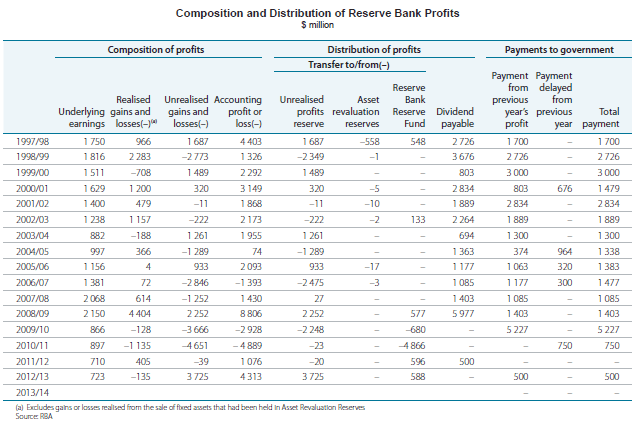
Moreover, as noted by Stephen Koukoulas, had the Howard-Costello Government withdrawn dividends from the RBA at a similar average rate to Swan (i.e. $1.5 billion a year rather than an average of $2 billion a year), then RBA’s capital base would now be healthy and no capital injection by Hockey would have been required.
Finally, maybe we should all question why the RBA has a reserve fund at all, given that it has the power to create money out of thin air in times of crisis, and is free of the liquidity and solvency issues that affect private banks and other financial institutions? Is it there to genuinely provide support in times of crisis, or so the RBA/Government can use taxpayers’ dollars to punt on the currency?
unconventionaleconomist@hotmail.com
