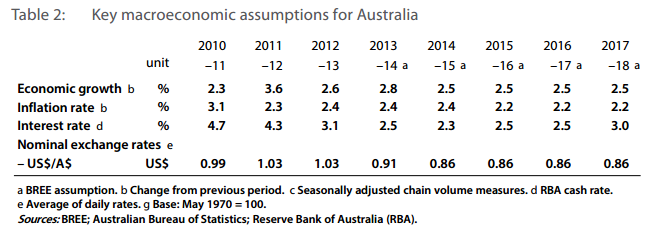
One government agency has told the truth finally about Australia’s growth prospects. As I reported yesterday, the new and improved Bureau of Resource Economics (BREE) yesterday released it’s quarterly update and one dimension of the report that I didn’t look at was its forecasts for the Australian economy:
Based on Australian Bureau of Statistics data, Australia’s GDP grew 0.6 per cent in the June quarter 2013 and 2.6 per cent over the financial year 2012–13. This growth in GDP was below the long term average and 0.3 percentage points lower than in 2011–12. It is assumed that economic growth will rebound slightly in 2013–14 to 2.8 per cent, primarily as a result of low interest rates stimulating housing construction and consumption expenditure. Although the minutes from the Reserve Bank of Australia’s (RBA) September board meeting indicate that there is potential for further interest rate cuts, the risk that this may generate unsustainable asset prices in the Australian real estate sector may limit the effectiveness and use of low interest rates to stimulate economic growth over the medium term.
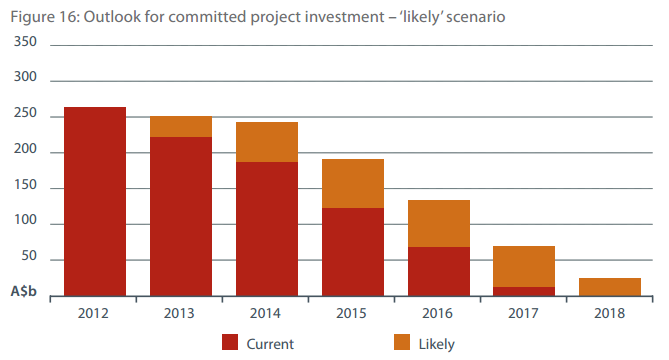
Lower interest rates have yet to translate into increased capital expenditure in Australia which was 2.3 per cent lower, year-on-year, in the June quarter 2013 reflecting the trend of declining non-mining capital expenditure. As noted in BREE’s Resources and Energy Major Projects Report – April 2013, capital expenditure in the mining sector is also now likely to have peaked due to a substantial draw back in the rate of high value projects over the past twelve months.
While there still remain several very large projects under construction, as these are completed over the next three to four years, there are few projects of equal value scheduled to offset the decline in mining capital expenditure. Over the medium term BREE assumes Australia’s GDP growth will moderate to 2.5 per cent from 2014–15. Proposed government spending on infrastructure, increased housing construction and a rise in mineral exports are expected to partially offset the decline in mining capital expenditure.
The Australian dollar has depreciated against the US dollar over the past four months due to speculation over the US QE3 program, the RBA’s decision to cut the official cash rate 25 basis points and concerns over growth in China. The exchange rate has dropped from as high as US 105c in January to around US 91c in September 2013. For this outlook the Australian dollar is assumed to average US 91c in 2013–14, 11 per cent lower than 2012–13. Over the outlook period, the tapering of QE3, declining terms of trade and lower relative interest rates are expected to lead to the value of the Australian dollar declining further. An average exchange rate of US 86c is assumed from 2014–15 for this report. However, a more rapid recovery in the US economy, a longer period of low interest rates in Australia and more rapid decline in the terms of trade could result in a lower exchange rate.
This is very sensible stuff by BREE and don’t forget that of all the agencies it is best positioned to track the mining capex cliff. It’s last estimate was pretty scary:
Advertisement
One wonders what it next update will look like. The latest RBA forecasts are for 3% next year then accelerating to 2¾ –4¼ in 2015. Treasury is similar. Good luck with that!
Growth at 2.5% will see unemployment rise continuously for the next four years by around 0.5 per annum. Prepare accordingly.
David Llewellyn-Smith is Chief Strategist at the MB Fund and MB Super. David is the founding publisher and editor of MacroBusiness and was the founding publisher and global economy editor of The Diplomat, the Asia Pacific's leading geo-politics and economics portal.
He is also a former gold trader and economic commentator at The Sydney Morning Herald, The Age, the ABC and Business Spectator. He is the co-author of The Great Crash of 2008 with Ross Garnaut and was the editor of the second Garnaut Climate Change Review.