

The New South Wales Government has revealed a surprise surplus of $239 million for 2012-13, despite forecasting a deficit of $374m on June 18. The result was driven, in part, by a big surge in stamp duty receipts on the back of Sydney’s booming housing market, which came in nearly $200 million higher than expected. Other factors contributing to the turnaround were a $123 million payment brought forward by the Federal Government and $215m from the sale of Port Botany and Port Kembla.
But the result all states will be watching is the resurgence of stamp duty receipts:
The brightest result, which will be watched by other states, is that there was a significant improvement in revenue, including stamp duty collections, which was $198m higher than forecast.
The Sydney property market has been buoyant since interest rates dropped, and the state government makes money on every transaction, benefiting from both more volume and higher prices.
The final result represents a dramatic turnaround from the original forecast in last year’s budget of a $824m deficit…
[Treasurer, Mike Baird] said economic conditions remained soft and there was ongoing pressure on revenues, particularly GST payments. “There is plenty of work to do before the state is on a path to a sustainable surplus position.”
Indeed, as shown by the next chart, which plots New South Wales housing transfers versus stamp duty receipts, transaction volumes have picked-up just as prices have accelerated, resulting in a huge revenue windfall for the state:
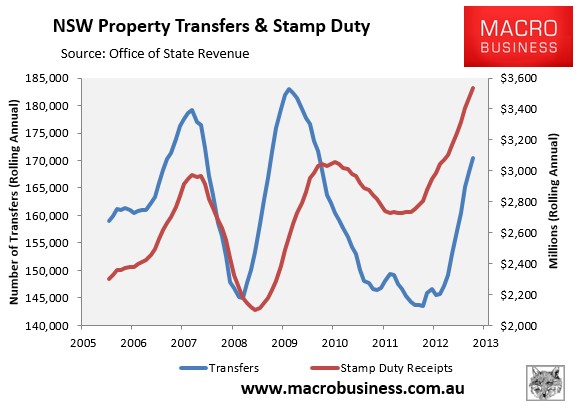
Note also the extreme volatility in stamp duty revenues, which is one reason why I push so hard for broad-based land taxes as a replacement.
unconventionaleconomist@hotmail.com
