

A few weeks back, Treasurer Joe Hockey cheered-on rising housing prices, arguing that they were necessary to lift dwelling construction:
…rising house prices in Australia help to make some of the more marginal new housing developments affordable and realistic and deliverable. And in turn, that increase in supply helps to manage the market…
It’s a view that has also been expressed by the Reserve Bank of Australia (RBA), which has frequently argued that rising house prices are necessary to rebalance the economy away from mining-led growth, in part by lifting dwelling construction so that it replaces the void left as the mining investment boom fades.
Over the past year, we at MacroBusiness have argued that there is next to no chance that dwelling construction could rise anywhere near enough to replace mining investment for two main reasons.
First, mining investment (represented by engineering construction below) is currently 50% bigger than total building construction and some 150% larger than residential construction (see below charts).
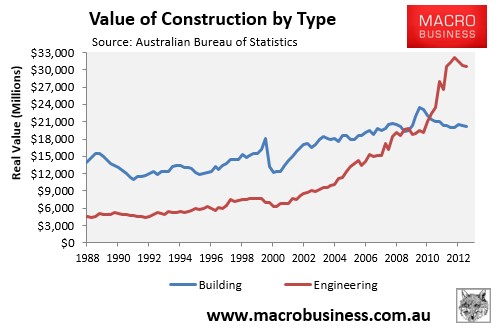
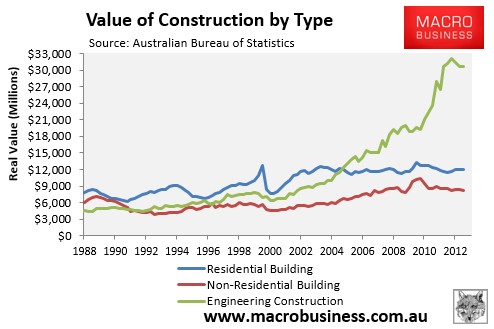
The sheer size difference means that for every 10% decline in mining investment, dwelling investment would need to rise by around 25% for construction activity to remain unchanged: a highly improbable proposition.
Second, rebalancing is made more difficult by urban consolidation policies adopted by Australia’s governments, including: inadequate land release; cumbersome planning systems; high levels of taxation on new development; and inadequate infrastructure funding and provision. Such policies have made it next to impossible for the building industry to supply what the market wants at an affordable price, all but guaranteeing that the construction response to higher prices will be lacklustre.
Indeed, the ANZ Bank seems to share our concerns, today arguing that Australia is likely to experience the weakest cyclical upturn in housing construction in the past 30 years. From the AFR:
Australian property prices will surge by more than two times average wages between now and the end of 2015…
ANZ property analysts said the market would rise by as much as 20 per cent.
Unlike previous house price booms, the coming gains may not repeat the past by translating into rapid construction growth, according to the analysts…
Despite an unprecedented shortage of physical housing stock . . . and an expected 15 to 20 per cent lift in home prices over the next 2½ years, we are likely to experience the most modest cyclical upturn in housing construction in the past 30 years,” ANZ analysts led by David Cannington said.
They blame rising vacancy rates and “growing valuation risks in some markets” for the likely slowing in the apartment growth.
“In addition, the issues that have plagued the industry in recent years largely remain in place,” they said, listing approvals red tape, excessive developer costs, and shortages of land, infrastructure and tradespeople.
As shown by the next chart, the rate of dwelling construction relative to population growth fell to its lowest rate on record at the end of 2012, with detached houses bearing the brunt of the decline (see below charts).
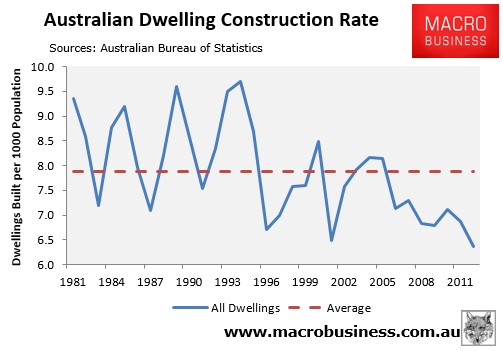
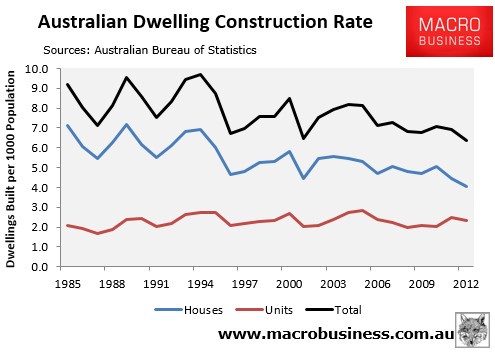
And while dwelling approvals, new home finance, and new home sales data suggests construction has picked-up through the year, it looks like an insurmountable task just to get the rate of dwelling construction back to 30-year average levels, let alone deliver a construction boom.
As argued repeatedly, further cuts to interest rates alone won’t get construction moving, and the solution instead lies in fundamental supply-side reform that tackles each of the bottlenecks alluded to above. Until governments tackle reform, the hopes of Australia successfully rebalancing away from mining-led growth will be forlorn.
unconventionaleconomist@hotmail.com
