
From Crikey:
As part of its campaign against the carbon price in 2011, the Coalition dramatically warned about carbon cops that were going to enforce the Gillard government’s draconian Clean Energy Acts and how Australian businesses would be “gagged” by the ACCC from telling customers they had to raise prices because of the carbon tax, under threat of fines of $1.1 million.
The tone of the Coalition’s attacks in 2011 bordered on hysterical. “The Gillard government’s plan to use the Australian Competition and Consumer Commission to gag small businesses from informing consumers of price increases due to the carbon tax is a further attack on the struggling sector,” then-opposition spokesman Bruce Billson lamented.
Now the cop is on the other beat, as it were:
…Environment Minister Greg Hunt’s carbon price repeal bill, released yesterday as an exposure draft, repeats the Howard government’s approach and re-establishes within the Competition and Consumer Act the extra GST-era power to pursue price exploitation, under which not merely is it an offence to “make a false or misleading representation … concerning the effect of the carbon tax repeal” but it becomes an offence to “engage in price exploitation in relation to the carbon tax repeal” — which is selling gas, power or other identified goods for an “unreasonably high” price.
The ACCC is specifically empowered by the bill to monitor prices for the purposes of pursuing price exploitation, including forcing companies to provide information about their internal activities. It can also hand out infringement notices (i.e. the equivalent of speeding tickets) to companies for price exploitation, and if they’re not paid, take them to court to face fines of up to $1.7 million (that’s the current equivalent of the old $1.1 million fine, after Commonwealth penalty units went up this year) or just over $1.1 million for breaching the “false and misleading” sections.
Regular readers will know that I hold no truck with rent-seekers. So, the usual hypocrisy aside, in theory I have no issue with pricing police in a sector dominated by large and capital intensive monopolies. The ACCC’s subsidiary, the Australian Energy Regulator (AER), regulates wholesale, transmission and some retail markets in the eastern states’ National Energy Market (NEM) so it is well placed to prevent abuses.
But as I said this morning, given the wholesale power sector is about to be smacked with “Direct Action”, which will cost it much more in the pursuit of emissions reductions than the carbon price would have, is it appropriate for the guv’ment to force discounts? Moreover, the wholesale electricity market is the one part of the electricity sector that is considered competitive, using a spot market bidding process that updates every five minutes. How is that going to be policed?
Our Tony may want to placate punters over the cost of living and he has certainly managed to tip that anger towards the carbon price. But in truth nether the carbon price nor the wholesalers are responsible. The vast bulk of price rises has come from the transmission networks which have been busy “gold plating” upgrades. The chart from the Productivity Commission breaking down price rises over the past six years says it all:
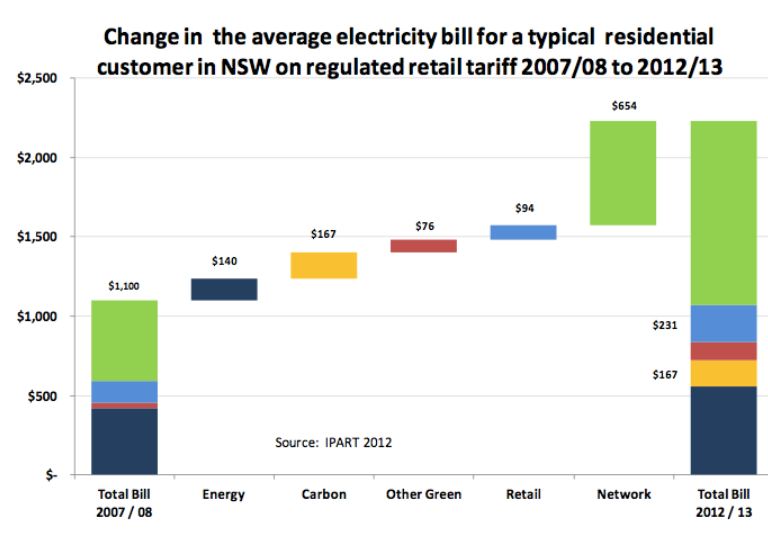
It seems ‘open for business’ also means crunching the wrong businesses margins for political benefit.
