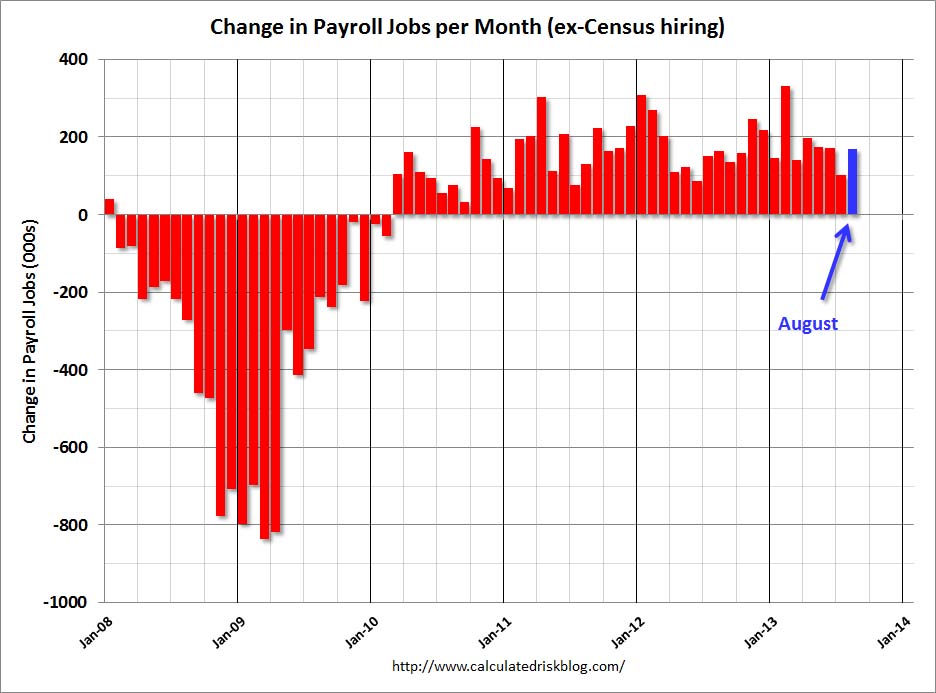
The US jobs report Friday night was solid enough at first glance coming in at consensus. However, under the hood there was significant weakness with big downward revision to past releases. Chart from Calculated Risk:
Total nonfarm payroll employment increased by 169,000 in August, and the unemployment rate was little changed at 7.3 percent, the U.S. Bureau of Labor Statistics reported today. ……The change in total nonfarm payroll employment for June was revised from +188,000 to +172,000, and the change for July was revised from +162,000 to +104,000. With these revisions, employment gains in June and July combined were 74,000 less than previously reported.
Merrill sums up the risks:
Perhaps the strongest case for tapering is reduced downside risks. The economy has weathered a fairly big fiscal shock—by our estimates, more than 2% of GDP—with just two bad quarters—0.1% growth in 4Q and 1.1% growth in 1Q. Moreover, stripping out inventories and trade—the two wildcards of GDP accounting—final sales to domestic purchasers follow a similar pattern, bottoming in 1Q, when the tax and spending shock hit. Unfortunately, when Congress returns from its summer siesta on September 9, three major policy risks loom: Syria, the 2014 budget and the debt ceiling. We don’t expect a major shock to the economy, but the Fed will not be sure when it meets September 17-18.
This has once again thrown up doubts about the timing of the “taper”. Two Fed presidents spoke Friday. From the FT:
Advertisement
“For me, to start the wind-down, it will be best to have confidence that the incoming data show that economic growth gained traction during the third quarter of this year and that the transitory factors that we think have held down inflation really do turn out to be transitory, said Charles Evans, president of the Chicago Fed, in a speech on Friday morning.
Mr Evans, a voting member of the FOMC this year, is regarded as a monetary policy dove. He said the Fed should buy at least $1.25tn in assets between January 2013 and the end of its third round of quantitative easing. That is more consistent with a first tapering of asset purchases in December.
But Kansas City Fed president Esther George said it would make sense to taper purchases from $85bn to $70bn in September and split buying evenly between Treasury and mortgage-backed securities. It currently buys $45bn of Treasuries and $40bn of MBS each month.
Friday’s mixed jobs report left Federal Reserve officials facing a cliffhanger decision in less than two weeks.
Fed officials want to start scaling back their $85 billion-per-month bond-buying program this year and could take a small step in that direction at their policy meeting Sept. 17-18. But the economic data in recent months have been ambiguous and new threats to the economy and markets loom, which could prompt officials to wait longer before acting.
…Many Fed officials want to start reducing their bond purchases to acknowledge the decline in unemployment, but they are also cautious because other labor market measures show persistent weakness — such as the falling share of Americans holding or seeking jobs. Another reason for caution is that the economy isn’t clearly on the stronger growth path they have been projecting for months.
“I’m going to go in [to the meeting] with an open mind. I can be persuaded” about the best path, Federal Reserve Bank of Chicago President Charles Evans told reporters in Greenville, S.C. Friday.
…One option that has gained support among some Fed officials in recent weeks: Reduce their monthly bond purchases by a small amount, say $10 billion to $75 billion, and signal as loudly as possible the next step will depend on more evidence the job market is continuing to improve and inflation is moving back toward 2% from its current low levels.
Advertisement
Goldman agrees:
“While the August employment report was a moderate disappointment, we believe it is probably not weak enough to prevent the FOMC from tapering in September. However, it does raise the likelihood of a “dovish taper,” which could include a small size of the overall adjustment to purchases, and which we think would likely coincide with an enhancement of the forward guidance. The continued decline in the participation rate further highlights the justification for maintaining the fed funds rate at an exceptionally low level even after unemployment reaches 6.5%.”
Pimco as well, though has paid a high price for being very wrong on this of late:
“I think Bernanke and company are committed to a taper,” Gross, co-founder of Pacific Investment Management Co., said today in a radio interview on “Bloomberg Surveillance” with Tom Keene. “It will be taper lite as opposed to a strong tapering.”
Advertisement
Markets were all over the place. Moves suggesting the taper is on delivered weak stocks and bonds. Moves suggesting the taper is off included a big fall in the US dollar and big jump in gold. Though the latter no doubt caught an updraft in sympathy with oil from rising Syrian bombing tensions.
It’s really a toss of the coin if the Fed will go ahead. It can’t control everything and shouldn’t try. But if it waits it doesn’t really matter. Unless US housing stalls in the next few months (it’s more of the 2014 story), the Fed discussion will keep the heat on. That means investors should be looking at the trends, not the volatility. These remain clear: weakening stocks and bonds, a strengthening US dollar, as well as pressure on EMs and commodity currencies.
David Llewellyn-Smith is Chief Strategist at the MB Fund and MB Super. David is the founding publisher and editor of MacroBusiness and was the founding publisher and global economy editor of The Diplomat, the Asia Pacific's leading geo-politics and economics portal.
He is also a former gold trader and economic commentator at The Sydney Morning Herald, The Age, the ABC and Business Spectator. He is the co-author of The Great Crash of 2008 with Ross Garnaut and was the editor of the second Garnaut Climate Change Review.