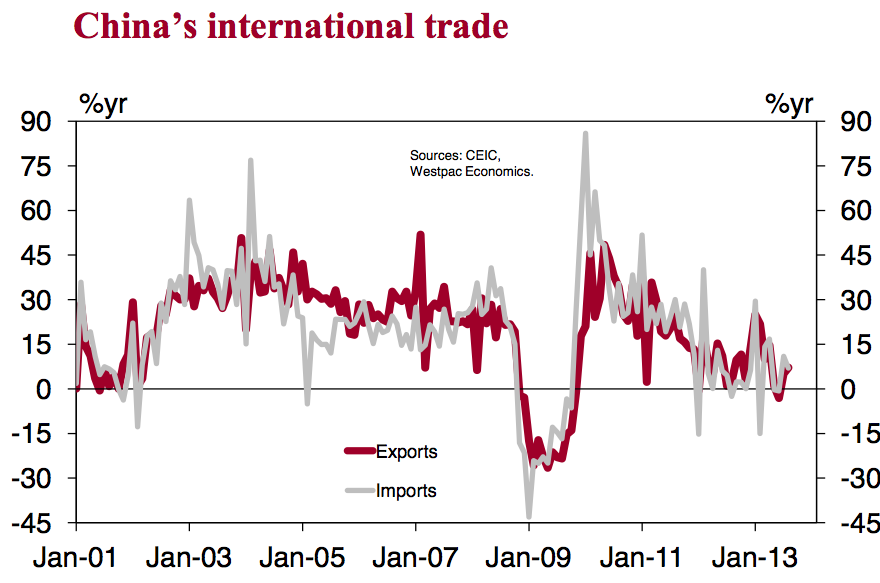
The trade balance widened to $US28.5bn in August from $US17.8bn in July, on the back of an acceleration in exports (7.2%yr from 5.1%yr previously) and a slowing of imports (7.0%yr from 10.9% in July). A year ago, imports contracted in August and exports were barely growing.All in all, this report describes a reasonable showing from the external sector. Exports to Europe rose in year-on-year terms for the second straight month; shipments within Asia (ex India and Japan) are looking sound; while non-European advanced markets (US-CA-AU-NZ) are all providing growth.
On the import side, imports from commodity producing countries are edging higher (with Indonesia and Russia two exceptions), while processing trade with the NIEs and the ASEAN remained subdued. Imports from the EU slowed from 8.4%yr to 5.1%, with Germany alone a little softer than that. In the resources space, seasonally adjusted iron ore imports had another strong month, as imported supply continues to gain market share. In fact, August raw imports were the second highest figure for the year, at a time when seasonal demand tends to be very light, thus producing a very striking seasonally adjusted observation. Even so, year-ended growth in iron ore imports slowed from 26.4% to 10.5%yr, reflecting the highly flattering base effect applied in July. The unit value of iron ore imports was steady versus July at around US118/t. Crude oil imports also slowed in year-on-year terms, from 19.6%yr in July to 16.5%yr in August.
David Llewellyn-Smith is Chief Strategist at the MB Fund and MB Super. David is the founding publisher and editor of MacroBusiness and was the founding publisher and global economy editor of The Diplomat, the Asia Pacific's leading geo-politics and economics portal.
He is also a former gold trader and economic commentator at The Sydney Morning Herald, The Age, the ABC and Business Spectator. He is the co-author of The Great Crash of 2008 with Ross Garnaut and was the editor of the second Garnaut Climate Change Review.