Credit Suisse has recent note asking this useful question:
Assumption: ASEAN+India are having a crisis. Judging from their balance of payments and FX reserves, we believe that this is more of a confidence crisis rather than something out of 1997, but do not rule out a much bigger crisis if policy responses are missing or inadequate.
(1) Market confidence is interrelated. Whatever happens in the south will affect the confidence of H shares and A shares. We suspect H shares are affected more as foreign exposure to A shares is rather limited.
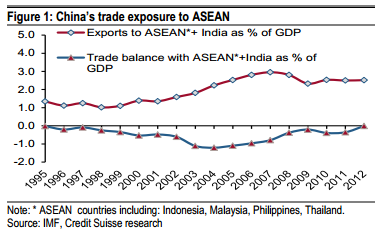
(2) Material impact to trade but not a disaster. China is a net deficit country for current account with ASEAN. But the trade deficit narrowed significantly last year, thus the impact might be more than perceived. Weakened orders from ASEAN would hurt China’s export performance, as exports to ASEAN and India count for 8.1% of China’s total exports. With the exception of selected capital goods (e.g., telecom equipment), the bulk of China’s exports are staple goods, less sensitive to a cyclical downturn, but which would be affected in case of a crisis. Meanwhile, a betterthan-expected order flows from the US could partially offset the deceleration from ASEAN.
(3) That may accelerate capital outflows. China recorded a second consecutive month of negative growth in banks forex purchase positions, and this is likely to continue. We imagine that the authorities will make outflows through the official channels more difficult, but there is plenty of leakage through other channels. Further, we may see unwinding of short-term debt and carry trades. We do not believe that capital outflows pose a threat to China’s balance of payments given the size of FX reserves.
(4) It drains domestic liquidity. Increase of FX reserves has been the single biggest source of domestic liquidity generation. This adds further stress to the banking system, following the dramatic rise in SHIBOR in June.
(5) This increases the chance of stimulus. The leaders in Beijing are getting nervous about an EM crisis, as the memory of the Asian crisis is vivid. They need to “play safe” in both reform and growth. We still think the scale of stimulus will be limited based on current external and domestic conditions. A cut in RRR looks more likely within the coming months. This would (1) neutralise the drain in liquidity, (2) help the liquidity situation for banks and local governments, and (3) boost domestic confidence.
(6) Implications to growth rate should be limited. Beijing is using fiscal tools to balance out growth. So slower exports would mean a little bit more public spending, in either consumption subsidies (preferred by the Li administration) or infrastructure investment (conducted by Wen administration in 2009).
In short, China would react exactly as it did in 1997, with the added complication in doing so it would further worsen it debt issues and risk its own crisis down the track.
David Llewellyn-Smith is Chief Strategist at the MB Fund and MB Super. David is the founding publisher and editor of MacroBusiness and was the founding publisher and global economy editor of The Diplomat, the Asia Pacific's leading geo-politics and economics portal.
He is also a former gold trader and economic commentator at The Sydney Morning Herald, The Age, the ABC and Business Spectator. He is the co-author of The Great Crash of 2008 with Ross Garnaut and was the editor of the second Garnaut Climate Change Review.