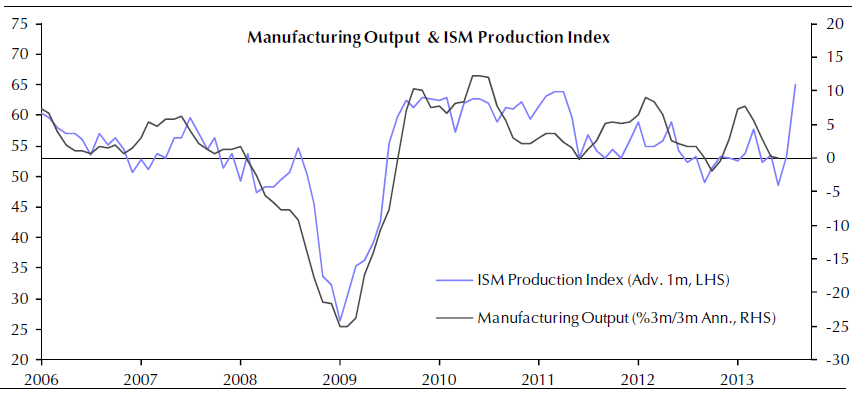
From Capital Economics this morning comes a nice assessment of last night’s out-of-the-box US ISM:
The entire surge in the ISM manufacturing index to a two-year high of 55.4 in July, from 50.9, was due to an improvement in domestic activity. This new level is consistent with a further acceleration in third quarter GDP growth and should strengthen the Fed resolve to begin tapering its asset purchases in September.
The jump in the ISM index left it well above the consensus and our own forecast of a rise to 52.0. Looking at the breakdown, the improvement was broad based. The production index surged to a nine-year high of 65.0, from 53.4. Although, at face value, this is consistent with manufacturing output growth rebounding to around 10% annualised, we doubt it will be that strong. (See Chart.)
The new orders index also rose in July, to a two-year high of 58.3, from 51.9 in June, suggesting further improvement in the domestic environment. Thankfully, the employment index rebounded and is now pointing to gains in manufacturing payrolls of around 10,000 a month. We are sticking to our forecast of a 200,000 rise in total payrolls in July. (Official payrolls data to be released tomorrow.)
Meanwhile, if it wasn’t for the modest decline in the inventories index (to 47.0 from 50.5), the headline index would have risen further. July’s international survey evidence was also patchy, with the Chinese manufacturing activity weakening, while the eurozone emerging from recession. This was apparent in the slight drop back in the ISM new export orders index to 53.5, from 54.5 in June.
Overall, a very positive report, with the headline index now consistent with a further pick-up in annualised GDP growth to more than 2.5% in the third quarter, leaving the Fed on course to scale back its monthly asset purchases at the next FOMC meeting.
I’ve got tell you I might have this one wrong. This is an extraordinary jump and Septaper is entirely appropriate if it’s backed up with good employment numbers.
The bogeyman of bond yields roared back with yields on the 30 year and 10 year jumping 3.5%to new highs but so they should on data like this.
David Llewellyn-Smith is Chief Strategist at the MB Fund and MB Super. David is the founding publisher and editor of MacroBusiness and was the founding publisher and global economy editor of The Diplomat, the Asia Pacific's leading geo-politics and economics portal.
He is also a former gold trader and economic commentator at The Sydney Morning Herald, The Age, the ABC and Business Spectator. He is the co-author of The Great Crash of 2008 with Ross Garnaut and was the editor of the second Garnaut Climate Change Review.