Yesterday’s 2% stock market rout shows what is likely in store if the US Fed goes head with its Septaper. The excellent Tim Duy at Fed Watch is getting pretty hawkish about the prospect:
…we see the comments of Chicago Federal Reserve President and noted dove Charles Evans. Again, via the Wall Street Journal:
During a breakfast briefing with reporters Mr. Evans said, “I clearly would not rule that out,” when asked if the Fed might begin throttling back on its asset purchases at theFederal Reserve‘s Sept. 17-18 policy meeting….
…The Fed is “quite likely to reduce the flow purchase rate starting later this year,” Mr. Evans said. “I couldn’t tell you exactly which month that will be.”
Hence why we can’t take September off the table. If Evans thinks it is possible, then it must be very possible, despite only another month’s data between now and then.
Both appear to find the 7% mark significant:
“Considering the cumulative improvement in economic conditions since September 2012, Our asset purchases likely will end with the unemployment rate somewhere in the range of 7%,” Mr. Evans said, adding he expects this to happen sometime in 2014.
and
Mr. Lockhart said he expects the unemployment rate to fall to 7% in mid-2014.
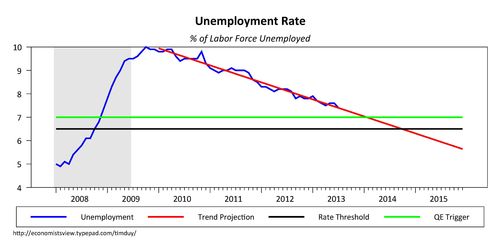
This I don’t understand unless they expect labor force participation to surge. We have six months left in 2013 to reduce the unemployment rate by 0.4 percentage points. Less than a percentage point a month:
7% just doesn’t seem like a high bar to cross by then end of 2013. Evans also highlights an argument to begin tapering sooner than later:
“Markets have begun to digest a world in which asset purchases are finite,” he said. He added that just because purchases might be scaled back, that doesn’t mean the Fed will raise interest rates, in fact, he said he sees rates remaining unchanged as long as inflation in kept in check, which could push unemployment below 7%.
The initial shock of tapering is behind us, giving the Fed more room to actually initiate the tapering. Tapering is the first step on the path to normalizing policy. The second step is making sure everyone is focused back on interest rates:
“Once we cross 6.5% [unemployment] we would be more closely monitoring” the information that informs the Fed funds rate, he said….
…“Suppose inflation were 1.5%. That’s much too low for our 2% target. Further accommodation would be called for,” he said, adding that he could even envision unemployment rates dropping “below 6% in certain environments.”
The more they believe they can hold rates in check even if they begin to tapering, then the more likely that tapering will be.
Bottom Line: I think the Fed very much wants to taper in September, and hence why I am wary to believe we need to see some significant acceleration in the data to push them in that direction.
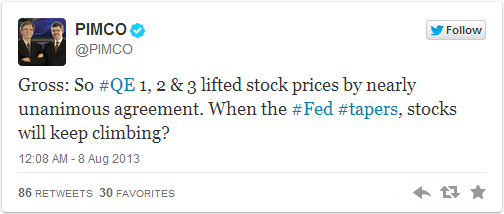
Meanwhile, Bill Gross, the bond king, sums up the argument succinctly on Twitter:
Yet last night, the weekly MBA mortgage applications were out and stopped falling for the first time in two months:
Mortgage applications increased 0.2 percent from one week earlier, according to data from the Mortgage Bankers Association’s (MBA) Weekly Mortgage Applications Survey for the week ending August 2, 2013. …The Refinance Index was unchanged from the previous week. The seasonally adjusted Purchase Index increased 1 percent from one week earlier. …The average contract interest rate for 30-year fixed-rate mortgages with conforming loan balances ($417,500 or less) increased to 4.61 percent from 4.58 percent, with points increasing to 0.42 from 0.38 (including the origination fee) for 80 percent loan-to-value ratio (LTV) loans.
Also last night longer bond yields and the US dollar fell sharply.
There is still plenty of confusion in markets as the Fed’s liquidity filled boat sloshes back and forth.
David Llewellyn-Smith is Chief Strategist at the MB Fund and MB Super. David is the founding publisher and editor of MacroBusiness and was the founding publisher and global economy editor of The Diplomat, the Asia Pacific's leading geo-politics and economics portal.
He is also a former gold trader and economic commentator at The Sydney Morning Herald, The Age, the ABC and Business Spectator. He is the co-author of The Great Crash of 2008 with Ross Garnaut and was the editor of the second Garnaut Climate Change Review.