Deutsche has a note out today revisiting the question of whether houses or holes offer better share market prospects. It argues:
Is the pace of growth in China worsening, or getting better?
Last week’s HSBC PMI remained below 50, and dropped to an 11-month low. In contrast, this week’s official PMI was above 50, and rose to a 6-month high (after accounting for seasonality). Which one to believe? We opt to let the data guide us. Specifically, we look at what the PMIs tell us for future industrial production and commodity price growth. We find the official PMI (again, after accounting for seasonality) is the most informative. It provides a longer lead, and has a higher correlation with IP & metal price growth than the HSBC PMI. As a result, we are inclined to think Chinese momentum is incrementally improving, not worsening.
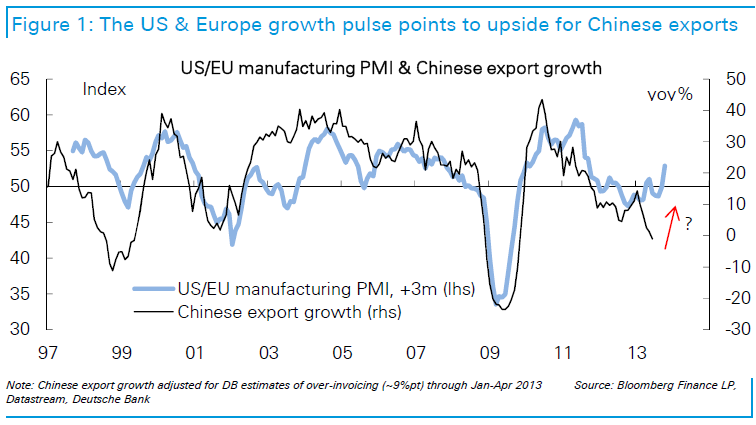
Export demand likely to return and support growth
China has reached its GDP growth target of 7½%, yet the market seems concerned that further slowing is in prospect. Yet this 7½% growth rate has been achieved despite lacklustre external demand, which may be close to turning. PMI surveys released this week point to a solid pick-up in US & European growth, and historical relationships would point to a substantial pickup in Chinese exports in 2H13.
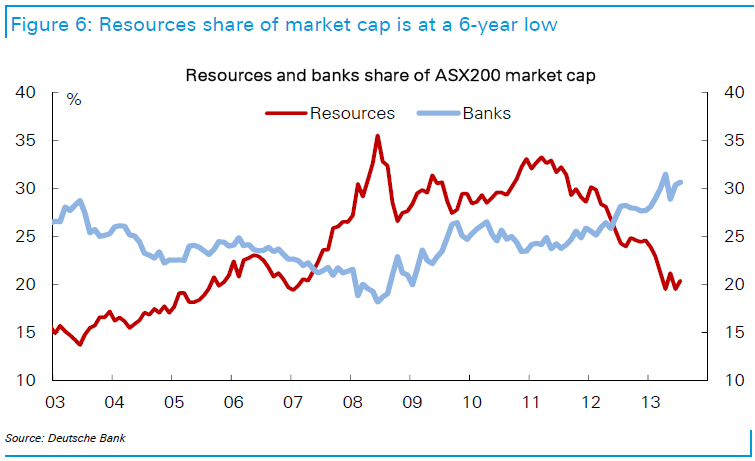
If China can stop slowing, valuations favour resources over banks
Resources account for just 20% of the Australian equity market, a 6-year low. Meanwhile, banks are at 30% of the market, a 10-year high. Bears may say that resources’ share of the market cap is appropriate, given China has slowed and the earnings super-cycle seems finished. But the earnings super-cycle for banks has finished too. Credit growth is less than one-third of the historic average rate, yet banks account for a record share of the market. Resources are cheaper than banks, a mark-to-market is neutral-to-positive for earnings, and the global growth pulse is improving. We retain our O/W resources, U/W banks view.
There a couple of reasons I don’t buy this argument. The first is that is that it’s possible that the relationship between US and EU demand and Chinese demand is eroding. I think it fair to assume a bottom for Chinese exports but as I argued this morning there is evidence to suggest that global rebalancing is happening in part because China is less competitive so the upturn may be shallow.
Advertisement
Second, Deutsche does not mention that the quality of Chinese growth may change. Even if Chinese external demand picks up, authorities will likely use this to accelerate reforms away from fixed asset investment and towards consumption, thus commodities will still suffer, especially bulks as the supply response continues.
Finally, retail investors should be aware that for them this is false binary. This argument is made for fund managers who measure their returns relative to the bourse. They are index huggers that win if they pick the right sector even if it loses money, so long as it loses less than the benchmark.
I continue to think that dollar-exposed industrials are the better play. They offer exposure to the falling dollar and improving global economy but avoid the potential fallout of the miming bust dragging down bank earnings.
David Llewellyn-Smith is Chief Strategist at the MB Fund and MB Super. David is the founding publisher and editor of MacroBusiness and was the founding publisher and global economy editor of The Diplomat, the Asia Pacific's leading geo-politics and economics portal.
He is also a former gold trader and economic commentator at The Sydney Morning Herald, The Age, the ABC and Business Spectator. He is the co-author of The Great Crash of 2008 with Ross Garnaut and was the editor of the second Garnaut Climate Change Review.