Westpac’s Red Book for August is out and continues to show household attitudes are oriented towards saving. There is no stand out point in it but a few highlights include:
The Westpac–Melbourne Institute Index of Consumer Sentiment rose 3.5% in Aug lifting the Index from the ‘faintly optimistic’ 102.2 reading in Jul to a more firmly optimistic reading of 105.7.
― The survey detail clearly shows the RBA’s Aug rate cut was behind the gain. Survey responses after the decision, which occurred during the survey week, show a big improvement, particularly around views on family finances. While the initial rate cut reaction from sentiment is a decent one, it remains to be seen how well the lift is sustained.
― Other factors such as the announcement of an election date, an Economic Statement showing a further deterioration in the Government’s finances, and the sustained decline in the AUD appear to have had little impact on sentiment overall. That said, the detail suggests these factors may have had an influence on specific sub-indexes and on sentiment in particular subgroups.
This is interesting. The competing Roy Morgan index showed a big fall after the Economic Statement. A divergence of this kind is not uncommon but they are not usually sustained for long so one index will move back into line.
Advertisement
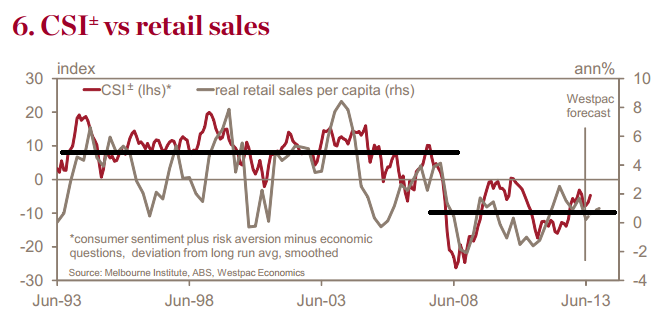
― CSI±, our modified consumer sentiment indicator which we favour as a guide to spending momentum, posted a similar
3.4% gain. It continues to point to subdued momentum consistent with per capita spending growth in the 0-½%yr range (1¾-2¼%yr range once population growth is included).
In context, the CSI is showing a very reliably prudent consumer (the black line is mine):
Advertisement
― The Aug survey included an additional question on consumers’ mortgage interest rate expectations. Responses show 41% expect rates to rise, 36% expect no change and 23% expect rates to fall, the latter shrinking to 19% across those surveyed after the RBA cut rates. While there is no majority view on the direction for mortgage rates, more expect them to rise or be unchanged than to fall.
This rather suggests two things. First, the consumer does no yet grasp the extent of the headwinds facing the economy. This might be read as a positive or a negative, keeping spending from deteriorating or leaving consumers vulnerable to a shock.
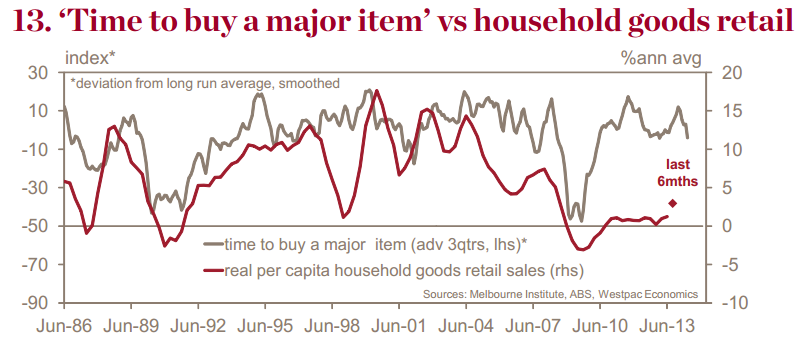
― The sub-index tracking views on ‘time to buy a major household item’ declined 5.5% in Aug to be off 13.4% since Mar. We suspect most, if not all, of this is linked to the decline in the AUD – the ‘parity premium’ that reflected the cheapness of imported goods rather than an intent to buy seems to be finally coming out of this sub-index.
Advertisement
With respect, this index has ceased to have meaning. Consumers may say it’s a good time to buy but they sure ain’t. I submit that the driver behind this huge divergence is a mismatch between elevated expectations and personal reality.
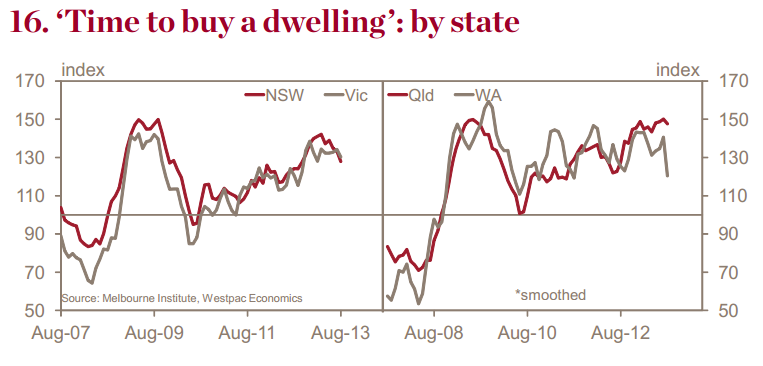
― The sub-index tracking views on ‘time to buy a dwelling’ rose 3.7%, only recovering part of Jul’s 8.4% drop. Buyer attitudes continued to weaken rapidly in WA, suggesting the mining downturn may be starting to impact.
Actually they seem be weakening everywhere but especially WA:
Advertisement
Not sure what we can take from this. Sydney and Melbourne have followed the script in increasing activity but Brisbane hasn’t budged. The big fall in WA is certainly sharp but it’s yet to break below its post-GFC lows. My guess is it will do so in the next six months.
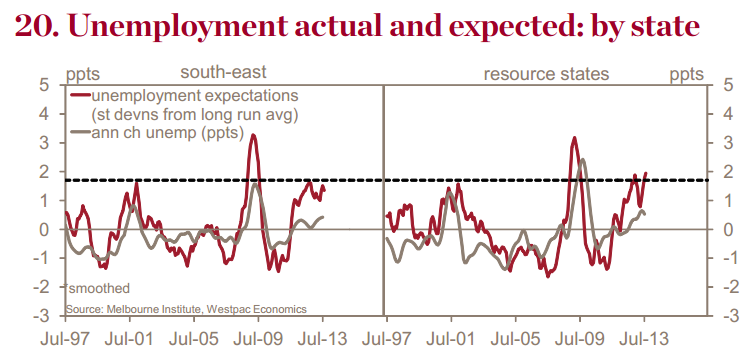
― The Westpac-Melbourne Institute Unemployment Expectations Index was unchanged in Aug but remains at a high level indicating widespread expectations of a rise in unemployment. Job loss fears remain intense and are showing a notable escalation in the resource states.
These are at recessionary levels, especially in resource states. Unemployment expectations and reality are the dam wall holding back punters. Those blaming the election for weak household and business spending need to look at this chart.
David Llewellyn-Smith is Chief Strategist at the MB Fund and MB Super. David is the founding publisher and editor of MacroBusiness and was the founding publisher and global economy editor of The Diplomat, the Asia Pacific's leading geo-politics and economics portal.
He is also a former gold trader and economic commentator at The Sydney Morning Herald, The Age, the ABC and Business Spectator. He is the co-author of The Great Crash of 2008 with Ross Garnaut and was the editor of the second Garnaut Climate Change Review.