
It was a decent night of US housing data but the peak is definitely passed. The MBA released it weekly mortgage applications:
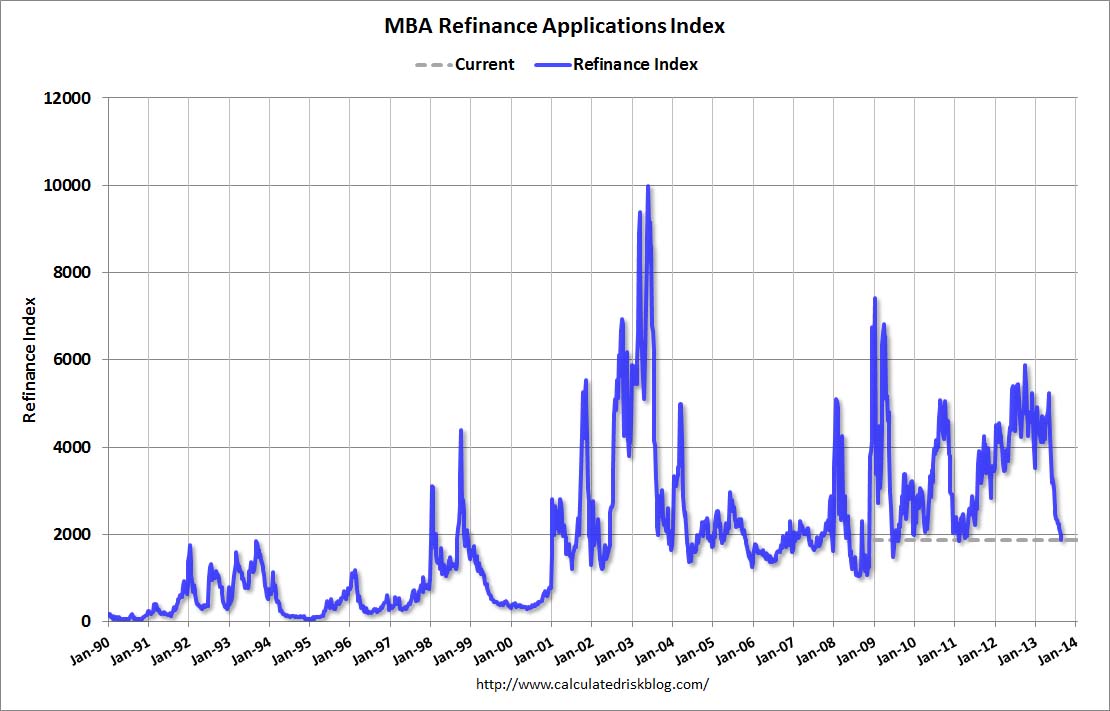
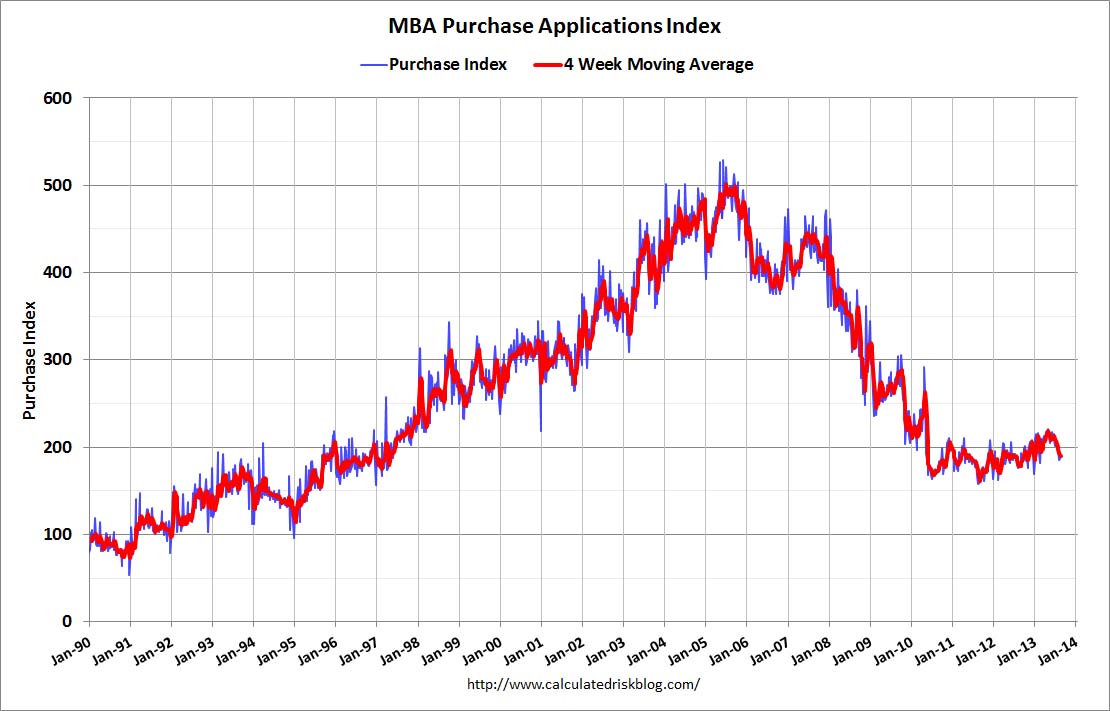
Mortgage applications decreased 2.5 percent from one week earlier, according to data from the Mortgage Bankers Association’s (MBA) Weekly Mortgage Applications Survey for the week ending August 23, 2013. …The Refinance Index decreased 5 percent from the previous week. The Refinance Index has fallen 64.2 percent from its recent peak the week of May 3, 2013. The seasonally adjusted Purchase Index increased 2 percent from one week earlier….The refinance share of mortgage activity decreased to 60 percent of total applications from 61 percent the previous week, which is the lowest share observed since April 2011. …The average contract interest rate for 30-year fixed-rate mortgages with conforming loan balances ($417,000 or less) increased to 4.80 percent, the highest rate since April 2011, from 4.68 percent, with points decreasing to 0.41 from 0.42 (including the origination fee) for 80 percent loan-to-value ratio (LTV) loans.
The charts from Calculated Risk tell the tale. Refi is toast and new mortgages have rolled but are holding up:
Pending home sales for July were also out and missed the consensus for flat:
Pending home sales were down in July, with higher mortgage interest rates slowing the market, according to the National Association of Realtors®.
The Pending Home Sales Index,* a forward-looking indicator based on contract signings, declined 1.3 percent to 109.5 in July from 110.9 in June, but is 6.7 percent above July 2012 when it was 102.6; the data reflect contracts but not closings. Pending sales have stayed above year-ago levels for the past 27 months.
Lawrence Yun, NAR chief economist, said there is an uneven pattern around the country. “The modest decline in sales is not yet concerning, and contract activity remains elevated, with the South and Midwest showing no measurable slowdown. However, higher mortgage interest rates and rising home prices are impacting monthly contract activity in the high-cost regions of the Northeast and the West,” he said. “More homes clearly need to be built in the West to relieve price pressure, or the region could soon face pronounced affordability problems.”
The PHSI in the Northeast fell 6.5 percent to 81.5 in July but is 3.3 percent higher than a year ago. In the Midwest the index slipped 1.0 percent to 113.2 in July but is 14.5 percent above July 2012. Pending home sales in the South rose 2.6 percent to an index of 121.5 in July and are 7.7 percent higher than a year ago. The index in the West fell 4.9 percent in July to 108.6, and is 0.4 percent below July 2012.
The 3o year and 10 year bonds both sold off with yields rising after a few days of sharp falls. The 30 finished at 3.75% and the 10 at 2.78%. It’s a steady rolling over here we’re seeing here. With inventory rising house prices are going to slow for the remainder of the year. Let’s see what that does to the consumer and, before that, the Fed!
