

The weekend AFR ran two articles lamenting the way in which both sides of politics have ignored Australia’s rising demographic pressures and commited to unsustainable spending.
The first article by Brian Toohey is particularly critical of policies made during the Howard Government’s reign, which lavished retirees with generous tax breaks and increased pharmaceutical subsidies:
Budget support for retirement incomes dwarfs all other fiscal problems, yet there is bipartisan support for pretending nothing needs to change. Without serious reform, an ageing population will impose a crippling burden on a proportionally smaller workforce. Conservative estimates put the combined cost of the age pension and the superannuation tax concessions at more than $100 billion a year by 2019-20 and almost $500 billion over the next four years.
In the Financial Review on Thursday, David Bassanese nominated Peter Costello’s removal of tax on super after age 60 as the worst policy blunder of the past decade or so (“The pick of the policy blunders”, August 22). Unhappily, the then Treasury head, Ken Henry, called it one of his department’s best policy proposals. Now Henry says taxes must go up to cope with rising costs…
Although not on Bassanese’s list, Howard’s introduction of the Commonwealth Seniors Health Card was another blunder. It lets people over 65 with a tax-free income of more than $500,000 receive prescription drugs for one sixth of the price for minimum wage earners. Abbott might agree to tighter means tests, but will be reluctant to scrap the card completely…
In a similar vein, the AFR’s Sue Mitchell noted that Australians need to brace for lower living standards as a shrinking workforce is called upon to fund a growing range of entitlement spending:
Australians have been warned to brace for a new era of lower living standards or face higher taxes because the tax base cannot support services that consumers now take for granted.
“We have a big appetite for services, whether it’s the NDIS [national disability insurance scheme] or Gonski or this or that, [but] we are simply not paying enough tax to meet our expectations as a society, ” said demographer Bernard Salt. “Regardless of who is in power we are moving into an era of more tax”…
“The bar is continually being lifted, not just in terms of our lifestyle but in terms of government support services.”
Mr Salt, a partner at KPMG, said Australians needed to be taught or encouraged to lower their expectations…
Mr Salt said: “One party is talking about the age of entitlement and at the same time they’re also talking about paid parental leave”.
As argued many times recently, public finances are facing stiff headwinds on multiple fronts.
Over the short-to-medium term, employment, incomes, growth and government finances will come under increasing pressure as the mining boom continues its shift from the lucrative high commodity price/high mining investment phases to the mine completion (export) phase. While Australia will sell higher volumes of iron ore, coal and LNG abroad, these sales are likely to be at significantly lower prices (reducing mining profits and company taxes) and, more importantly, will require a much smaller workforce than required when the new mines and mine expansion projects were under under construction (reducing income tax receipts and raising outlays on unemployment benefits and welfare).
However, these shorter-term challenges arguably pale into insignificance when compared against the stiff demographic headwinds facing Australia as the large baby boomer generation enters retirement.
In the 40-plus years to 2010, Australia benefited from a “demographic sweetspot”, whereby the proportion of working aged people (i.e. those aged between 20 and 65) grew continuously relative to non-workers (i.e. those aged below 20 and above 65). This produced conditions optimal for economic and national income growth, as well as greatly improved public finances since more taxes could be collected from an ever-growing tax base (see next chart).
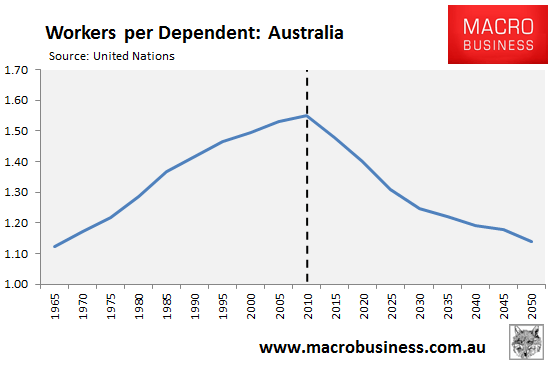
Since 2010, however, Australia’s demographic fortunes have reversed, with the proportion of working-aged population beginning to shrink relative to non-workers as the baby boomers enter retirement. This process is projected to continue for many decades, meaning that Australia’s governments are facing a shrinking relative pool of workers to extract taxes from, whilst also facing significant increases in aged care-related expenditures.
Yet, despite the obvious demographic storm brewing, Australia’s politicians have ignored the challenges facing the Budget and economy. Not only do they continue to commit to unsustainable and unaffordable spending, such as the Coalition’s paid parental leave, they have largely refused to wind-back entitlements implemented when Budget revenues were being juiced by the once-in-a-century commodity price boom, rising household debt, rising asset prices, and still-favourable demographics.
Like it or not, Australia’s fortunes have shifted. The favourable tailwinds caused mostly by favourable demographics and the once-in-a-century commodity price and mining investment booms are now becoming headwinds. It’s high time that Australia’s politicians and public policy reflected these changed dynamics.
unconventionaleconomist@hotmail.com
