
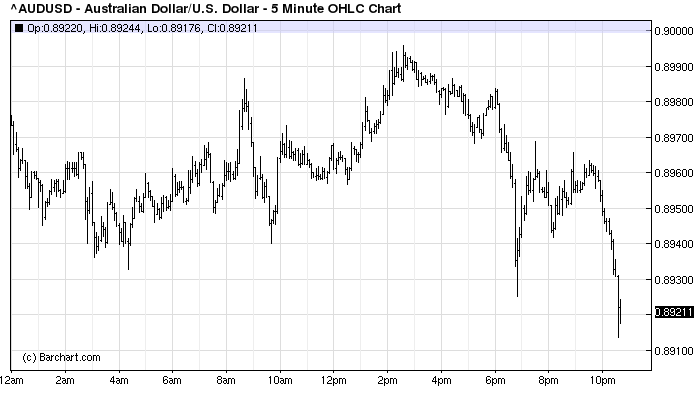
The Australian dollar is breaking lower, and looks set to go lower still…
The Obama administration believes that U.S. intelligence has established how Syrian government forces stored, assembled and launched the chemical weapons allegedly used in last week’s attack outside Damascus, according to U.S. officials.
The administration is planning to release evidence, possibly as soon as Thursday, that it will say proves that Syrian President Bashar al-Assad bears responsibility for what U.S. officials have called an “undeniable” chemical attack that killed hundreds on the outskirts of the Syrian capital.
The report, being compiled by the Office of the Director of National Intelligence, is one of the final steps that the administration is taking before President Obama makes a decision on a U.S. military strike against Syria, which now appears all but inevitable.
“We are prepared,” Defense Secretary Chuck Hagel told the BBC on Tuesday. “We have moved assets in place to be able to fulfill and comply with whatever option the president wishes to take. We are ready to go.” The assets include four cruise-missile-armed destroyers in the Mediterranean.
The timing of such a military response is being dictated by the need not only to assemble incontrovertible evidence against Assad — an important prerequisite for the administration, and the country, given the recent memories of a war based on false claims of weapons of mass destruction — but also to allow consultation with Congress and international partners.
Britain, France and Turkey have indicated willingness to contribute to military action. The administration is weighing the importance of direct international participation in an effort that U.S. forces are prepared to undertake themselves.
…One question that is unlikely to be addressed in the intelligence report is why Assad would launch such a massive chemical strike in the face of a near-certain international response. It is a question that Russia, Assad’s principal international backer, has raised repeatedly in suggesting that Syrian rebels arranged the attack to implicate the government.
In a telephone call Tuesday with British Prime Minister David Cameron, Russian President Vladimir Putin said his government “did not have evidence of whether a chemical weapons attack had taken place, or who was responsible,” a statement on Cameron’s official Web site said.
…As it continued to consult with other countries, the administration earned key support from the Arab League. In an emergency meeting in Cairo, the influential organization blamed Assad for last week’s alleged attack and called for the perpetrators to be brought to international justice.
The 22 league members stopped well short of endorsing outside military action, but they urged the U.N. Security Council to agree on “deterrent” measures.
Saudi Arabia’s longtime foreign minister added that a “decisive and serious” international stand is required against Syria.
…“The conventional wisdom is that they will launch some Tomahawks [cruise missiles] from destroyers in the eastern Mediterranean. That’s not going to dramatically change the course of events in Syria,” said Ryan C. Crocker, a retired senior U.S. diplomat and former ambassador to Syria and Iraq.
To avenge what they called the “massacre” in the Damascus suburbs, al-Qaeda-linked Islamist extremists among the rebels said Tuesday that they would strike Assad’s security branches and infrastructure, according to a statement signed by the Islamic State of Iraq and the Levant, the Ahar al-Sham rebel group and seven other factions.
