
Yesterday, I slammed Prime Minister Rudd’s commitment to a high speed railway connecting Melbourne, Canberra, Sydney and Brisbane.
In my view, the estimated $114 billion cost of the project would be far too high to justify given Australia’s smallish population and the limited benefits that such an expensive project would provide. I also argued that there were likely to be other potential projects far more worthy of funding that would provide far bigger productivity pay-offs to the economy.
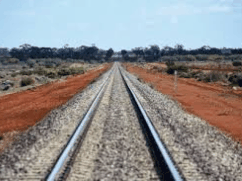
One potential area worthy of examination is Australia’s freight railways, which have suffered from decades of neglect and now drag on both productivity and Australia’s export competitiveness. An article in today’s Australian newspaper, which quotes agricultural firm Cargill’s Josh Martin and GrainCorp’s chief executive, Alison Watkins, outlines some of the issues:
Cargill exports more than 20 per cent of Australia’s wheat and owns two million tonnes of annual rail capacity after purchasing the grain assets of the Australian Wheat Board two years ago.
But the company is now deeply concerned about the state of the nation’s railway infrastructure. It could be one of the prime factors that prevents Australia capitalising on its chance to profit from Asia’s food demand boom…
“Are we maximising capacity utilisation of the existing infrastructure?” Mr Martin asked delegates at the PBB Advisory inaugural agribusiness conference. “The answer to that is no. Today we are not”.
…we need to work with governments and industry bodies to ensure that investment is being made in the rail infrastructure to promote the efficiency at a higher rate”…
“Investment in infrastructure needs to be focused very much on driving long-term, sustainable, competitive and efficient export supply-chain economics,” Mr Martin said…
Mr Martin’s comments were backed by GrainCorp chief executive Alison Watkins, who said that Australia’s rail infrastructure needed urgent investment to reduce supply chain costs for grain and other products.
“Supply chain costs make up a very large proportion of delivered costs in marketing products overseas, whether it is grain or another product”…
“A lot of it is about the way we operate the rail system. That it is the most efficient, lowest cost and with the least carbon emissions.
“There is an opportunity to ensure our supply chain can be efficient as it can be”…
Whether investing a significant amount of taxpayer funds into freight rail is the best use of taxpayer funds is a moot point. Arrangements would obviously need to be put into place to ensure that the costs of such investment doesn’t fall entirely on the taxpayer, whereas the lion’s share of the benefits flow to private firms (e.g. producers and private above-rail operators). Setting access charges at an appropriate level to both recoup the cost of the investment, while still providing rail operators and exporters with net benefits would be key to ensuring its success.
What the above does highlight, however, is the need for rigorous cost-benefit analysis of alternative uses of scarce taxpayer funds, to ensure that investment takes place only on projects that provide the biggest pay-off to the economy and society as a whole.
As noted yesterday, what Australia needs to avoid are dubious big ticket pet projects that politicians love, but leave taxpayers and the economy significantly worse-off. High speed East Coast rail looks like such a white elephant. By contrast, improving Australia’s freight rail network, while far less sexy from a political expediency point of view, looks like it could potentially deliver much greater benefits at lower cost.
unconventionaleconomist@hotmail.com
