

RP Data’s Cameron Kusher has published an interesting blog explaining why he believes there will be an ongoing gradual recovery in Australian housing values:
The growth in home values has been moderate, as we have noted in recent weeks, the response to the low mortgage rate environment has not been as strong as in the past. This begs the question where to from here?…
Broadly speaking, I can’t see anything in the current housing or broader economic conditions which will see the market’s performance return to that which we saw prior to the financial crisis for a number of reasons.
Firstly, household debt to disposable income currently sits at 147.3%. No doubt Australian households have a large amount of debt, most of which (133.2%) is housing debt. If you look at the chart below, you will see that the debt to disposable income ratio has been virtually unchanged since the end of 2005, which is seven and a half years ago now! Clearly households have reached the limits to how much debt they can take on…
Secondly, and which directly relates to the first point, households have increased their level of savings and shown less of a propensity to spend…
Thirdly, consumers are changing the way they spend and doing it with their own money rather than with credit cards…
The previous run-up in home values had been assisted by significant changes to economic conditions such as financial deregulation, significant falls in mortgage rates, a large reduction in unemployment, much lower inflation and strong growth in housing credit…
In my opinion, none of these economic measures are likely to shift as significantly as they have in the past and therefore any changes are not as likely to be as conducive to significant growth in home values as they have been in the past.
All this is sensible analysis, which I largely agree with. However, I would go even further. There were other structural factors that worked to increase asset prices, which are now turning into headwinds.
First, as explained in detail yesterday, Australian household income growth was inflated significantly over the 2000s by the once-in-a-century rise in commodity prices and Australia’s terms-of-trade. Annual real per capita household disposable incomes grew on average by an extraordinary 2.6% over the 2000s, well above the 0.4% average growth rate experienced over the 1980s or the 1.25% average growth rate experienced over the 1990s. However, between 2010 and 2013, income growth has so far averaged just 1.4%, despite the terms-of-trade index (89.1 as at March 2013) still sitting above its level at the beginning of this decade (78.6 as at December 2009).
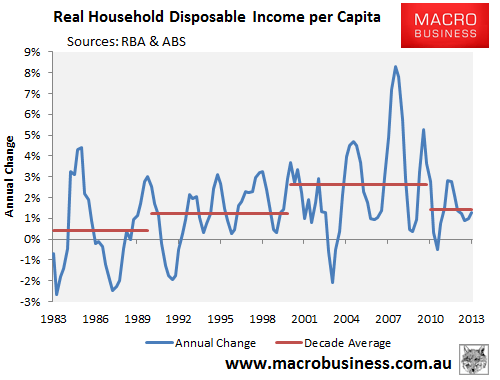
As commodity prices and the terms-of-trade continue to retrace back towards their longer-term average level, it will detract from household income growth, unwinding much of the gains enjoyed over the 2000s. This lower income growth will also cap the potential upside for housing (and other assets).
Second, the massive mining investment boom, which has supported growth, incomes and jobs across the economy, is now unwinding and likely to retrace back towards its pre-boom level (see next chart). Other things equal, this will also weigh on asset prices going forward.
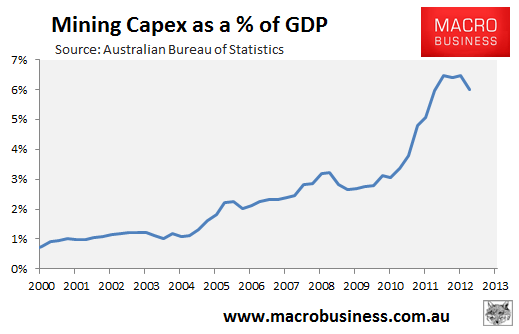
Finally, the ratio of workers per dependent peaked in 2010 and is projected to fall over coming decades as Australia’s population ages (see next chart).
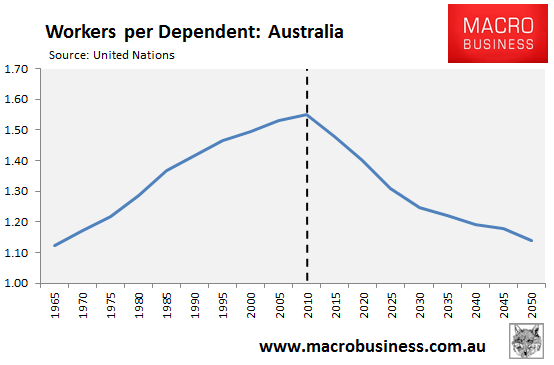
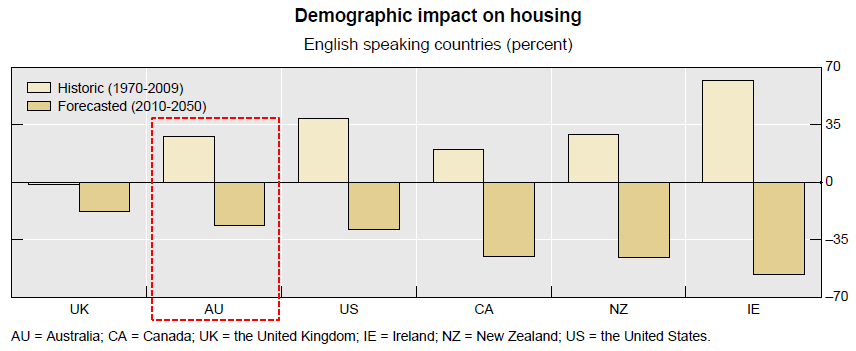
According to modelling by the Bank for International Settlements (BIS), the inexorable rise in the proportion of workers per dependent in the 40 years to 2010 boosted Australian real house prices by around 30%. However, in the 40 years to 2050, the BIS projects that the decline in the ratio of workers per dependent will reduce real house prices by around 30% compared with neutral demographics (see below chart).
With a bit of luck, the unwinding of Australia’s mining boom (both commodity prices and mining investment) will occur in an orderly manner. The key risk going forward for both the economy and housing market is that China’s economy experiences a “hard landing” (i.e. growth and fixed asset investment slows abruptly), bringing about a steeper decline in both commodity prices and mining-related capital expenditures.
Either way, it seems the key growth drivers for the housing market present over the past two decades are now absent, which portends a slow growth future.
